The latest friend torture game: cracking knuckles

Okay ready? Put your palms together. Fold your pinkie and ring fingers down. Tuck in your middle and pointer fingers. Cross your thumbs. Allow your BFF to lean over and suddenly push your knuckles together:  c-r-a-c-k ! She cracks your knuckles.

It’s one in a long line of mildly torturous friendship games children play. Remember building a “rose garden” on your friend’s arm by pinching his forearm until it turned beet red?

As I watch my kids play the “knuckle cracking game,” I am reminded of a question  parents often ask: “He is always cracking his knuckes! Won’t that cause early arthritis?”

When I look over at the object of the parent’s complaint in the office, the child usually gives me a big grin, and c-r-a-c-k, happily demonstrates to me the reason for the parent’s question. To the parent’s dismay, I tell the family knuckle cracking will not lead to early arthritis. However, I always laugh and warn the kid that harm from cracking knuckles comes not from the action of cracking knuckles but rather from an irritated parent’s wrath.

What’s the consequence of allowing a friend to crack your knuckles? That I do not know… although I have a suspicion the parental consequence is similar to when you crack your own.

Naline Lai, MD with Julie Kardos, MD
©2010 Two Peds in a Pod℠

Share

How will my own childhood impact how I raise my children?

Earlier in the month I attended a developmental pediatrics conference in Philadelphia. The keynote speaker, Barry Zuckerman MD, professor and chairman of pediatrics at Boston University, raised a set of thoughtful questions. Parents can use the answers as a starting point for understanding how they were raised. Here are some of the questions with modifications:


        -What was it like growing up? Who was in your family? Who raised you?


        -Do you plan to raise your child like your parents raised you?


        -How did your relationship with your family evolve throughout your youth?

 
How did your relationship with your caregivers (mother/father/aunt/grandparent/etc) differ from each other? What did you like or not like about each relationship?

 
Did you ever feel rejected or threatened by your parents? What sort of influence do they now have on your life?

 
Did anyone significant die during your youth? What was your earliest separation from your parents like? Were there any prolonged separations?

 
If there were difficult times during your childhood, were there positive role models in or outside your home that you could depend on?


Some of these questions may be tougher than others to answer. Ultimately you are not your parents (although you may feel otherwise when you hear a familiar phrase escape your own lips), and likewise your children are not you. Parenting techniques that worked, or did not work, for your parents will not necessarily work, or not work, for you. However, stopping to reflect on your own youth will help you understand why you parent the way that you do.


Naline Lai, MD with Julie Kardos, MD

© 2010 Two Peds in a Pod℠


Share

Can’t you just call in an antibiotic for me?

Our guest blogger today is Dr. Jason Komasz. Practicing pediatrics in Pennsylvania for nearly a decade, he is the father of two and a respected colleague.

“Can’t you just call in an antibiotic for me?
As doctors we hear this question a lot.  Parents are often disappointed and upset when we answer that question with a “No.”  Your child is sick, you missed the Saturday office hours, and now you can’t schedule an appointment until Monday morning.  There are reasons why doctors usually do, and should, answer “no” to this question.

  1. Not every illness requires an antibiotic. Only bacterial illnesses respond to antibiotics and many illnesses are viral. In fact, misuse of antibiotics can lead to antibiotic resistance in our population.
  1. The physical exam is very important in the evaluation of a patient.  The exam helps doctors determine if a patient needs antibiotics, and if so, what type.  If we do not see a patient, we are “flying blind.”  This puts the patient as risk for misdiagnosis and incorrect treatment.
  1. Antibiotic use before a patient is evaluated can affect laboratory results. For example, after starting antibiotics, Strep Throat and urinary tract infection tests may be inaccurate and therefore obligate the patient to an unnecessary course of antibiotics.
  1. All but the most severely ill patients can usually be managed at home with pain/fever control and symptomatic care (fluids, etc) until they can be evaluated by a doctor.
  1. If your child is ill enough to require an antibiotic, he is sick enough to need an evaluation by a physician.  It is better to wait in an ER and receive proper care than to just treat without proper evaluation.

As always, your physician is trying to do what is best for your child.  Your doctor should always be able to offer an explanation for why he or she is choosing a particular course of action for your child’s illness.  We do not want them to suffer, just as you don’t.  Just remember, the antibiotic is not always the answer.

Jason M. Komasz, M.D., F.A.A.P.
© 2010 Two Peds in a Pod®

Share

Childhood and Teen Depression: know the signs

It’s June, a time of hellos and goodbyes.


Change in routine can be tough.  For some children and teens the transition from school year to summer unmasks depression.


The signs of depression in younger children can look different than depression in teens and young adults.  Younger children are less likely to tell you that they feel sad- often because they can not pinpoint what is wrong.    Of course everyone is allowed periodic “bad days”, but when there are more “bad days” than “good days” action must be taken.  Below are some warning signs that your child may be depressed:


Feels down or sad much of the time


Acts angry much of the time


Acts “out of control” or has new behavior problems that seem resistant to your usual discipline measures.


Loses interest in activities which normally bring pleasure, withdraws from friends


Exhibits changes in sleep patterns-difficulty falling asleep, numerous awakenings, or excess sleeping


Has feelings of worthlessness (feelings she let a family member or teacher down, etc.)


Finds it difficult to concentrate


Performs worse in school, grades slip, or tries to avoid going to school


Shows low energy or fatigue or conversely seems restless or “hyper”


Alcohol or drug use (attempts at “self-medicating”)


Expresses thoughts of being better off dead or desires to hurt himself.


If you suspect your child is depressed, ask him the hard questions. Ask him if he is thinking of hurting himself or others.  Ask if he wants to commit suicide. You will not be “planting an idea.” Asking will allow you to find the medical help he needs immediately.  Not asking may lead to death. We always tell patients and their parents not to hesitate to call “911” or go to the emergency room if the patient is suicidal.  After all, it is an emergency– a life is at stake.


Sometimes it’s not your child who is depressed.Your child’s friend may confide that he or she is extremely sad and may tell your child to keep the information a secret.  Let your child know that her friend is giving a “cry for help” and that it is appropriate to share information with adults.


Children and teens can have “real” depression just like adults and they need treatment from an experienced health care professional just like adults do. Consequences of untreated depression, just like adults, can include loss of enjoyment in life, estrangement from friends, school or job failure, and untimely death from suicide.


Naline Lai, MD and Julie Kardos, MD


© 2010 Two Peds in a Pod℠

Share

In the Blink of an Eye: corneal abrasions

Sand and specks of dried seaweed fly into the air. Your kids are on the beach shoveling their way to China.  “Watch out!” you yell. “Watch those shovels! The ocean is big. The beach is big. You don’t need to be right on top of each other.  There is plenty of sand for everyone.”

You sigh and go back to counting snacks and unearthing buried flip-flops.  You look back at the kids. Aw, you think to your self, they look so cute. Just as you reach for the camera, the idyllic moment is shattered. Your youngest is holding his eye and everyone, even the kid who threw sand into the injured child’s face, is crying.

Quickly you grab a water bottle and flush the irritating granules out of his eye.  Satisfied nothing is left, you ask, “Does that feel better?”  Your child ruefully nods, and resumes holding his eye.  An hour later his eye is still watering. What next?

With any eye injury, pain, watery eyes or visual changes are all reasons to seek medical care. In this case, the sand or a little wood chip probably caused a scratch on the outer layer of the eye.  This layer, called the cornea, heals very quickly. But like a scratch on any part of the body, the major potential complication is infection.

The most common way for health care providers to find a scratch on the cornea is to place a dye (fluorescine) into the injured eye. This dye glows under black light. The dye pools wherever there is a depression or scratch on the eye. Pictured here is a photo of a child I saw in the office the other day. The scratch is marked with an arrow. If an abrasion is found, your child’s doctor will prescribe antibiotic eye drops to prevent infection.  Placing a patch over the eye has not been shown to hasten healing. However, for comfort, some children prefer putting on an eye patch for a day.

It’s a good thing our eyes are set back in our skulls, otherwise, we’d constantly have scratches on our eyes. Despite any precautions you may take, accidents still happen. Years ago a nurse I knew accidentally rolled over in bed and scratched her spouse’s eye with her diamond engagement ring.  Imagine explaining that to the in-laws.

Naline Lai, MD with Julie Kardos, MD

© 2010 Two Peds in a Pod

Share

Avoiding “TV Heads”: how to limit your child’s TV and video game time

“Mom, can we do screen?”

My kids ask me this question when they are bored.  Never mind the basement full of toys and games, the outdoor sports equipment, or the numerous books on our shelves. They’d watch any screen whether television, hand-held video game, or computer for hours if I let them. But I notice that on days I give in, my children bicker more and engage in less creative play than on days that I don’t allow some screen time.

Babies who watch television develop language slower than their screen-free counterparts (despite what the makers of “educational videos” claim) and children who log in more screen time are prone to obesity, insomnia, and behavior difficulties.  The American Academy of Pediatrics recommends no more than two hours of television watching a day for kids over the age of two years, and NO television for those younger than two.

Over the years, parents have given me tips on how they limit screen time. Here are some ideas for cutting back:

  • Have children who play a musical instrument earn screen time by practicing music. Have children who play a sport earn screen time by practicing their sport.
  • Turn off the screen during the week. Limit screen to weekends or one day per week.
  • Set a predetermined time limit on screen time, such as 30 minutes or one hour per day. If your child chooses, she can skip a day to accumulate and “save” for a longer movie or longer video game.
  • Take the TV, personal computer, and video games out of your children’s bedrooms. Be a good role model by taking them out of your own bedroom as well.
  • Turn off the TV during meals.
  • Turn off the TV as background noise. Turn on music instead.
  • Have books available to read in relaxing places in the house (near couches, beds, etc.). When kids flop on the couch they will pick up a book to relax instead of reaching for the remote control.
  • Give kids a weekly “TV/screen allowance” with parameters such as no screen before homework is done, no screen right before bed, etc. Let the kids decide how to “spend” their allowance.

Not that I am averse to “family movie night,” and I understand the value of plunking an ill child in front of a video in order to take his mind off his ailment. In fact, Dr. Lai lives in a house with three iPod Touches, two iPhones, a Nintendo DS and three computers. But I do find it frightening to watch my otherwise very animated children lose all facial expression as they tune in to a television show.

For more information about how screen time affects children, see the American Academy of Pediatrics web site (www.aap.org) and put in “television” in the search box.

Let us know how you dissuade your children from the allure of the screen.

Julie Kardos, MD with Naline Lai, MD
© 2010 Two Peds in a Pod®

Share

What’s the big deal about Fifth Disease?

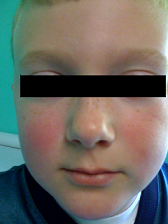
fifth diseaseEeek, you say to yourself when you see your child’s bright red cheeks. I forgot to apply enough sunscreen.  Other than the splash of color, however, your kid is acting fine and does not say his face hurts. You are perplexed…and it has been raining most of this week. 


Another reason for stomach acid-churning parental guilt?


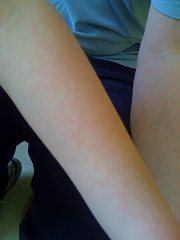
 A day or two later, your child breaks out in a lacy, light pink rash mainly on his upper arms, thighs and chest.  So it’s NOT sunburn. It’s the common childhood illness Fifth’s disease. This illness, your child’s doctor tells you, was the fifth childhood rash to be classified. Also called Parvovirus, it won’t impact him very much. Occasionally there are mild cold symptoms, headache, or fever before the rash and the rash is not particularly itchy. Within a week the rash fades, but it can come and go for a few weeks. Sun, exercise and heat can bring out the rash. As a bonus, your child now has life-long immunity (protection) to the disease. You only get it once.


Pictured is the characteristic facial rash often described as “slapped cheeks.” Also pictured is the “lacy” rash on a child’s arm.


If the symptoms are mild, then why do we care about diagnosing Fifth’s disease?  If your child has certain types of chronic anemia, parvovirus can make the anemia much worse. But for most families, the impact of the disease is not on the child who catches it but on the child’s contacts.  If a pregnant woman contracts the disease, the disease can be lethal to the fetus.  Luckily, most women already contracted the disease in childhood and have immunity against the germ.  In adults who did not have the disease as a child, parvovirus can cause achy joints in the hands and feet.

The tricky thing about preventing spread of fifth disease is that children are NO LONGER CONTAGEOUS once they have the rash. They expose others before parents realize their children are sick. The virus is spread through respiratory secretions and saliva-another reason to teach your children to wash their hands.


Again, if your child comes down with Fifth’s disease, remember to tell any pregnant contacts (teachers, friends’ moms, etc) so that they can let their obstetricians know about their exposure.


As a precaution when I was pregnant, my obstetrician checked my parvovirus immunity.  “Wow,” he said, “those are some of the highest levels of immunity I have seen.” When it comes to parvovirus, I suppose a history of being around sick kids can be good for you.


Naline Lai, MD with Julie Kardos, MD

© 2010 Two Peds in a Pod

Share

That’s using your head! Or, how to assess your child’s knock on the noggin.

Your son’s baseball league has just upped the ante, moving from “coach pitch” to “kids pitch.” The good news is that your budding major league pitcher gets some practice. The bad news is that the pitches can be wild. Thank goodness for batting helmets!

So what if the unthinkable happens? You are cheering your child on, when suddenly the wild pitch (or the hit ball, or the wild throw to first base) wacks into your child’s head. He is knocked down and you go running.

First evaluate if your child is conscious. Passing out even momentarily is a reason to seek medical attention right away. Most likely he will not have passed out and will want to return to play. However, the safest bet is to have your child sit out the rest of the game.

Next determine if your child is bleeding inside his head. You may see a growing lump on his head which looks gruesome. However, we pediatricians are less concerned about bleeding or bruising that occurs on the outside of his skull than about possible bleeding inside his skull.

How can you tell where the bleeding is? Again, a loss of consciousness, or passing out, is a worrisome event that may signal bleeding on the inside. In addition, watch for blurry or double vision (“I see two mommies!”), inability to speak clearly or rationally, difficulty walking or loss of balance, vomiting more than once (some kids vomit once when they are scared or in pain), or headache so severe that it is not relieved by acetaminophen (Tylenol) or ibuprofen (Motrin, Advil).  Not all symptoms appear immediately.

So now your child has cheered the team on to victory, enjoyed the after-game snack, has forgotten about the trauma, and is nodding off in the back seat of your car. As you drive him home you remember some vague advice about not letting your child fall asleep after a head injury. Now what?

Go ahead and let your child sleep for a couple of hours, he probably is tired both from the game and from the injury.  You have the rest of the day to observe him.

Sometimes, injuries are not conveniently timed. If a head injury occurs right before bedtime, you will not be able to watch for signs of internal head bleeding because your child will be sleeping. The best way to assess him is to wake him briefly every 2-3 hours throughout the night. 

If your child makes it to 24 hours without symptoms, it is unlikely your child is bleeding inside his head. However, if your child still seems “off” he needs medical attention. Even if he is not bleeding, he may have a concussion (now termed “traumatic brain injury”).

Although it’s never easy to see your child hurt, whether it’s a scrape on the knee or a bump on the head, you can empower yourself by knowing what to watch for. Now that’s using your noggin!

Julie Kardos, MD and Naline Lai, MD
© 2010 Two Peds in a Pod℠

Share

Hot Summer Tips

Here is a photo of a lovely plant nestled along side the bicycle path my family rode on over the weekend. Recognize it? “Leaves of three, let them be!”- That’s right, it’s either poison oak or poison ivy. In this case my iphone captured poison ivy in its late spring glory. As we rode along I barked at my family to avoid the poison ivy, reminded them about Lyme ticks, rubbed in sunscreen, fitted bike helmets and fretted over everyone’s hydration status.  Nothing is more jovial and carefree than a bike ride with your pediatrician mom!


Back by popular demand are the links to summer posts which some of you missed last year when we initially launched Two Peds in a Pod.


Yes, you too can start summer by spewing health tips at your children.

Naline Lai, MD with Julie Kardos, MD

© 2010 Two Peds in a Pod℠

Share

A Parent’s Field Guide to Field Trips

A parent recently wrote us to about her three and one–half year old child’s scheduled field trip to a nature center.  “I really wanted my child to attend,” the parent wrote,” but felt uncomfortable without attending with him.  I asked if it would be okay if I went, but was told no because it would be distracting to the children. In addition, I had to sign a release of responsibility…  Most of his classmates are attending and the parents don’t seem to be concerned.”

Next week Dr. Kardos’s child will go on a class trip to a farm.  Last week one of Dr. Lai’s children went with her class to a colonial plantation.  Spring field trips often are the highlight of a child’s school year and take learning to a different level. Sometimes you are asked to chaperone as a parent, but what if you aren’t invited along? Particularly for parents of young children, it can be disconcerting when their children are taken out of a familiar structured class environnment. Here are some steps you can take to insure their safety:

Check adult to child supervisory ratios. Developmentally appropriate ratios should be kept whether in the classroom or on trips.   According to Caring for our Children (the national health and safety performance standards for out-of-home child care programs), for three year olds the maximum recommended child: staff ratio is 7:1, for four and five year olds the ratio is 8:1, for 6-8 year olds the ratio is 10:1,  and for 9-12 years old 12:1

Ask teachers how they keep track of children. Often groups will have children wear the same brightly colored t-shirt.  Usually, children are counted at several points during a visit.

Ask if previous class trips to the same place have gone smoothly. Chances are, the supervisory teacher has been to the site so many times that she knows every nook and cranny.

Check how the children will be transported.  Ideally, they are transported with age appropriate restraints. If they will be traveling in the traditional school bus, review bus safety with your child including sitting down and facing forward during the ride.

Be comfortable with the school’s emergency procedures and notifications.

Remind your child to continue his good health habits even if you are not present. For instance, wash hands prior to eating and after going to the potty.

Get to know the adult supervisors.  Connecting with the adult to whom you are entrusting your child will make you feel more comfortable when your child leaves school grounds.

Go ahead and visit the field trip site ahead of time if you need to visualize your child at his field trip. Who knows, you may emerge with plans to go again for a future birthday party.

Remember your goal is to grow a confident kid. Send the signals to your child that he will have a fun time- not that you will be watching the clock every second he is gone. Otherwise, he may approach the trip, and later other new situations, with trepidation rather than anticipation.


If there are medical or behavioral concerns, discuss them with your pediatrician and the adult supervisors before the trip. Since my own children have food allergies, I call teachers in advance to make sure there is an adult who is,if needed, comfortable administering an emergency shot of epinephrine. If you know your child has ADHD and needs constant redirection, perhaps additional adult supervision (not necessarily yourself) can be arranged.

Remember too that the reason parents need to sign permission slips before their children attend field trips is that parents have a choice. If you are not convinced about the value of a particular trip, by all means do not send your child. 

Like many steps toward independence, a field trip can be a growing experience for a child but nerve wracking for a parent. Reassure yourself that you are not sending your child off to an unsafe environment and then take pride when she returns confident, safe, and sound, and asking when she can go on another field trip.

Naline Lai, MD

© 2010 Two Peds in a Pod

 

Share
image_pdfimage_print