
Evaluating Vaccine Sites on the Internet

A concerned parent wrote to us:

Can you please read this and comment?www.thinktwice. com.
I’m terrified to vaccinate due to sites like these. There seems to be many horrifying stories out there to what happens to kids after getting vaccines. If the chance of them getting these diseases is small, is it worth taking the risk of them suffering these near death or death experiences?

Here is our response:


Dear Concerned,

We looked at the web site you sent to us. When evaluating the merit of information that you read on the internet, it is important to know the source of the information. The thinktwice site has an easy to read disclaimer. To highlight: the founders of the site explain that they are NOT medical professionals and that they do NOT give medical advice. They refer their readers to “licensed medical professionals” for medical advice. In addition, they acknowledge that their site is NOT endorsed by the American Academy of Pediatrics (AAP), the Food and Drug Administration (FDA), or the US Center for Disease Control (CDC). In fact, they refer their readers to these organizations for vaccine information and advice. They post “information” that will certainly cause a stir on the internet but actually defer to well established medical experts at the AAP, the CDC, and the FDA for definitive advice about vaccines. If you investigate those sites,  you would find that all  of the organizations actually endorse the use of vaccines.  

It makes sense to consult experts in the field for any problem that you have. When researching a health care issue, actresses, political figures, and web site sponsors, while experts in knowing their own children, are not medical professionals. If, for example, we had a car problem, we would consult a mechanic. We would not read testimonials of car owners on the internet to figure out how to fix a car. If we did not trust our mechanic’s recommendation, we would get a second opinion from another car expert.

Doctors are trained to evaluate evidence. We are medical professionals who read all the medical textbooks for you. Pediatricians go to school and train for nearly a quarter of a century before they even begin practicing on their own. We base our medical advice on the pediatric standards set forth by the American Academy of Pediatrics. These standards represent consensus of thousands of pediatricians who dedicate their lives to improving the well being of children. We would never support a practice that causes more harm than good.

If you are moved by testimonials, then you should also read testimonials of parents whose children were not vaccinated and then died or suffered disability from vaccine preventable diseases:  http://vaccinateyourbaby.org/why/victims.cfm, http://vaccine.chop.edu. In addition, we encourage you to read our own vaccine posts: How Vaccines Work and Do Vaccines Cause Autism? Please visit the websites we provide in these articles for more information about vaccines.

Experts in pediatrics have evaluated data based on millions of vaccine doses given to millions of children. The evidence shows that the benefits of vaccines outweigh risk of harm.  Think of seat belts. You may imagine that your child’s neck may get caught in a seat belt, but you would never let your child go without a seatbelt.  The reason is that rather than trust a “feeling” that theoretically the seat belt could cause harm, we know from evidence, data, and experience that seatbelts save lives.

Vaccines are a gift of protection against childhood disease. As moms, both of us vaccinated our own children on time according to the standard schedule. Tragically, the more parents don’t vaccinate, the easier it will be for all of our children to contract these preventable and often deadly disease. Proof of this is California’s current whooping cough epidemic which has killed six infants so far. Most of the illness is breaking out in areas where parents stopped vaccinating their children.

If you are wondering about the merits of a web site, try to cross reference the information with organizations which set medical standards such as The American Academy of Pediatrics, the Centers for Disease Control, and your local Children’s Hospital.  And of course, you can always ask your pediatrician.

By asking questions you are being a responsible parent. 

Keep on asking.

Julie Kardos, MD with Naline Lai, MD
© 2010 Two Peds in a Pod℠

Share

Rotten News: A Salmonella Story

Eeew! Pictured is the raw chicken I left sitting out in a pot for a day (inadvertently, of course).  The putrid mess was teaming with germs and amongst them was probably salmonella. This bacteria is in the news because of the thousands of eggs recently recalled for contamination (Centers for Disease Control , New York Times, National Public Radio.)


Non-typhoidal Salmonella usually causes fever and crampy diarrhea.  This stomach bug mainly lurks in raw poultry, raw eggs, raw beef, and unpasturized dairy products. Luckily, salmonella does not jump up and attack humans. People are safe from disease as long as they do not eat salmonella-infested food.


In the case of my pot of rotten chicken, the obvious stench warned me that it was inedible.  However, salmonella often hides in food and it is difficult to tell what is or is not contaminated.  A perfectly fine looking egg may harbor the germ. Even before this outbreak, the Centers for Disease Control estimates in the United States as many as 1 in 50 people are exposed to a contaminated egg each year.


Luckily salmonella is killed by heat and bleach.  Even if an egg has salmonella, adequate cooking will destroy the bacteria. Gone are the days when parents can feed kids soft boiled eggs in a silver cup, have kids wipe up with toast the yolk from a sunny-side up egg, or add a raw egg to a milkshake.  Instead, cook your hardboiled eggs until the yolks are green and crumble, and tolerate a little crispness to your scrambled eggs.  Wash all utensils well. The disinfecting solution used in childcare centers of ¼ cup bleach to 1 gallon water works well to sanitize counters. Do not keep perishable food, even if it is cooked, out at room temperature for more than two hours.


A mom once called me frantic because her child had just happily eaten a half-cooked chicken nugget. What if this happens to your child? Don’t panic. Watch for symptoms — the onset of diarrhea from salmonella is usually between 12 to 36 hours after exposure but can occur up to three days later.  The diarrhea can last up to 5-7 days. If symptoms occur, the general recommendation is to ride it out. Prevent dehydration by giving plenty of fluids. My simple rule to prevent dehydration is that more must go in than comes out. 


According to the American Academy of Pediatric’s 2009 infectious diseases report, antibiotic treatment may be considered for unusually severe symptoms or if your child is at risk for overwhelming infection. People at high risk for overwhelming disease include infants younger than three months old and those with abnormal immune systems (cancer, HIV, Sickle Cell disease, kids taking daily steroids for other illnesses). Using antibiotics in a typical case of salmonella not only promotes general antibiotic resistance, but in fact does not shorten the time frame for the illness. Also, the medication can prolong how long your child carries the germ in his stool.


I ended up tying the chicken up, pot and all, in a plastic grocery bag and throwing out the whole mess.  Don’t tell my husband, he is the kind of guy who gets annoyed because I throw out germy sponges on a frequent basis. If he knew, he’d probably want me to at least keep the pot. Yuck.

Naline Lai, MD with Julie Kardos, MD


©2010 Two Peds in a Pod℠

Share

Cry Baby- Why do infants cry?

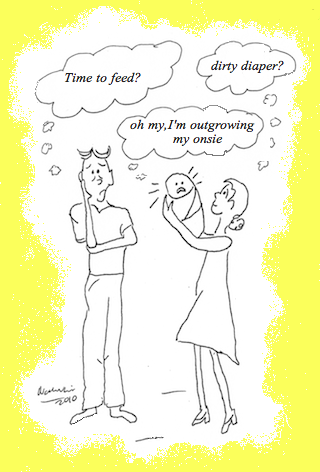
crybabyonesieWhy do babies cry? This may seem like a silly question, but sometimes you really want to know why your infant is crying.

Remember, newborns cannot talk. They can’t even smile back at you until around six weeks of age.  Why do babies cry? In short, newborns cry to communicate.

Ah, but what is it, exactly, that they try to communicate? Babies cry when they…

      – Are tired.

      – Are hungry.

      – Feel too cold.

      – Feel too hot.

– Need to be changed –I never really believed this reason before I had my twins. My firstborn couldn’t have cared less if he was wet and could nap right through a really poopy diaper. Then I had my twins.  I was amazed that their crying stopped if I changed the tiniest bit of poop or a wet diaper. Go figure.

– Are bored. Perhaps she is tired of the Mozart you play and prefers some good hard rock music instead. Maybe she wants a car ride or a change of scenery. Try moving her to another room in the house.

– Feel pain. Search for a piece of hair wrapped around a finger or toe and make sure he isn’t out-growing the elastic wrist or ankle band on his clothing.

– Need to be swaddled. Remember a fetus spends the last trimester squished inside of her mom. Discovering her own randomly flailing arms and legs can be disconcerting to a newborn.

– Need to be UN-swaddled. Hey, some like the freedom to flail.

– Need to be rocked/moved. Dr. Lai’s firstborn spent hours tightly wrapped and held by her dad in a nearly upside down position nicknamed “upside-down-hotdog” while he paced all around the living room.

– Check to see if there is a burp stuck inside her belly. Lay her down for a minute and bring her up again to see if you can elicit a burp. 

– Does your baby seem gassy? Bicycle his legs while he is on his back. Position him over your shoulder so that his belly presses against you. You’d be gassy too if you couldn’t move very well. The gassy baby is a topic for an entire post- talk to your doctor for other ideas.

– Are sick. Watch for fever, inability to feed normally, labored breathing, diarrhea or vomiting. Check and see if anything is swollen or not moving. Listen to his cry. Is it thin, whimper-like (sick) or is it loud and strong (not sick)? Do not hesitate to check with your pediatrician. Fever in a baby younger than eight weeks old is considered 100.4 degrees F or higher measured rectally. A feverish newborn needs immediate medical attention.

What if you’re certain that the temperature in the room is moderate, you recently changed his diaper, and he ate less than an hour ago?

– Walk outside with your baby- this can be a magic “crying be gone” trick. Fresh air seems to improve a newborn’s mood.

– Offer a pacifier. Try many different shapes of pacifiers. Marinade a pacifier in breast milk or formula to increase the chance your baby will accept it.

– Pick her up, dance with her, or walk around the house with her. You can’t spoil a newborn.

– Try vacuuming. Weird, but it can work like a charm. Place her in a baby frontal backpack or in a sling while cleaning.

– Try another feeding, maybe she’s having a growth spurt.

-When all else fails, try putting her down in her crib in a darkened room. Crying can result from overstimulation. Wait a minute or two. She may self-settle and go to sleep. If not, go get her. The act of rescuing her may stop the wailing.

-If mommy or daddy is crying at this point, call your own mom or dad or call a close friend. Your baby knows your voice and maybe hearing you speak calmly to another adult will lull her into contentment.

– Call your child’s health care provider and review signs of illness.

– If you feel anger and resentment toward your crying baby, just put her down, walk outside and count to ten. It is impossible to think rationally when you are angry and you may hurt your child in order to stop your frustration. Seek counseling if these feelings continue.

Now for the light at the end of the newborn parenting tunnel: the peak age when babies cry is six weeks old. At that point, infants can cry for up to three hours per day. Babies with colic cry MORE than three hours per day. (Can you believe people actually studied this? I am amused that Dr. Lai won a prize in medical school for a paper on the history of colic). By three months of age crying time drops dramatically.

While most crying babies are healthy babies and just need to find the perfect upside-down-hot-dog position, an inability to soothe your baby can be a sign that she is sick. Never hesitate to call your baby’s health care provider if your baby is inconsolable, and don’t listen to the people who say, “Why do babies cry?…They just do.”

———

Thanks to our Facebook friends for other ideas for what the cartoon baby is saying:

“Stop looking at me like that and please loosen this blanket and don’t hold me up here like this and where is my hat my diaper is giving me a wedgie! JUST MAKE IT ALL STOP!”

“WHY CAN”T YOU LET ME GO BACK TO SLEEP, PEOPLE!”

———


Julie Kardos, MD with Naline Lai, MD

©2010 Two Peds in a Pod℠


Share

Tips on caring for your son’s circumcision

Ok, so now you are in charge of caring for a newly circumcised penis. As a mom who’s never had a penis or as a dad who has no memory of his pre-circumcised days, you may have questions after you leave the hospital about how to care for this “wound.” 

Unlike most infants in the world, in the United States, most boys are circumcised. Parents choose to circumcise their sons for various reasons including medical and cultural beliefs. In this blog post I will not address any debates about circumcision. I will only address care of the recently circumcised penis.

It takes about one week for a circumcised penis to fully heal. This is not long in the scheme of things. While there are no absolute standards of circumcision care, most providers recommend putting a walnut size amount of either petroleum ointment or antibiotic ointment directly onto the head of the penis at every diaper change for the first 3 or 4 days. Some find it easier to dollop the ointment onto a gauze pad and then tuck the ointment covered pad into the diaper.

Be sure to clean any stool on the penis using mild soap and water. Some white, gray, or yellow material will accumulate on the head of the penis around the third or fourth day. This material, called granulation tissue, is a normal part of the healing process. (You may remember a similar healing process occured when you skinned your knee as a child). Go ahead and wash the goo with warm water, the secretions will disappear over the next few days.

Infection is rare, but does occur. Watch for an increase in swelling, an increase in redness, redness extending down the shaft of the penis, an increase in pain, pus discharge from the wound site, and fever of 100.4 F or higher. With any of these symptoms, take your child to be evaluated by your child’s health care provider.

Sometimes extra, or redundant, foreskin remains around the head of the penis. Over time, this extra tissue does retract back. Scar tissue rarely forms permanently because with each erection (yes, infants have erections) the head of the penis pulls away from the shaft. As the baby gets older, parents can gently pull back redundant skin with their hands when they give the baby a bath. If you are concerned about the appearance of your child’s penis, ask his health care provider to take a look.

One last tip: remember to point the penis DOWN when putting a new diaper on your son; otherwise he will urinate “up” through the diaper and all over his shirt. Trust me on this one.

Julie Kardos, MD and Naline Lai, MD
©2010 Two Peds in a Pod®

Share

The Ins and Outs of Baby Proofing

A mom once told me about a time when she left their toddler in the care of her husband who worked from home. 

“Are you sure you can concentrate on your work and watch him?” she asked quizzically.


“No problem,” he said reassuringly.


Hours later, the mom was delighted to come home to a quiet house. She found her husband busy working at his desk. Everything seemed calm. That is, until the mom glanced in the dining room and saw her toddler. Somehow he had scampered to the top of the table and now dangled from the chandelier.


A kid hanging from the chandelier is a parent’s baby proofing nightmare. Out there are an overwhelming number of baby proofing checklists and catalogs of safety devices.  But you don’t need to read reams on how to baby proof or spend a fortune on equipment. To baby proof, just roll back to 5th grade and remember your prepositions… those little placement words such as “IN, OUT, ON and OVER.” Remember those words? Then you are ready to baby proof. Let’s go.


Drop DOWN on your hands and knees and look at your home from your child’s perspective. Start when your child is about six months old, before he can crawl. Because baby proofing is time consuming and it’s tough to take time out of your sleep deprived life, you need to start early, or you may not be done before your child is ready for high school.


Clear play areas of anything which may go IN your baby’s mouth and choke or poison him. Anything small enough to fit inside of a toilet paper tube is a potential choking hazard.  Don’t leave loose change lying around on a counter top. Lock caustic and poisonous substances UP and OUT of reach. Have the Poison Control Center’s phone number BY the phone in case of accidental ingestion (United States 1-800-222-1222).  The clinicians at the Center will instruct you whether or not to go to the emergency room. Do not induce vomiting because the emergency room has more effective ways to detoxify your child and if the ingested substance is caustic, vomit will cause a chemical burn both going DOWN and coming back UP.


Brain death can occur within five minutes of oxygen deprivation, so anything a child can pull OVER or AROUND his airway passages is hazardous.  Dangling drapery cords, plastic bags, crib bumpers, and loose crib sheets fall into this category. To avoid neck strangulation, bars ON cribs and on banisters should be less than 2 3/8 inches apart (the width of a soda can) to prevent a child from trapping his head between them.  Do not allow more than two fingerbreadths between the crib frame and the mattress.  

All standing water is a potential drowning hazard.  Even a large ice bucket at a party poses a risk. Several years ago, one of my neighbor’s children toddled up to an ice bucket at a party and right UNDER my nose flipped head first INTO the icy water.


What goes UP must come DOWN.  An unsteady kid who climbs UP the stairs may come tumbling DOWN.  Gate the top and the bottom of the stairs. Make sure to bolt the top gate into the wall. An angry toddler can break THROUGH any pressure secured gate. Walkers are also associated with an increased injury from falls DOWN steps. Since walkers do not actually teach your baby to walk any sooner than he would have anyway, just avoid them altogether.  


Look also INSIDE his crib.  Too much soft bedding (crib bumpers and large blankets) are not only suffocation risks but older babies can use the material as a step ladder and climb out.  Also ensure that your five month old cannot reach UP and pull the mobile OVER the crib down ON himself.


Outside the crib, your child can still fall DOWN, so cushion and move sharp edges (end tables) out of the way.  Not just children fall. Furniture which is UP may tumble DOWN ONTO a child’s head.  Make sure your excited child reaching for a dancing dinosaur does not pull the television DOWN.


Don’t allow children to get their hands ON a burn hazard. Secure electrical outlets and cords. Set the temperature of hot water to no more than 120 degrees and protect children from the stove and open heating units.


Beware of other people’s homes and hotels. Grandparents tend to leave pills within reach of little hands ON end tables or NEAR bathroom sinks.  Once when my family stayed AT a hotel, one of my children proudly showed me a pill she found ON the floor. “Look mommy at what I found,” she said and handed me a pill of Viagra!


Sooner or later children will need to identify potential hazards on their own. Help them understand what is safe. For instance, watch and teach your two year old to “bite then chew” a grape. Practice going UP and DOWN a few steps at a time and have her always hold the rail. 


Of course, nothing is a substitute for adult supervision. But not everything can be anticipated.  Sometimes you just have to cross your fingers. When my oldest was 15 months old, my husband was eating an open faced toasted bagel. My daughter toddled up, looked at daddy and scraped her forehead on the hard edge of the bagel.


Maybe we should just cushion children WITH pillows and keep helmets ON their heads until they go AWAY from home.


Naline Lai, MD with Julie Kardos, MD

© Two Peds in a Pod

Share

Podcast Party Potpourri-milk and more milk, daycare guilt and thumb sucking

CHC podcastparty

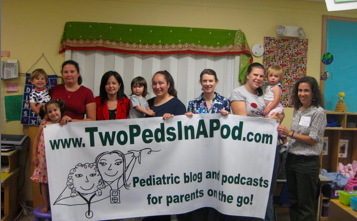
Join us as we talk with moms from Building the Family, part of Child, Home and Community, a Pennsylvania based organization dedicated to empowering young parents.  We share with you a few tidbits on milk, daycare and thumb sucking – topics gathered from a podcast recording party held this summer. Here we are pictured with the fabulous moms and some of their children (listen carefully and you will hear the pitter-patter of little feet in the background).

Play the podcast here!

Naline Lai, MD and Julie Kardos, MD

©2010 Two Peds in a Pod℠

Share

Happy Birthday Two Peds in a Pod!

One year ago today we posted our first blog post Maiden Voyage and what an adventure it has been! In honor of Two Peds in a Pod’s first birthday we reprint Dr. Kardos’s post “Let ‘Em Eat Cake”:

After completing my pediatric training, I worked for a couple of years in a large pediatric office before I had any children of my own. I was always struck by the Life Event of a child’s first birthday. This milestone carries so much meaning and emotion for families. My patients’ parents described huge birthday parties with characters such as Elmo walking around or Moon Bounces, large catered affairs with numerous friends, family members, and entire neighborhoods. Often I would see a child sick in my office a few days before such an event with parents who were panicked that their child might be sick on his Big Day, or I would see a child for his one year well check and hear many details about the enormous party. Of course I also saw plenty of children a few days after their first birthday party who became ill, most likely, from a well-intentioned friend or relative who was already sick and passed the illness on to the birthday child at the party. I heard about the kids who clapped for the Happy Birthday song and kids who cried and one who vomited from excitement… all over the birthday cake. Many of my patients had their first full blown temper tantrum during their own over-stimulating first birthday party.

I remember not quite understanding why parents go through such effort and expense to throw a party that their child will never remember at a developmental stage where 99 percent of children are having stranger anxiety and separation anxiety. Well meaning famillies would often forgo daily routine to skip naps, eat at erratic times, and then expect their birthday child to perform in front of a large crowd singing loudly at them. “My husband and I will do it differently,” I would tell myself.

Now, three of my own children later, I must apologize for not quite understanding about that first birthday. I remember waking up on the day my oldest turned one year. My pediatrician brain first exclaimed “Hurray! No more SIDS risk!” Then my mommy brain took over, “Ohmygosh, I survived the first year of parenthood!” This day is about Celebration of the Parent. I finally understood completely why my patients’ parents needed all the hoopla.

Because I am actually a little uncomfortable in large crowds, my son’s first birthday party included all close relatives who lived nearby, people he was well familiarized with. Some pediatric tips I had picked up which I will pass on:

1)      Sing the Happy Birthday song, complete with clapping at the finale, for about one month straight leading up to the birthday. Children love music and hearing a very familiar song sung by a large group is not as overwhelming as hearing an unfamiliar song.

2)      Plan mealtime around your child, not the guests. If you are inviting people close to your heart, they will accommodate. Dinner can be at 5:00pm if that’s when your child usually eats, or have a lunch party that starts midmorning and then end the party in time to allow your child to have his regularly scheduled afternoon nap. Most one-year-olds are usually at their best in the morning anyway.

3)      If your child becomes sick, cancel the party. Your child will not be disappointed because he won’t understand what he is missing. You as parent would have a lousy time anyway because all of your attention will be on your ill child and you will be anxious. Your guests who are parents will appreciate your refraining from making them and their own children sick.

Recently while performing a one-year-old well check I asked about my patient’s birthday party and her parents told me “Oh, we didn’t have a party. It was like any other day, although we did give her a cupcake for dessert.”

Now THIS is a pragmatic approach to parenting because, again, no child will ever have memories of her own first birthday. However, I hope the parents did take time, at least with each other, to congratulate themselves and to feel really good about making it to that huge milestone in their parenting career. I hope they savored their accomplishment as much as their child savored the cupcake.

_____________________________

How far we’ve come, and it is all thanks to you. We’ve watched with excitement as our readership climbed from two hits (from our husbands) to almost 20,000 hits. Two Peds in a Pod now has email and Facebook subscribers. You can find us through directories such as Technorati and iTunes and recently, Two Peds expanded to the West Coast of the United States with a bimonthly column in Family Magazine Group. Some of our Face book friends hail from Canada and we consistently receive hits from the United Kingdom. Looks like our goal to impact one million kids around the world may not be a far-fetched dream.

Our greatest reward is when people say to us, “That blog post was so helpful.” We are thrilled to reach out to many families.

While our main podcast recording studio continues to be our kitchen table, we also recorded with one mom’s group in their living room and another parenting group in a child care center.  From focus group back out to cyperspace!

We still depend on you to tell other families about our site. Our sources of inspiration continue to be our patients, your children and our own clans. Please keep those topic suggestions coming! As working pediatricians and parents like you, we want to continue to be your reliable (and sometimes amusing) source of sound pediatric information.

Thank you for reading, listening, commenting and letting your friends know about Two Peds in a Pod. Let the adventure continue!

Sincerely,
Julie Kardos, MD and Naline Lai, MD
©2010 Two Peds in a Pod℠

Share

How will my own childhood impact how I raise my children?

Earlier in the month I attended a developmental pediatrics conference in Philadelphia. The keynote speaker, Barry Zuckerman MD, professor and chairman of pediatrics at Boston University, raised a set of thoughtful questions. Parents can use the answers as a starting point for understanding how they were raised. Here are some of the questions with modifications:


        -What was it like growing up? Who was in your family? Who raised you?


        -Do you plan to raise your child like your parents raised you?


        -How did your relationship with your family evolve throughout your youth?

 
How did your relationship with your caregivers (mother/father/aunt/grandparent/etc) differ from each other? What did you like or not like about each relationship?

 
Did you ever feel rejected or threatened by your parents? What sort of influence do they now have on your life?

 
Did anyone significant die during your youth? What was your earliest separation from your parents like? Were there any prolonged separations?

 
If there were difficult times during your childhood, were there positive role models in or outside your home that you could depend on?


Some of these questions may be tougher than others to answer. Ultimately you are not your parents (although you may feel otherwise when you hear a familiar phrase escape your own lips), and likewise your children are not you. Parenting techniques that worked, or did not work, for your parents will not necessarily work, or not work, for you. However, stopping to reflect on your own youth will help you understand why you parent the way that you do.


Naline Lai, MD with Julie Kardos, MD

© 2010 Two Peds in a Pod℠


Share

Top Ten Skills You Acquire as a Father

In honor of Father’s Day, we bring you our second “Top Ten” list.


Top ten skills you acquire as a father:


10. The ability to attract swarms of women if you walk in the park or the grocery store with your infant.


9. Tolerance of temperature extremes at the skating rink or on the ball field.


8. Not being completely grossed out by spit up on your nicely pressed shirt.


7. The ability to sit patiently through a 3 hour ballet recital, school music concert or graduation.


6. The ability to sit patiently through an endless one hour television show featuring some sort of dancing and singing animal and then to stand in an hour long line to buy the stuffed toy version of the animal.


5. The skill to coach teams for which you last played the sport twenty years ago.


            4. The ability to swing a child, “again!”, “again!”,  and “again!”

3. The ability not only to get through a day after one (or many) completely interrupted night’s sleep, but to wake up in the morning having forgotten about the interruptions.

2. An ability to seize the moment and create great memories for your child: you ignore the dishes, the garbage, and the dirty bathrooms in lieu of an impromptu wrestling match.


1. Ability to love more than you ever thought possible, and the ability (finally) to understand just how much your father loves you.


Happy Father’s Day from Two Peds in a Pod!


Julie Kardos, MD and Naline Lai, MD

© 2010 Two Peds in a Pod

Share

A “New” Old Vaccine: Prevnar 13

Ten years ago I watched a very sick, feverish toddler arch his back on my exam table while a high pitched screech weakly escaped his mouth as I tried to examine him. Attempts by his mother to cradle him in her arms only resulted in more pain.

The diagnosis –– bacterial meningitis, puss in the spinal cord and around the brain.

The culprit ––a potentially deadly germ called Streptococcus pneumonia.

A few months after I saw that toddler with meningitis, a vaccine against Strep pneumonia, under the brand name Prevnar-7, entered the market. I often wonder how outcomes would have differed for that toddler if the vaccine had been released earlier.

In addition to causing bacterial meningitis in children, this pneumococcal germ is also responsible for other forms of invasive disease such as pneumonia and overwhelming infection in the blood (sepsis). After Prevnar-7 entered the market in 2000, the number of children contracting invasive pneumococcal disease dropped by 76 percent. This decrease was seen in children under age five years, the most common age group for contracting pneumococcal disease. Vaccines at work!

The original Prevnar-7 offered protection against 7 types of the pneumococcal germ. But other types which weren’t targeted by Prevnar continued to cause infections. A new vaccine called Prevnar-13 offers protection against six additional types.


How does the release of the new Prevnar-13 affect your child? Recently, the American Academy of Pediatrics released its immunization recommendations:

If your child has never been immunized against Pneumococcus, he will receive Prevnar-13 instead of Prevnar-7 on the same schedule as in the past. The series of four doses total are given at two months of age, four months, six months, and lastly a booster dose at 12-15 months of age. 
If your child is under five years old but has completed the full Prevnar-7 schedule, he will need at least one dose of Prevnar-13 to be fully protected.
If your child is in the middle of the Prevnar series, he will likely complete the series with Prevnar-13. 
Children from 6 years to 18 years of age who are at very high risk for complications (e.g., children with sickle cell anemia and cochlear implants) may consider at least one dose of Prevnar-13 along with their usual “high risk” pneumovax 23 vaccine. 

At this point there aren’t any recommendations to immunize non-high-risk children after five years of age because for most children, the risk of contracting life-threatening illness from this germ dramatically decreases after age five.

There’s more protection out there against more streptococcal pneumonia. Go get it!

For the full AAP recommendations see the online version of the AAP Policy Statement May 24, 1010 at www.pediatrics.org.

See also: Center for Disease Control March 12, 2010 Mobidity and Mortality Weekly Report for information about the impact of Prevnar on invasive pneumococcal disease.

Naline Lai, MD with Julie Kardos, MD

© 2010 Two Peds in a Pod℠

Share
image_pdfimage_print