“Should I give my kid the Gardasil® vaccine?” Friends and relatives, as well as our patients’ parents, continue to ask us this question.
Our answer is always: “Yes.”
Gardasil® vaccine is the current HPV vaccine on the United States market. The vaccine prevents cancer-causing strains of human papillomavirus from infecting a person’s body. HPV cancers include cervical cancer in women, penile cancers in men, and cancers of the mouth and throat in everyone. The vaccine also protects against genital warts.Continue reading “Update on Gardasil vaccine: yes, it is safe and effective”
Some games are riskier than others and it’s hard for teens to tell the difference.
Remember playing “Truth or Dare” as a kid? Some of the dares were silly, some potentially embarrassing, but some were downright risky. Now our children are playing potentially dangerous games. How can you prevent your teen from taking unnecessary risks?
To understand why kids would play risky games such as the Cinnamon Challenge or the Laughing Game, let’s step into the mindset of a teenager. Don’t let their adult-like appearances deceive you. Based on what we know about teenage brain development, teens are more likely to misinterpret or mislead social cues and emotions and to engage in risky behavior. Even though your teens may be taller than you, their deductive reasoning skills are not fully developed until around 25 years old. They have difficulty thinking through long term plans.
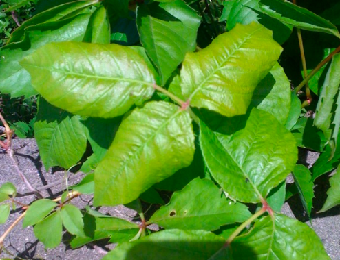
Teach your child to recognize poison ivy: “leaves of three, let’em be!”
Recently we’ve had a parade of itchy children troop through our office. The culprit: poison ivy.
Myth buster: Fortunately, the rash of poison ivy is NOT contagious. You can “catch” a poison ivy rash ONLY from the plant, not from another person.
Another myth buster: You can not spread the rash of poison ivy on yourself through scratching. However, where the poison (oil) has touched your skin, Continue reading “Poison ivy: stop the itch”
In the wake of chef Anthony Bourdain and designer Kate Spade’s deaths from suicide, you may be wondering how to address the topic of suicide with your child. We bring back psychotherapist Dina Ricciardo’s post for guidance:
“Hi, it’s me, Hannah. Hannah Baker.” So begins the first episode of 13 Reasons Why, a thirteen installment Netflix series that focuses on the aftermath of the suicide of a 17-year-old high school student. Based on the novel by Jay Asher, the series has sparked quite a bit of debate and concern among parents and mental health professionals. At its best, the series has served as a conversation starter; at its worst, it has glamorized suicide and the fantasy of revenge. At the end of the day, however, an important question remains: How do we talk with our kids about suicide? While many difficult topics have become increasingly safer to discuss, suicide is one that is still shrouded in secrecy and shame. In fact, it is so difficult to talk about that I had a hard time writing this post. Continue reading “Discussing suicide: how much should I tell my kids?”
Raw chicken left out overnight—Dr. Lai’s recipe for Salmonella
These days it seems that the bacteria Salmonella is lurking everywhere. Last month’s egg recall for possible Salmonella contamination affected over 200 million eggs, but Salmonella is not just in eggs. In the last few months, dried coconuts and even guinea pigs (as pets, not as food!) have caused people gastroentestinal misery.
Gepetto always said his son had allergies, but the villagers knew better
It’s not your imagination. This is a particularly bad spring allergy season. We didn’t need media outlets to tell us that there are more itchy, sneezy, swollen eyed kids out there this year.
It’s time for another Two Peds in a Pod photo quiz.
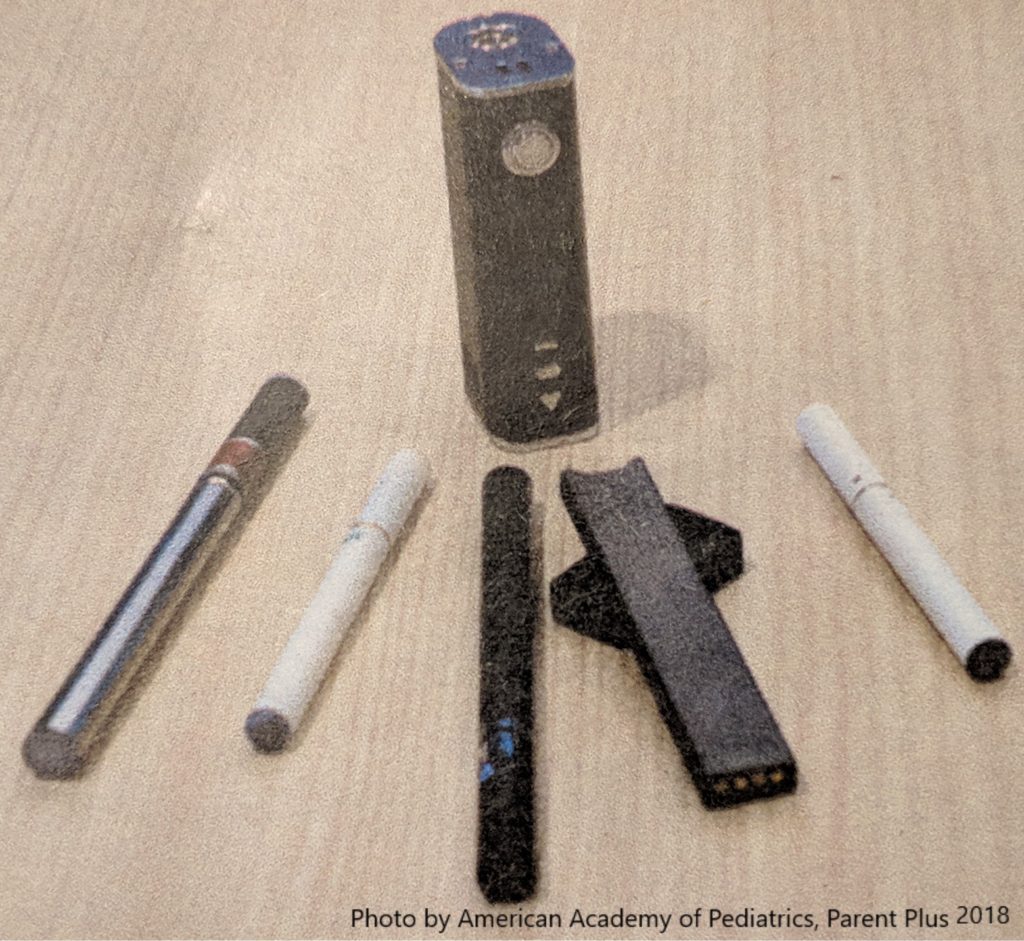
The question: What’s depicted in this photo?
If you answered: a pen, a thumb nail drive, or an asthma inhaler, you would be wrong.
Kids use these devices, which purposely look like common innocuous objects, to inhale electronic cigarettes (e-cigarettes). Vaping, also called “Juuling” and an even more concentrated form of vaping, called “dripping,” is unfortunately popular among teens. It’s unhealthy: the stuff that the kids are inhaling contains nicotine and other chemicals.
Ask your middle schooler or high schooler. They most likely have seen these devices if they have not actually used one.
Parents need to know kids are vaping in school as well as outside of school. Unlike conventional cigarettes, it’s easy for the kids to hide: no smoky smell, no cigarette cartons. The vaping liquid or “e-juice” comes in all kinds of “kid friendly” flavors such as gummy bear, fruit, or chocolate, and the devices needed to inhale them look like items in every kid’s pencil case or backpack.
It’s easy for kids to get the e-juice on the internet because online stores don’t always ask for proof of age (legal age to buy is 18 years in the US). Most e-juices contain nicotine, which is addictive. Emerging data show that kids who vape are more likely to go on to use regular cigarettes than kids who do not vape.
Bottom line: Vaping, or using electronic cigarettes, is unhealthy and addictive, and startlingly easy for kids to hide.
Nope, warthogs don’t actually have warts. But kids often do!
Emma’s dad and I both peered at the filamentous growth dangling from his nine year old’s right nostril. “Yes,” I said, “it’s definitely a wart.”
Emma’s dad offered, “When I was a kid, I heard the way to get rid of a wart was to cut a potato in half, rub it on the wart, and bury the potato in the backyard. Legend had it, by the time the potato disintegrates, the wart will be gone.”
“I wish it were so easy,” I replied.
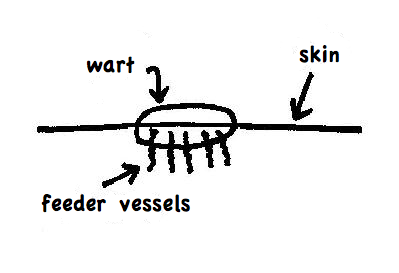
Warts are caused by skin-dwelling viruses. On the feet, warts can sometimes be mistaken for calluses. One distinguishing feature is that warts sit in the skin like this:
Fine “feeder” blood vessels extend from the wart into the skin. Therefore, if you scrape off the top layer of a wart, a dotted pattern usually appears from above. The dots will not appear in a callus. View from above:
There are simply no glamorous ways to get rid of warts. Most treatment modalities destroy warts by pulverizing the home they live in, a.k.a. your skin. Your doctor may be armed with various agents such as liquid nitrogen or dimethyl ether propane, which produces a chemical “freeze” and dries up the wart. Another agent called cantharidin (otherwise known as “beetle juice”) is a caustic liquid derived from the blister beetle. Application of beetle juice causes the warts to blister.
Some doctors will even manually take a scalpel and cut out the warts.
Like I said, there are no glamorous treatments. However, more gentle creams which stimulate the immune system, such as Imiquimod (Aldara) show some promise in children. Other compounds such as 5-fluorouracil can be topically applied or injected and treatments such as pulsed dye laser therapy have mixed reviews.
Over-the-counter remedies exist in a milder form. Commonly used wart removers such as Compound W, Dr Scholl’s Clear Away Wart, and Duofilm all contain salicylic acid. The acid slowly dries up the warts. When applying salicylic acid, after a few applications make sure you peel the dead crusty top layer off the wart. Without peeling, future medicine will not reach the wart. These methods can take weeks to months to work, but they do work.
And don’t forget the duct tape. Duct tape, the great all-purpose household item, has also been shown to speed up the resolution of warts. Scientists hypothesize the constant presence of the adhesive somehow stimulates a natural immune response. If you try duct tape, have your child wear the duct tape over the wart for several days in a row and then give a day off. If the wart is on a hand or foot, the tape tends to fall off during the day: just re-apply some tape at bedtime. Effects should be seen within a couple of months if not sooner. Now, the original study that showed duct tape was helpful, was followed by a study which showed duct tape was not helpful. Some hypothesize that the results differ because silver sticky duct tape was used in the initial study, while the later study used less sticky duct tape. So be sure to use the old-fashioned silver duct tape.
The prevention of warts is tricky. Some people just seem genetically predisposed. However, your best bet for keeping warts away is to keep your child’s skin as healthy as possible. Warts tend to gravitate towards areas of skin broken down by friction such as feet or fingers. Liberally apply moisturizing creams daily to prone areas. After a summer of wearing flip-flops and walking on the rough cement by the side of a swimming pool in bare feet, many children end up with warts on the bottom of their feet. I know a teen whose warts on the tips of her fingers stemmed from months of guitar strumming.
Turns out that even without treatment, 60% percent or more of all warts will disappear spontaneously within two years.
Coincidentally, I think that’s also the time it takes for a potato half to disintegrate.
When the Tin Man was a child in Oz, I’m sure his pediatrician never told his parents, “Has anyone ever said your child has a heart murmur? I hear one today.”
I know that when I tell parents about a heart murmur in their child, their hearts skip and jump. But not all heart murmurs are bad.
What is a heart murmur?
A heart murmur is an extra sound that we pediatricians hear when we listen to a child’s heart with a stethoscope. A normal heart beat sounds like this: “lub, dub. lub, dub. lub, dub.” A heart murmur adds a whooshing sound. So what we hear instead is “lub, whoosh, dub” or “lub, dub, whoosh.”
The “whoosh” is usually caused by blood flowing through a relatively narrow opening somewhere in or around the heart. Think of your blood vessels and heart like a garden hose. If you run the water (blood) very hard, or put a kink or cut a hole in the hose, the whoosh of the water grows louder in those locations.
Heart murmurs signal different issues at different ages.
In a newborn, some types of heart murmurs are expected. Normal newborn hearts contain extra holes that close up after the first hours or days of birth. One type of murmur occurs as the infant draws in his first breath and holes in the heart, present inside the womb, begin to seal. As the holes get narrower, we sometimes hear the “whoosh” of blood as it flows through the narrowing opening. Then these holes close completely and the murmur goes away.
However, some murmurs in infancy signal “extra holes” in the heart. As pediatricians, we experience our own heart palpitations when moms want to leave the hospital early with their infants who are less than 48 hours old. We worry because many infants who have abnormal hearts may not develop their abnormal heart murmurs and other signs of heart failure until the day or two after birth.
Preschool and early school-age children often develop “innocent” heart murmurs. “Innocent” implies that extra blood flows through their hearts, but the hearts are structurally normal. These murmurs are fairly common and can run in families. However, there are some significant heart problems which do not surface until this age. For this reason, remember to schedule those yearly well child checkups.
For teens, during the pre-participation sports physical, pediatricians listen carefully for a murmur that may indicate that an over grown heart muscle has developed.
What else can cause a heart murmur?
Holes are not the only culprit behind a murmur. The whoosh sound can also arise when a person is anemic and blood flows faster than normal. In anemic kids, the blood flows faster because it lacks enough oxygen-carrying red blood cells and the heart needs to move blood faster in order to supply oxygen to the body. The most common cause for anemia is a lack of eating enough iron-containing foods. Subsequently, we hear these flow murmurs in children whose diets lack iron, in teenagers who grow rapidly and quickly use up their iron stores, and in girls who bleed too much at each period. Replenishing the iron level makes a heart murmur from anemia go away.
Even a simple fever can cause a heart murmur on physical exam. The murmur goes away when the fever goes away.
Pediatric health care providers can often distinguish between “innocent” heart murmurs and not-so- innocent heart murmurs by the sound of the murmur itself (not all “whooshes” sound alike). If any question exists, your child will be referred for more testing, which could include a chest x-ray, an EKG (electrocardiogram), an ECHO (echocardiogram, or ultrasound of the heart), or evaluation by a pediatric cardiologist.
If your child’s pediatrician tells you that your child has a heart murmur, “take heart.”
Many times a murmur comes and goes or just becomes part of your child’s baseline physical exam. Even if your child has a serious heart problem, most cases respond well to medication, surgery, or both. While not all heart problems cause heart murmurs, and while not all murmurs signal heart problems, the presence of a heart murmur in a child can signal that your child needs further testing.
Unless, of course, your child is the Tin Man. In this case, extra sounds indicate that your child needs more oil!

 “Should I give my kid the Gardasil® vaccine?” Friends and relatives, as well as our patients’ parents, continue to ask us this question.




 It’s time for another Two Peds in a Pod photo quiz.