Spotting the rash of ringworm

ringwormAlthough it’s called ringworm, this rash isn’t caused by a worm.  In fact, it barely looks like a worm. Otherwise known as tinea corporis, the patch of ringworm is usually a flesh or light-pink colored, slightly scaly oval with raised, red edges.

Caused by a fungus, sometimes the patch is itchy. The same organism also causes athlete’s foot (tinea pedis), jock itch (tinea cruris)  and scalp infections (tinea capitis).

Ringworm falls into the mostly-harmless-but-annoying category of skin rashes (cover it up and no one will notice). Your child’s doctor will diagnose the rash by examining your child’s skin. To treat the rash, apply antifungal medication until the rash is gone for at least 48 hours (about two to three weeks duration). Clotrimazole (for example, brand name Lotrimin) is over-the-counter and is applied twice daily. You will find it in the anti-athlete’s foot section.

On the scalp, ringworm causes hair loss where the rash occurs.  Treatment is not so straight forward. Ringworm on the scalp requires a prescription oral antifungal medication for several weeks. The fungus on the scalp lives not only on the skin, but also in hair follicles. So, topical antifungals fail to reach the infection.

Ringworm spreads through direct contact. Wrestling teams are often plagued with this infection. Cats may carry ringworm. If your family cat has signs of feline ring worm such as patches of hair loss, take him to the vet for diagnosis.

If your child’s “ringworm” fails to improve after a week of applying antifungal medication, have your child’s doctor examine (or re-examine) the rash. Other diagnoses we keep in mind include eczema and granuloma annulare. If the rash continues to enlarge we consider Lyme disease.

The sooner you start to treat ringworm, the more quickly it resolves. Just remember, “the early bird catches the…” oh never mind.

Naline Lai, MD and Julie Kardos, MD
©2012 Two Peds in a Pod®

Share

The dirt on tetanus

tetanus
fodder for tetanus…don’t get this stuck under your foot

Look at this rusty old anchor atop an old fort. Rust plus dirt equals a perfect breeding ground for tetanus. As my kids scampered between different anchors last week, I quickly calculated in my mind whether their preventative tetanus shots were up to date.

“Getting the tetanus shot” is part of the American societal childhood rite of passage, but most people don’t know much about why their kids are vaccinated. Everyone knows they want to avoid IT, but what is IT? Because it is somewhat rare in the United States, I still remember asking one dad about his child’s family history. I was startled when he erupted onto peals of laughter after he told me the child’s grandfather had died of tetanus. “Why are you laughing?” I said in disbelief.

“You’re right, it’s not funny… It’s just the look on your face is funny,” he said. “Everyone has the same shocked expression when I tell them that he died from tetanus.”

Also known as Lock Jaw, tetanus is an organism which thrives in places with little oxygen. Thus, it tends to live on rusty nails (and anchors!) and deep in dirt. Tetanus secretes a poison which causes muscles to spasm painfully and severely and also causes seizures. Exposed to tetanus, your jaw muscles clench into a sardonic smile which prevents eating – hence the name Lock Jaw. Eventually, the tetanus poison infiltrates the chest muscles that help you breathe, and if you are like nearly 40 percent of cases, you will stop breathing and eventually die.

We have no antidote for the poison of tetanus- but we do have a preventative immunization which causes our bodies to preemptively prepare antibodies as self-defense. At the time of a high risk injury, if needed, doctors will boost your child’s tetanus immunization. If your child is under- immunized, the doctor will also inject your child with tetanus antibodies (tetanus immunoglobulin) to further ensure that your child will not contract this disease.

Because tetanus thrives away from oxygen, it easily multiples in deep wounds contaminated by the germ. The germ surrounds us in soil and also lives in intestines of humans and animals. Since tetanus lives in dirt, the following are considered “high risk” injuries:

   -Bites from animals which dig and “eat” dirt such as dogs.

    -Deep puncture wounds from dirty, rusty nails.

    -Wounds with embedded rocks and gravel.

Be wary of tetanus in wounds possibly contaminated with stool, dirt ,or saliva. In developing countries, there are continued cases of infantile tetanus because poultices of mud are used to take care of the umbilical cord stump of newborns.

For kids, the recommended ages for tetanus shots are at 2 months old, 4 months old, 6 months old, 15-18 months old, 4-6 years old, 11-12 years old, and then every ten years through adulthood. Note, if a high risk wound is sustained, the last shot should be within five years. Thus, a kid around 9 years old may be up-to-date for shots, but because he received a tetanus vaccine at four-years-old (on time) he will still need an immunization at the time of a risky injury. Watch out also if you have a teen. His pediatrician will immunize him at 11-12 years of age, but after 16-17 years old he will need a booster if he sustains a dirty wound.

Nowadays, the tetanus immunization is in the same solution as an immunization against diptheria (a disease that causes a choking-inducing coating at the back of your throat), and usually in the same solution as pertussis (whooping cough). If your doctor gave your child an immunization recently against pertussis, she also received a tetanus immunization.

Kids are expected to get dirty. Enjoy the dirt—just not the tetanus.


Naline Lai, MD with Julie Kardos, MD
©2012 Two Peds in a Pod®

Share

From KFIT video star Dr. Pat: Tips to get kids to eat their fruits and vegetables

It’s a heat wave and in extreme temperatures, kids, like adults, find it tough to go outside for physical activity. We find it perfect timing for the release of Dr. Pat Cantrell’s new kid fitness video (demo below). The video, made in conjunction with kids fitness expert Anna Renderer, gives follow-along exercises along with health advice tailored to kids.  We asked Dr. Pat to expand on one piece of advice she gives in the video: eat five servings of fruits and vegetables a day. For many parents, even one serving can be tough to get into a child. Many a parent has asked himself, “Does one bite of zucchini spit back onto the table count as a serving?” If this is you, then you’ll appreciate Dr. Pat Cantrell’s guest blog post.

– Dr. Lai and Dr. Kardos

Not eating enough fruits and vegetables is one of the biggest concerns that parents have regarding their children’s diet.  The US department of agriculture recommends that children get at least five servings of fruits and/or vegetables in their diet every day.  But most kids aren’t getting that amount.  Below are 5 tips that can help children get their 5 a day.

  1.  Cut it!  Kids love when food is cut into pieces that they can pick up.  An apple or orange might sit on the counter in the fruit bowl.  But, cut it up and all of a sudden it is much more appealing.  Even the fast food restaurants have figured this out and instead of just handing a child an apple or orange with their kid’s meal, they get apple or mandarin slices.
  2. Dip it!  Some vegetables can be bitter to a child’s immature taste buds.  Offering a yogurt or ranch dip can add the flavor they like and helps mellow out the taste of the vegetable.  
  3. Hide it! What they don’t know won’t hurt them!  By disguising fruits and vegetables, kids will get the nutrients they need.  Plus, without knowing it, kids will learn to develop the taste for the vegetables or fruits and their taste buds will be more accepting of the fruit or vegetable in the future.  Smoothies are a perfect way to blend in a few servings of fruits and/or vegetables.  You can also puree vegetables like carrots or spinach and add that to a pasta sauce!  For more ideas, check out Jessica Seinfeld’s cookbook “Deceptively Delicious”.
  4. Grow it! Gardens are a great way to get kids to eat more fruits and veggies!  I took my sons (7 and 9) to their grandmother’s house and they ate just-picked sugar snap peas.  I was shocked!  First of all, they tried it without whining and second, they liked it and asked for more!  Since the fruits and vegetables can be picked when they are ripe, they often taste better than the store bought version.   Kids love to see the food grow and helping them be a part of the process encourages healthy eating.
  5. Make it fun!  Put cream cheese on celery and add raisins on top and you have Ants on a Log.  Use cookie cutters to cut watermelon or cucumbers into fun shapes.  The more appealing it looks, the more kids want to try it.  For some fun ideas, check out http://familyfun.go.com/recipes/cooking-with-kids/.

Be creative and persistent and try to offer at least one or two servings of fruits and/or vegetables at each meal.

Pat Cantrell, MD, FAAP

Dr. Pat Cantrell, mother of two young boys (who can be picky eaters at times!), is a board certified pediatrician who has been practicing pediatrics at Southern California Permanente Medical Group for over 14 years. She has a special interest in pediatric obesity and is the President of KFIT Health, LLC (www.kidfitnessandhealth.com) which creates fitness and nutrition DVDs and products for children. A board member of the San Diego Childhood Obesity Initiative, Dr. Cantrell is also the Pediatric Obesity Champion for her medical group. Additionally she serves as Secretary of the San Diego Chapter of the American Academy of Pediatrics.


©2012 Two Peds in a Pod®


Share

So big- we’re three years old today!


Two Peds in a Pod® turns three years old! In honor of our third birthday, we bring you our top ten parental experiences through the years list:

  1. “Helping” your child manage his ice-cream cone (especially when he orders the soft chocolate kind with the chocolate sprinkles)
  2. Coaching a sport you have not played in twenty years.
  3. Playing hours of Mario Cart or Just Dance on the Wii (and losing every time)
  4. Building snowmen
  5. Coloring with brand new crayons (and the aroma of opening that new box of Crayolas!)
  6. If you are a mom, discovering your teen daughter is the same shoe size and you can borrow her hip shoes
  7. Experiencing your child’s first bike ride without training wheels
  8. Getting to be the Tooth Fairy (shhh… don’t tell!)
  9. Re-reading your favorite kid books (Dr. Seuss really was a genius)
  10. Realizing your child honestly believes that you have a really good singing voice

We hope to celebrate many more birthdays with you. Please continue to send us your ideas at twopedsinapod@gmail.com, comment on our posts and tell your friends about us. 

Happy,

Julie Kardos, MD and Naline Lai, MD
©2012 Two Peds in a Pod®


Share

Hold tight, but remember to let go

Let’s think about universal parental admonishments:

                “Hold on tight.”

                “Be careful.”

                “Look out!”

                “Don’t let go.”

Now let’s think about the universal goal of parenting: to create children who grow up to become independent.

That means that at some point, after your child learns to hold tight, be careful, and look out, your child will need to let go.

This inevitable march toward independence does not begin when your child turns eighteen, but rather years before. Kids learn independence in small steps starting when they are still babies in our eyes.

For instance, take feeding. First you breastfeed or bottle feed. Eventually you encourage your young child to drink out of her own cup as SHE holds it. When she’s able to pick up lint from the floor and stuff it into her mouth, you know she’ll be able to feed herself finger foods from the family dinner table.  At 18 months, children are capable of wielding their OWN spoons and fork—so let her do so, no matter the mess. By constantly challenging her with self feeding, your toddler becomes the preschooler who eats lunch with her friends at “lunch bunch” and the college student who chooses to eat salad at the cafeteria. 

How does a child learn to maneuver stairs? If you always carry her, she will never learn. Older siblings often teach the younger ones how to crawl backwards to the top of the steps and then go down safely buttocks first. I have fond memories of my son crawling backwards like a dump truck nearly the entire length of the hallway before reaching the steps. I would imagine a high pitched beeping sound as he inched backwards. As walking becomes steadier, your kid will learn to hold onto the banister as she goes up and down. Fast-forward and someday she will be the dexterous mom who carries her coffee in one hand, the laundry basket in the other and her phone between her ear and shoulder as she heads downstairs.

What does “be careful” mean? I find that kids often have no frame of reference for “careful” So be specific with your advice. When my kids were toddlers and carried cups of milk to the table, instead of only saying “be careful” I would remind them to “walk slowly.” If they (gasp) cut paper with scissors, I would say, “watch where your fingers are.” 

For kids, personal safety is often not enough of a motivation to listen to advice. When my twins were almost two years old, I realized that I belted them in their double stroller so often in public, they did not have an opportunity to learn how to stay with me. So, one day I had them hold my hands as we crossed the parking lot at their older brother’s school. They immediately tried to escape and run in opposite directions. I instructed them to “hold tight to my hands” or “Mommy will have to carry you like a baby.” The thought of walking into their older brother’s school like “big boys,” kept them holding on. 

Sometimes we need to allow children to fall, literally and figuratively. If missing the carpeted step that leads to the living room means your toddler falls, then let her learn from her mistake. An older child who insists on leaving his jacket at home will learn from natural consequences if he is too cold outside (remember you can’t catch a cold from the cold, you just feel cold). Remember all those skinned knees you sustained as a child? Yet now you can ride a two wheeler bike and you run faster because you practiced running, even if you fell a few times. If you make your child too afraid of falling, then he will be unable to take the risks involved in learning new skills.

Let your child complete his own homework from a young age. Offer to proofread but don’t nag. Teachers already have consequences in place for children who do not complete homework, or for those who do a sloppy job. Let your middle schooler choose which foreign language or musical instrument or sport he wants to learn without pointing out the practicalities of what you consider the “better” choice.

Of course we need to protect and guide our children. But we need to learn to relinquish control over our children’s actions at the appropriate ages. 

As the viral internet sage Eva Witsel says, “I can spend my energy on limiting my child’s world so that he will be safe and happy or I can spend my energy on helping my child learn the skills to navigate our world himself so that he will be safe and happy. I think the latter has a better chance of success in the long term.”

In grade school I remember holding tight to the chains of the playground swing as I swung higher and higher. But I also remember that glorious feeling as I let go, sailed through the air, and landed on my feet.

Don’t deprive your child of that same glorious feeling of letting go.

Julie Kardos, MD with Naline Lai, MD
©2012 Two Peds in a Pod®

Share

Molluscum contagiosum: the little rash with the big name

wart, molluscumnKinda cute. At least that’s what the medical books lead you to believe.  They are described as little pink or flesh-colored dome-shaped harmless bumps with belly buttons. The little rash with the big name, Molluscum Contagiosum, is cute only until you discover the bumps on your child’s skin. Like your neighbor’s cute toddler, the little belly-buttoned rash can overstay its welcome.

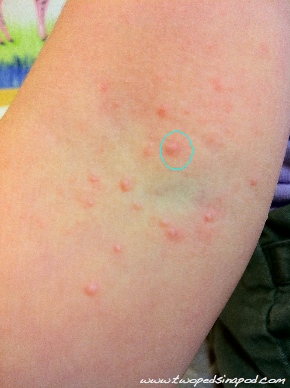
Pictured here is the rash of molluscum. The bumps are generally flesh colored, but can be slightly pink.  Look carefully at the circled bump— this one has a tiny dimple in the center (the “belly button”). While the rash often appears on areas with irritated skin such as eczema, molluscum can show up on every part of the body. As with any new rash, visit your child’s doctor to confirm the diagnosis.

The best thing about molluscum is that it is not harmful. Children can attend school and camp with it. Yes it looks funny, but like warts, it is a virus that is only skin deep. Also, like warts, it can be very stubborn about going away. Probably because it is so benign, children’s immune systems don’t get excited about an out-cropping of molluscum and do not bother attacking the rash.


The rash is spread by direct skin to skin rubbing (think wrestlers or think kids rolling around in play or think sexual contact—teens can get molluscum in compromising areas) and by towel sharing and very close contact in water—siblings catch molluscum from each other when they bathe together. However, kids do not contract the virus in swimming pools. The rash itself is not particularly itchy. But, because it often appears on itchy patches of skin, kids will scratch areas with molluscum and with each scratch, spread the molluscum over a greater area. One of my patients first developed molluscum on the inner aspect of his arm.  During the summer when he went shirtless, the rubbing of his arm against his body caused molluscum to appear on the side of his chest where his arm brushed against his body.  Mysteriously, some kids don’t seem prone to picking up the rash. One of my twins had the rash all over his belly for close to a year. Yet my other twin only had one bump on his ankle for a few months. 

Treating molluscum is frustrating. Pediatricians and dermatologists have some agents which irritate the molluscum in hopes that the body’s immune system will wake-up and get rid of it.  Medications such as cantheridin (extract of blister beetle), Retin A, liquid nitrogen, and others all are used to treat molluscum with varying success rates. Hydrocortisone 1% three times a day for a few days will soothe itchy skin patches of molluscum. Although the medication will not cure the rash, it will help calm the itch and prevent further spread. Rarely, just like any area which is scratched, bacteria from the skin will infect the rash. If a bump is scratched open, put a dab of antibacterial ointment on along with the hydrocortisone. If redness increases and the area becomes progressively tender, seek medical attention. Take heart in the fact that molluscum DOES go away on its own, but can linger for months or even years before finally fading. My husband and I opted not to treat our twins, and waited for the molluscum to leave on its own, which it did. Often, just before spontaneously going away, the bumps become red and irritated for a day or so and then just… go.

When I diagnose a patient with this condition, the name of this rash always makes me feel like I am casting a Harry Potter spell:

Parent: “Doctor Kardos, what is this rash on my child?”

Dr. Kardos, brandishing a magic wand: “MOLLUSCUM CON-TA-GIOSUM!!!”


The medical literature and 15 years in pediatric practice tell me there are no vitamins or behavior therapies that play any role in banishing this rash. In short, there are no quick fixes.


If only the cure were as easy as waving a wand. We’ll let you know if we hear of any new spells.


Julie Kardos, MD with Naline Lai, MD
©2012 Two Peds in a Pod®


Share

Dad to Dad: Parenting Like a Pro

Dad to Dad David HillJust in time for Father’s Day— the book Dad to Dad: Parenting Like a Pro. Written by our pediatrician colleague, Dr. David Hill, this North Carolina based Pediatrician brings a humorous, yet practical perspective on fatherhood. His book includes chapters on nontraditional parenting relationships, talking to kids about sexual development and helping your child sleep. Two Peds in a Pod is pleased to give you a sneak peek:


Dads are not good for kids just because we do the same stuff moms do. That’s not to say doing that stuff isn’t important; it’s critical! Mothers and fathers have a similar effect on their children’s moral development,  social comptence, school performance, and mental health. There is a reason, after all, it takes 2 parents to make a baby, and not just because it’s more fun that way.


Probably the most accurate generalization about dads versus moms is that fathers play more. In the first 4 years of a child’s life we tend to focus on activities that involve touch and stimulation, like tickling, wrestling, and playing an airplane. It’s our job, in other words, to get kids all wound up so they won’t go to bed, to make them laugh until they pee on themselves. (Note: If this happens, be a good sport and help with the clothing change; after all, it is your fault.) During middle childhood, we’re more likely than mothers to get out and do stuff, like take walks, go fishing, or see a ball game. Are you surprised? No, you are not. You already knew that from watching sitcoms.


……


Some people might still call this a man’s world, but the corners of it devoted to child care can sometimes feel downright unfriendly to fathers. I recall times when, taking my young children to the playground, moms actually got up from a park bench where they had been talking and moved over to the next swing set. It’s possible they were just following the shade, but I couldn’t help looking around to see if my picture was stapled to a nearby utility pole. 


As an involved father you might expect everyone you encounter to smile and praise you or tell you how impressed they are at what you’re doing. At times you will get this reaction. Some people seem amazed I can get my kids out of the house wearing 2 matched shoes. In fact, one of my pet peeves is when the children’s clothes clash and someone says, “Daddy must have dressed you today.” I want to look that person dead in the eye and say, “You don’t know me very well, do you? My daughter here left the house in a perfect little outfit, but she threw up on that one, and this is what was in the trunk of the car. Now stand back— she’s looking a little pale.”


David L. Hill, MD, FAAP


excerpted with permission, from Dad to Dad: Parenting like a Pro


Dr. David Hill is a pediatrician, writer and father of 3. He believes humor is essential to surviving parenthood. He has put this theory to the test at various times as a stay-at-home dad, a primary breadwinner, part of a 2-working-parent family, and a single father. He is vice president of Cape Fear Pediatrics. As a writer, Dr. Hill has composed and recorded humorous commentaries for National Public Radio’s All Things Considered and NPR affiliate WHQR. Dad to Dad: Parenting like a Pro is available at bookstores everywhere and through Independent Publishers Group and the American Academy of Pediatrics bookstore


Share

A shred of advice: how to remove splinters

Yow!

Although I first cringed when I saw this splinter, it is actually one of my favorite kinds. It’s obvious and relatively easy to remove.

Now that summertime is upon us, many kids will want to run barefoot outside. Have your children wear shoes, especially on decks and docks, in the woods, and even in grass and sand in order to protect their feet. In short, if they are not actually swimming, kids (and adults) should wear shoes outside. Even for those who are careful, splinters have a way of magically embedding themselves in bare feet.

If the splinter is very tiny (too small to grab with tweezers,) seems near the skin surface, and does not cause much discomfort, simply soak the splinter in warm soapy water several times a day for a few days. Fifteen minutes, twice a day for four days, works for most splinters. Our bodies in general dislike foreign invaders and tend to evict them. Water will help draw out splinters by loosening up the skin holding the splinter. This method works well particularly for multiple hair-like splinters such as the ones obtained from sliding down an obstacle course rope. Oil-based salves such as butter will not help pull out splinters. However, an over-the-counter hydrocortisone cream will help calm irritation and a benzocaine-based cream such as Oragel will help with pain relief.

If the splinter is “grab-able”, gently wash the area with soap and water and pat dry. Don’t soak an area with a “grab-able” wooden splinter for too long because the wood will soften and break apart. Next, wash your own hands and clean a pair of tweezers with rubbing alcohol. Then, grab hold of the splinter and with the tweezers pull smoothly in the direction opposite of the way the splinter entered. Take care to avoid breaking the splinter before it comes out.

If the splinter breaks or if you cannot easily grab the end because it does not protrude from the skin, you can sterilize a sewing needle by first boiling it for one minute and then cleaning with rubbing alcohol. With the needle, pick away at the skin area directly above the splinter. Use a magnifying glass if you have to, make sure you have good lighting and for those middle-age parents like us, grab those reading glasses. Be careful not to go too deep, you will cause bleeding which makes visualization impossible. Continue to separate the skin until you can gently nudge the splinter out with the needle or grab it with your tweezers.

Since any break in the skin is a potential source of infection, after you remove the splinter, wash the wound well with soap and water. Flush the area with running water to remove any dirt that remains in the wound. See our post on wound care for further details on how to prevent infection. If the splinter is particularly dirty or deep, make sure your child’s tetanus shot is up to date. Also, watch for signs of infection over the next few days: redness, pain at the site, or thick discharge from the wound are all reasons to take your child to his doctor for evaluation.

Some splinters are just too difficult for parents to remove. If you are not comfortable removing it yourself of if your child can’t stay still for the extraction procedure, head over to your child’s doctor for removal.

Now you can add “surgeon” to your growing list of parental hats.

Julie Kardos, MD with Naline Lai, MD

©2012 Two Peds in a Pod®

Share

Limiting BPA and other potential toxins in your child’s environment

BPA childGuest blogger pediatrician Heidi Román returns to us today to give practical advice on how to decrease potential toxins in your child’s environment.
In today’s world we are surrounded by “stuff”. We touch it, we eat from it, we drive in it, and we wear it. Before becoming a parent, I have to admit I didn’t think all that much about whether this “stuff” was safe. I had passing thoughts about toxic chemicals in “stuff”. Mainly, the environmental toxin I worried about as a pediatrician was my little patients’ exposure to lead.
 
Suddenly, as a new mom, I started to think about toxins a lot. I did little things like get BPA-free cups and bottles and avoid plastic toys. But, sometimes it feels like a losing battle. I did all kinds of research and bought a car seat with great safety ratings, only to later read a report that suggested it was “toxic”. And, in many cases the science is not definitive. A product may be found to have a substance that is considered toxic, but it is unclear whether or not the exposure is sufficient to actually impact the health of children. It all feels a bit overwhelming.
 
So, I’m here today to offer a few practical tips to parents who want to make their home environment safer for their kids; and, to let you know about some important legislation that is coming up that may help us all out.
 
1. Reduce exposure to BPA (bis-phenol A). We don’t yet have all the answers about the impact BPA may have on our kids. But, we do know this. BPA is all around us- particularly in food containers and linings. And, we have emerging evidence that it is an “endocrine disruptor“. The endocrine system is a set of organs that controls everything from body temperature to puberty via complex hormonal interactions. So called “endocrine disruptors” are thought to somehow alter these interactions. There is enough evidence out there about potential detrimental impact of pre-natal and post-natal exposure in kids (including suggestion of impact on behavior of young children) that I think it is time to dramatically reduce our exposure to BPA. Many companies who market products to babies have already made the switch- so look for BPA-free bottles and the like. You can also reduce your own exposure. Switch to glass food containers. Try to eat less canned food.
 
2. Improve the air quality in your indoor environment. Bring a few plants into your home. Varieties like the peace lily and rubber plants have been shown to significantly improve air quality. Switch to less toxic household cleaners or make your own from simple ingredients like vinegar, lemon juice, and baking soda. “Conventional cleaners often contain volatile organic compounds whose fumes can trigger asthma attacks and irritate the eyes, nose and respiratory passages”, says Maida Galvez, a pediatrician and environmental health specialist at New York’s Mount Sinai School of Medicine. Not only that, they are a significant poisoning risk to children if swallowed.
 
3. Decrease the number of products (cosmetics, etc) you use on your hair and skin. Learn more about the safety of those that you continue to use. Definitely use broad-spectrum sunscreen, but consider switching to a zinc oxide or titanium dioxide based formulation, especially for young children. Avoid aerosolized skin products, as there is risk of inhalation. Keep all personal care products out of reach of children.
 
4. Support TSCA reform. The Toxic Substances Control Act is the federal law that regulates which chemicals are deemed “safe” for use. The problem is that TSCA was passed in 1976 and has never been updated. TSCA grandfathered in 62,000 chemicals that were “presumed safe”. It does not require studies of health impact prior to chemicals reaching the market. Instead of requiring industries to prove the safety of chemicals, TSCA leaves the onus on the consumer and public and environmental health agencies to prove that they are unsafe after they’ve been available for use. It ties the hands of agencies like the EPA when they try to limit exposure, even to chemicals such as asbestos that are known to have adverse effects.
 
The great news is that for the past few years a growing coalition has organized to tackle TSCA reform. The EPA put forth a list of Essential Principles for Reform of Chemicals Management Legislation. Most importantly, the Safe Chemicals Act of 2011 (SB 847), put forward by Senator Frank Lautenberg, is making its way through the early legislative process. This bill seeks to improve chemical safety and protect our health using the best science available. It aims to reward innovative companies that attempt to put safer products on the market. The bill still needs our help to push it forward. Call your Senator and ask him or her to sign on as a co-sponsor.
 

One last thought. Many products are actually very safe. The trouble is, right now it is really hard to know which ones are okay for children and which ones aren’t. Parents have enough to worry about. Let’s give some of the responsibility regarding unsafe chemical exposures back where it belongs- to the industries producing chemicals and the regulatory agencies designed to keep our communities safe. And, for now, a few easy changes at home can keep toxic stuff away from your kids and help keep them safe and healthy.Heidi Román, MD

Heidi Román MD, FAAP is a mother and pediatrician who practices in San Jose, California. She has special interest and experience in public policy issues and working with under-served families from diverse racial and socio-economic backgrounds. Find her thoughtful blog posts at

mytwohats.wordpress.com.

 
Special thanks to toxicologists Alan Woolf and Melisa Lai Becker for reviewing this post.
©2012 Two Peds in a Pod®
Add 7/18/12: The FDA announced on July 16, 2012 that BPA is banned from use in baby bottles and sippy cups. BPA use in other containers is still permitted. Click here for the New York Times article.
Share
image_pdfimage_print