“Chloe” is a two month old baby who cries. Often. Loudly. Although most of the wailing occurs in the late afternoon and early evening, she also cries other times. She eats great and in fact, seems very happy while she feeds. She smiles at her parents mainly in the morning. She also smiles at her ceiling fan and the desk lamp. Movement calms her and her parents worry that she spends excessive time rocking in their arms or in her swing. Her cries pierce through walls and make her parents feel helpless. She often spits up during crying jags, and erupts with gas. She gained weight well since her last visit. Here’s the lesson: All babies cry. All babies pee and poop. All babies sleep (at times). AND: all babies spit up. The muscle in the lower esophagus that keeps our food and drink down in our stomachs and prevents it from sloshing upwards, called the “lower esophageal sphincter,” is loose in all babies. The muscle naturally tightens up and becomes more effective over the first year of life, which is why younger babies tend to spit up more than older babies. Max has GER (gastroesophageal reflux) , Chloe has GER/ colic and Mona has GERD (gastroesophageal reflux disease). Max and Chloe have physiologic, or normal, reflux. Mona has reflux that interferes with her mood, her feedings, and her growth. GER, GERD and colic (excessive crying in an otherwise healthy baby, see our post on this topic) improve by three to four months of age. If your baby cries often (enough to make you cry as well) then you should see your baby’s pediatrician to help determine the cause. It helps, before your visit, to think about when the crying occurs (with feedings? At certain times of the day?), what soothes the crying (feeding? walking/rocking?) and other symptoms that accompany the crying such as spitting up, fever, or coughing. Keeping a three day diary for trends can help pinpoint a diagnosis. We worry a lot when the babies are not “spitting up” but are actually “vomiting.” Spit blobs onto the ground. Vomit shoots to the ground. Vomit which is yellow, is accompanied by a hard stomach, is painful, is forceful (think Exorcist), or enough to cause dehydration, all may be signs of blockage in the belly such as pyloric stenosis or vovulus. Seek medical attention immediately. The treatment for Max, the happy spitter with GER? Lots of bibs for baby and extra shirts for his parents. The treatment for Mona, the baby with GERD? Small, frequent feedings to prevent overload of her stomach, adding cereal to the any bottle feed to help thicken them and weigh down the liquid, thus preventing some of the spit up (ask your doctor if this is appropriate for your baby), holding her upright after feeds for 15-20 minutes, and inclining her crib by putting a thick book under each of 2 crib legs to help her upper body stay higher than her feet which helps her stomach to empty sooner. To prevent Sudden Infant death Syndrome, she should still be placed on her back to sleep. Sometimes, pediatricians prescribe medication that decreases the acid content of the stomach to help relieve the pain of stomach contents refluxing into the esophagus. Treatment for Chloe, the crier? Patience and tincture of time. You can’t spoil a young baby, so hold, rock and sway with her to keep her calm. Enlist a baby sitter or grandparents to help. Treatment for parents? Knowing that someday your baby will grow up, no longer need a bib, and probably have a baby who spits up too. ©2012 Two Peds in a Pod® 
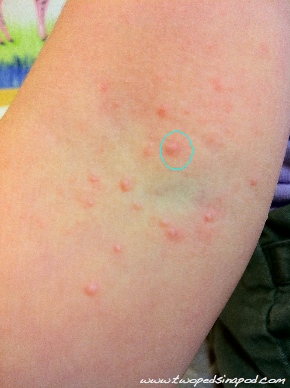
Kinda cute. At least that’s what the medical books lead you to believe. They are described as little pink or flesh-colored dome-shaped harmless bumps with belly buttons. The little rash with the big name, Molluscum Contagiosum, is cute only until you discover the bumps on your child’s skin. Like your neighbor’s cute toddler, the little belly-buttoned rash can overstay its welcome.
Pictured here is the rash of molluscum. The bumps are generally flesh colored, but can be slightly pink. Look carefully at the circled bump— this one has a tiny dimple in the center (the “belly button”). While the rash often appears on areas with irritated skin such as eczema, molluscum can show up on every part of the body. As with any new rash, visit your child’s doctor to confirm the diagnosis.
The best thing about molluscum is that it is not harmful. Children can attend school and camp with it. Yes it looks funny, but like warts, it is a virus that is only skin deep. Also, like warts, it can be very stubborn about going away. Probably because it is so benign, children’s immune systems don’t get excited about an out-cropping of molluscum and do not bother attacking the rash.
Parent: “Doctor Kardos, what is this rash on my child?”
Dr. Kardos, brandishing a magic wand: “MOLLUSCUM CON-TA-GIOSUM!!!”
The medical literature and 15 years in pediatric practice tell me there are no vitamins or behavior therapies that play any role in banishing this rash. In short, there are no quick fixes.
If only the cure were as easy as waving a wand. We’ll let you know if we hear of any new spells.
Julie Kardos, MD with Naline Lai, MD
©2012 Two Peds in a Pod®
Just in time for Father’s Day— the book Dad to Dad: Parenting Like a Pro. Written by our pediatrician colleague, Dr. David Hill, this North Carolina based Pediatrician brings a humorous, yet practical perspective on fatherhood. His book includes chapters on nontraditional parenting relationships, talking to kids about sexual development and helping your child sleep. Two Peds in a Pod is pleased to give you a sneak peek:
Welcome to summer! Some seasonal topics to read up on: a germ that lurks in pool water, itchy rashes from poison ivy, painful ears from swimmer’s ear and how to prevent kids from dehydrating.
Julie Kardos, MD and Naline Lai, MD
©2012 Two Peds in a Pod®
Yow!
Although I first cringed when I saw this splinter, it is actually one of my favorite kinds. It’s obvious and relatively easy to remove.
Now that summertime is upon us, many kids will want to run barefoot outside. Have your children wear shoes, especially on decks and docks, in the woods, and even in grass and sand in order to protect their feet. In short, if they are not actually swimming, kids (and adults) should wear shoes outside. Even for those who are careful, splinters have a way of magically embedding themselves in bare feet.
If the splinter is very tiny (too small to grab with tweezers,) seems near the skin surface, and does not cause much discomfort, simply soak the splinter in warm soapy water several times a day for a few days. Fifteen minutes, twice a day for four days, works for most splinters. Our bodies in general dislike foreign invaders and tend to evict them. Water will help draw out splinters by loosening up the skin holding the splinter. This method works well particularly for multiple hair-like splinters such as the ones obtained from sliding down an obstacle course rope. Oil-based salves such as butter will not help pull out splinters. However, an over-the-counter hydrocortisone cream will help calm irritation and a benzocaine-based cream such as Oragel will help with pain relief.
If the splinter is “grab-able”, gently wash the area with soap and water and pat dry. Don’t soak an area with a “grab-able” wooden splinter for too long because the wood will soften and break apart. Next, wash your own hands and clean a pair of tweezers with rubbing alcohol. Then, grab hold of the splinter and with the tweezers pull smoothly in the direction opposite of the way the splinter entered. Take care to avoid breaking the splinter before it comes out.
If the splinter breaks or if you cannot easily grab the end because it does not protrude from the skin, you can sterilize a sewing needle by first boiling it for one minute and then cleaning with rubbing alcohol. With the needle, pick away at the skin area directly above the splinter. Use a magnifying glass if you have to, make sure you have good lighting and for those middle-age parents like us, grab those reading glasses. Be careful not to go too deep, you will cause bleeding which makes visualization impossible. Continue to separate the skin until you can gently nudge the splinter out with the needle or grab it with your tweezers.
Since any break in the skin is a potential source of infection, after you remove the splinter, wash the wound well with soap and water. Flush the area with running water to remove any dirt that remains in the wound. See our post on wound care for further details on how to prevent infection. If the splinter is particularly dirty or deep, make sure your child’s tetanus shot is up to date. Also, watch for signs of infection over the next few days: redness, pain at the site, or thick discharge from the wound are all reasons to take your child to his doctor for evaluation.
Some splinters are just too difficult for parents to remove. If you are not comfortable removing it yourself of if your child can’t stay still for the extraction procedure, head over to your child’s doctor for removal.
Now you can add “surgeon” to your growing list of parental hats.
Julie Kardos, MD with Naline Lai, MD
©2012 Two Peds in a Pod®

Guest blogger pediatrician Heidi Román returns to us today to give practical advice on how to decrease potential toxins in your child’s environment.One last thought. Many products are actually very safe. The trouble is, right now it is really hard to know which ones are okay for children and which ones aren’t. Parents have enough to worry about. Let’s give some of the responsibility regarding unsafe chemical exposures back where it belongs- to the industries producing chemicals and the regulatory agencies designed to keep our communities safe. And, for now, a few easy changes at home can keep toxic stuff away from your kids and help keep them safe and healthy.Heidi Román, MD
Heidi Román MD, FAAP is a mother and pediatrician who practices in San Jose, California. She has special interest and experience in public policy issues and working with under-served families from diverse racial and socio-economic backgrounds. Find her thoughtful blog posts at
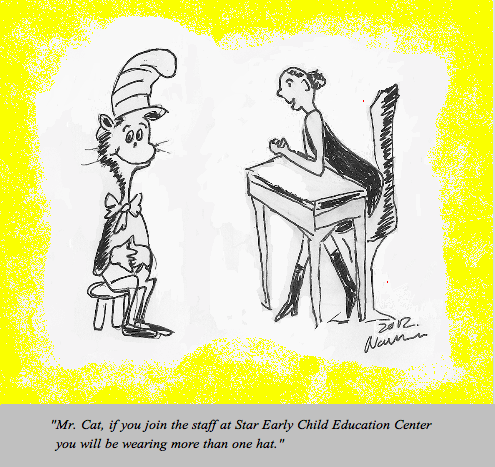
Early childhood educators wear many hats. Not only do they teach, but also they are often called on to give medical attention to their students. Last week we shared with early childhood teachers at the Delaware Valley Association for the Education of Young Children’s 2012 Early Childhood Conference the signs a child is in respiratory trouble. Although we focused on asthma, these signs of respiratory difficulty may be present in a variety of illnesses such as pneumonia.
- Breathing faster than normal
- Your child’s nostrils flare with each breath in an effort to extract more oxygen from the air
- Your child’s chest or her belly move dramatically while breathing—lift up her shirt to appreciate this
- Your child’s ribs stick out with every breath she takes because she is using extra muscles to help her breathe—again, lift up her shirt to appreciate this. We call these movements retractions
- Grunting sound (a slight pause followed by a forced grunt/whimper) or a wheeze sound at the end of each exhalation
- A baby may refuse to breast feed or bottle feed because the effort required to breathe inhibits her ability to eat
- An older child might experience difficulty talking
- Your child may appear anxious as she becomes “air hungry” or alternatively she might seem very tired, exhausted from the effort to breathe.
- Your child is pale or blue at the lips
In this video, the child uses extra chest muscles in order to breath. He tries so hard to pull air into his lungs that his ribs stick out with each inhalation.
For those with sensitive asthma lungs, review our earlier asthma posts. Understanding Asthma Part I explains asthma and lists common symptoms of asthma and Understanding Asthma Part II tells how to treat asthma, summarizes commonly used asthma medicine, and offers environmental changes to help control asthma symptoms.
Julie Kardos, MD and Naline Lai, MD
©2012, links updated 2015, Two Peds in a Pod®
My youngest child clambered off the bus Friday afternoon with a fixed grin across his face.
“What are you doing here?” he asked curiously. Usually, I am not home in time to greet the afternoon bus.
“I came to walk you home from the bus stop and then go for a run,” I said beaming, and kissed him on the forehead.
As my son stiffly kissed me back, the strange fixed grin remained on his face. Then I noticed his hands were behind his back. With a sly glance, I saw he clutched a crinkled brown paper bag. I smiled. Hidden crumpled paper bags close to Mother’s Day mean only one thing — a “surprise” gift.
“Don’t you want to go running now?” my son asked as we walked up our driveway, carefully rotating his body so that he continued to face me.
“Yes, good idea” I said, and resisted the temptation to look back.
As I jogged through the neighborhood, I mused over the upcoming holiday and what it meant to be a “happy” mother on mother’s day. Last week I had gained some insights after participating on a panel at Brown University’s Women’s Leadership Conference. The topic of the discussion was “Happy Kids/Happy Parents: What’s the Secret Sauce?” The talk was lively, and since it was a women’s conference, discussion focused on motherhood. Ultimately the conclusion made by moderator Clare Hare was “There is not one right way to parent,” but, perhaps, some good guidelines. Here are some ideas to think about:
On the dilemma of working outside the house vs. working full time as a mom at home: As a mom it is easy to give, give, and give so much of yourself to others that you can lose a little (or a lot) of your own self-identity. By maintaining a self-identity you become a more confident mother. Some women draw confidence from forging a career outside the home. Others draw from organizing local community-based activities. A mom ultimately needs to feel at the end of the day that she raised her own child, no matter how she does it. Stop comparing yourself to others and do what is right for your own family. In an economy where it is often not financially feasible for one partner to stay at home, working outside the home may be less of a choice and more of an obligation; however, the crucial point remains— if you are not the person you want your child to see, then become the person you want her to see.
On helicopter parenting: Worried that you are too much of a helicopter parent? Know where to draw the line. Use the “cry now or cry later” philosophy. If you know your child will be crying in 30 years when he is obese and diabetic because you didn’t insist on a healthy diet with limited “junk”, stand your ground and let him cry now and you refuse him a second helping of cake. If you know your child will NOT be crying in 30 years because you didn’t insist that he continue piano lessons, let it go.
On keeping you and your child sane during the college admission process: Yes, statistically it’s tougher than ever to get into colleges- this is a matter of demographics. There are more college-bound seniors because of population growth, and hence more applicants per spot. But the pressure for students to overextend themselves in multiple activities is imposed by parents and the kids themselves, not by the admission offices. In the years preceding applying to college, encourage your child to concentrate on excelling in specific areas—think quality not quantity. Do what comes from the heart. When your child seems overwhelmed, as Dr. Kardos and I always say, insure basic needs are met — eat, sleep, drink, pee and poop. And don’t forget to leave time for play and relaxation.
On ignoring hype: Be willing to change your opinion in light of data. Use evidence, not hype, to drive your actions. Despite data showing teens naturally awaken later in the morning than younger children, one audience member recounted how she still encountered many difficulties when she advocated for later high school start times in her school district.
All thoughts to nosh on.
You never realize the soaring magnitude of your own mother’s love until you meet your child. No matter your approach to raising children, we wish you “happy” as you remember how you felt when you were the child who brought home a brown crinkled paper bag to surprise your own mom. And again “happy” as you feel gratitude and awe for the privilege of now receiving the surprise.
Dr. Kardos and I wish you a Happy Mother’s Day.
Naline Lai, MD
Special thanks to my fellow panelists: Clare Hare, Principle of Clare Hare Design; Jill Hereford Caskey, Director, Alumni College Advising Program, Office of Alumni Relations, Brown University; Judith Owens , Director of Sleep Medicine, Children’s National Medical Center; Peg Tyre, Director of National Advocacy, Edwin Gould Foundation, author of The Trouble With Boys and The Good School.
© 2012 Two Peds in a Pod®

Today we bring you more advice from the Atlantic Regional Osteopathic Convention 2012 Adolescent session, where Dr. Amanda Manning updated us about adolescent vaccines. As always, be sure to review with your child’s doctor any contraindications as well as reasons to vaccinate early with all of these immunizations.
Tdap : This vaccine, which prevents pertussus (whooping cough), tetanus and diphtheria, is given to 11- 12 year olds. But since the pertussis component of the Tdap vaccine was not recommended until six years ago, your teen may have received the formulation without pertussis protection (dT). If so, he should now get a dose which contains pertussis. Recent evidence shows teens and adults lose their immunity to whooping cough and can spread disease to vulnerable infants and young children.
The meningitis vaccine, or “quadrivalent meningoccal conjugate vaccine”: Pediatricians routinely give this vaccine to tweens. New recommendations add a booster dose at age sixteen years. If the first dose was not given until age sixteen, a booster dose is not needed. Read our earlier post for more information about this vaccine and the disease it prevents.
HPV vaccine: This vaccine protects against Human Papillomavirus (HPV), which causes cancer of the cervix, vagina, penis, and throat. HPV also causes genital warts. Most people who are infected pick up the virus unknowingly during their first two years of sexual activity. In fact, eighty percent of women by age 50 are infected with some form of HPV. Luckily, the majority of infected women do not develop illness. The Pap tests that women receive at their yearly gynecology visits screen for cervical cancer caused by this virus. Here are common questions parents ask about the HPV vaccine:
Yes, but for Gardasil only up through 26 years and for Cervarix through age 25. Cervarix is not approved for males. Last year, the FDA did not find there was enough of a decrease in disease to widen the age range for Gardasil after age 26.
FLU: The guidelines for the flu vaccine are the easiest to remember of all the vaccines. Give a dose of flu vaccine to every teen every year, before the start of flu season. In fact, EVERYONE should get flu vaccine every year, including adults. The mist-in-the-nose form is safe for anyone without asthma or other chronic health conditions, and now, safety data shows most everyone can receive the injectable form, even kids with egg allergy. Please see our earlier post for more information about the flu virus, the flu vaccine, and how to tell if your child has the flu.
Amanda Manning, DO, FAAP, FACOP, is the site supervisor of the pediatric group at Geisinger Medical Group in Bloomsburg, Pennsylvania. She is a graduate of Duke University and The University of Medicine and Dentistry of the New Jersey School of Osteopathic Medicine, and completed her pediatric residency at the Geisenger Medical Center. Dr. Manning has been practicing general pediatrics for fifteen years.
Julie Kardos, MD and Naline Lai, MD
©2012 Two Peds in a Pod®
I have a confession to make. Two of my kids still have not had their blood cholesterol checked. You see, according to the National Heart, Lung and Blood Institute (NHLBI), kids with risk factors for heart disease (in my children’s case, a grandfather who had an early heart attack) should have their cholesterol level checked. But I’ll be getting my kids to the lab soon. New research shows that although heart attacks and strokes are rarely seen until adulthood, atherosclerosis (cholesterol plugs) in blood vessels, which is a precursor for heart disease, can be seen as early as during fetal growth. The concern is so great for heart health that guidelines were recently revised: EVERYONE, regardless of risk factors, should be screened twice during childhood.
For those WITHOUT risk factors, your child’s doctor can order NON-fasting total and high-density lipoprotein-HDL (aka “total cholesterol” and “good cholesterol”) levels for initial screening. Routine screening should occur sometime between 9-11 years and again between 17-21 years.
For kids WITH heart disease risk factors like mine, the American Academy of Pediatrics recommends a nine to twelve hour fasting “lipid panel.” Lipid panels usually measure low density lipoprotein (LDL) “bad cholesterol” and triglycerides in addition to total and HDL cholesterol. For kids with risk factors, screening should occur when the risks are discovered.
Pediatricians start asking for a family history of risk factors by three years old. Risk factors include: a parent, grandparent, aunt/uncle, or sibling with a heart attack or evidence of heart blood vessel damage less than 55 years in males or less than 65 years in females, or a parent with high cholesterol or triglycerides. Other risk factors for your child include having medical conditions such as diabetes, high blood pressure, obesity (Body Mass Index/BMI ≥95th percentile) and smoking cigarettes. Ask your child’s doctor for a full list of qualifying conditions.
The easiest way to time a “fasting” blood draw is to give your child dinner at his regular time, send him off to bed, and go to the lab first thing in the morning. Bring a snack with you so you can feed your child immediately after his blood is taken.
Because drinking water will not affect the lab results, have your child drink plenty of water before-hand and throw a sweater on him. The extra fluid will plump up the veins and the warmth from the sweater will dilate blood vessels, making it easier for the lab technician to draw blood.
Worried about calming down your kids’ nerves before a blood draw? Use techniques discussed in How to take the sting out of injectible vaccines.
For the full NHLBI report check out http://www.nhlbi.nih.gov/guidelines/cvd_ped/index.htm . For guideline analysis look at this link from the American Academy of Pediatrics.
Naline Lai, MD with Julie Kardos, MD
©2012 Two Peds in a Pod®