
Do you have a gassy newborn? Please read our tips on how to help your gassy baby in the Children’s Hospital of Philadelphia’s Health Tip of the Week.
Trust us, it’s a gas!
Julie Kardos, MD and Naline Lai, MD
© 2022 Two Peds in a Pod®

Do you have a gassy newborn? Please read our tips on how to help your gassy baby in the Children’s Hospital of Philadelphia’s Health Tip of the Week.
Trust us, it’s a gas!
Julie Kardos, MD and Naline Lai, MD
© 2022 Two Peds in a Pod®

A lot of life’s issues boil down to the essentials…eat, sleep, drink, pee, poop, love and learn… for your child and yourself. We are here to help you to carry out your parenting New Year’s resolutions in all of these areas.
1- Eat Resolve to help your picky eater become less picky. Become more patient and creative in helping your children eat new foods.
2- Sleep Resolve to fix your child’s sleep problems. Help create a reasonable bedtime routine for your baby and end night time wakenings, and help your tired teen get better sleep.
3- Drink This year resolve to wean your toddler from the bottle/breast to a cup.
3- Pee Resolve to help your child avoid urine accidents and gain a better understanding of bed-wetting.
4- Poop For parents of newborns: resolve to help your gassy baby. For parents of toddlers: resolve to end the battle of the potty and encourage your child to potty train in a peaceful, non punitive and non-controlling way. Help solve your child’s tendency to hold onto poop, which leads to constipation.
5- Love and Learn to understand your child’s developmental abilities in order to discipline appropriately and have reasonable expectations. Learn how and when to use “time out.”For your teen, learn how to talk with them. Help your child learn to “go it alone,” and calm test/school work anxiety.
As for us, we resolve to continue to be your source of dependable pediatric advice. We resolve to keep current with pediatric advances, remain honest, and treat your family with respect and care as we help you grow your children into confident, independent adults.
Wishing you health and peace in the New Year,
Drs. Kardos and Lai
©2018 Two Peds in a Pod®
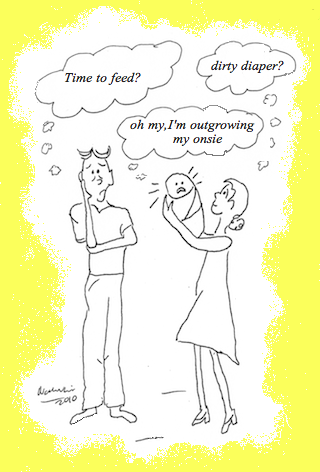 Why do babies cry? In short, newborns cry to communicate. Remember, newborns cannot talk. They can’t even smile back at you until around six weeks of age.
Ah, but what are they trying to tell us? Babies cry when they…
What if you’re certain that the temperature in the room is moderate, you recently changed his diaper, and he ate less than an hour ago?
If you feel anger and resentment toward your crying baby, just put him down, walk outside and count to ten. It is impossible to think rationally when you are angry and you may hurt your child in order to stop your frustration. Seek counseling if these feelings continue.
Now for the light at the end of the newborn parenting tunnel: the peak age when babies cry is six weeks old. At that point, infants can cry for up to THREE HOURS per day. Babies with colic cry MORE than three hours per day. (Can you believe people actually studied this? I am amused that Dr. Lai won a prize in medical school for a paper on the history of colic). By three months of age crying time drops dramatically.
While most crying babies are healthy babies and just need to find the perfect upside-down-hot-dog position, an inability to soothe your baby can be a sign that she is sick. Never hesitate to call your baby’s doctor if your baby is inconsolable, and don’t listen to the people who say, “Why do babies cry?…They just do.”
Julie Kardos, MD and Naline Lai, MD
©2015, 2010 Two Peds in a Pod®

