

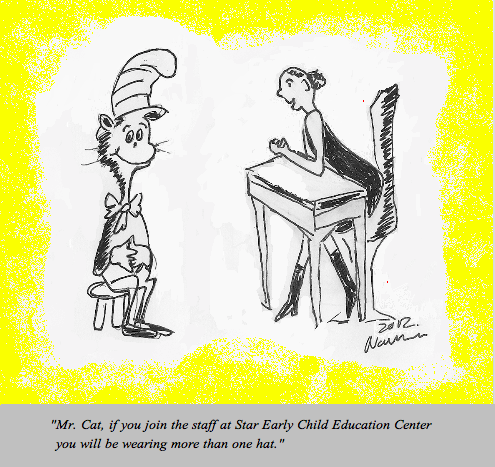
 Mid-west respiratory virus, RSV, The Flu! Lots of respiratory-distress-causing- germs. Although Enterovirus D68 is in the news these days, a slew of infections can hit the lungs hard. So even if you think your child has a simple cold, it’s important to recognize when your child is having difficulty breathing. Share this information with all of your child’s caretakers, including teachers. As this cartoon illustrates, many people wear medical hats. Too often we get a child in our office with labored breathing which started during school hours but was not recognized until parent pick up time.
Signs of difficulty breathing:
- Your child is breathing faster than normal.
- Your child’s nostrils flare with each breath in an effort to extract more oxygen from the air.
- Your child’s chest or her belly move dramatically while breathing—lift up her shirt to appreciate this.
- Your child’s ribs stick out with every breath she takes because she is using extra muscles to help her breathe—again, lift up her shirt to appreciate this. We call these movements “retractions.”
- You hear a grunting sound (a slight pause followed by a forced grunt/whimper) or a wheeze sound at the end of each exhalation.
- A baby may refuse to breast feed or bottle feed because the effort required to breathe inhibits her ability to eat.
- An older child might experience difficulty talking.
- Your child may appear anxious as she becomes “air hungry” or alternatively she might seem very tired, exhausted from the effort to breathe.
- Your child is pale or blue at the lips.
In this video, the child uses extra chest muscles in order to breath. He tries so hard to pull air into his lungs that his ribs stick out with each inhalation.
For those with sensitive asthma lungs, review our earlier asthma posts. Understanding Asthma Part I explains asthma and lists common symptoms of asthma and Understanding Asthma Part II tells how to treat asthma, summarizes commonly used asthma medicine, and offers environmental changes to help control asthma symptoms.
Julie Kardos, MD and Naline Lai, MD
©2014 Two Peds in a Pod®
updated from our previous 2012 post


 Wondering how to place limits on your kids’ screen time? We know that winter break often finds kids spending more time in front of screens: watching TV, playing video games, or surfing the internet. Today we post our suggestions to help limit screen time in your home.
 We love being pediatricians because it’s an honor to be a part of your family, it’s intellectually challenging, and it gives us a chance to teach. But mostly, we love to make people feel better.
 We are so proud: Two Peds in a Pod® turns four years old today and our colleague, pediatrician Dr. Robert Sasson, wrote a sweet poem for us to share with our readers. Thank you, Dr. Bob!
 We are proud to
 We are parents to three boys so needless to say, our house is always full of cuts, bruises or injuries of some sort. Band-Aids and “feel better” kisses are a regular part of our daily activity. And while my husband is a great “Doctor Dad” to all three boys, it is his every day involvement in my youngest son’s medical care that makes him a truly amazing father.
 Yesterday morning we were aghast to read medical misinformation in the print edition of our local newspaper. Aghast, because we were the pediatricians interviewed for the content of a summer time tips article.
 Two Peds in a Pod has reached over ONE MILLION visits!


