
Potty training: the advanced course

Even after potty training, some kids refuse to use the toilet at times
Just when you thought your child graduated from potty training …there’s more


Believe it or not, this post is for parents of kids who are already potty trained. Because sometimes even kids who are potty trained will refuse to use the toilet.

Changes and transitions, such as the start of a new school year, can trigger regression in kids who have been potty trained for years. Now that your children have been back to school for a few weeks take the quiz:

-Does your child come home from school and make a mad dash for the bathroom before he even gets his shoes off or asks you for a snack?

-Does your child stop eating and complain of belly pain after two bites of dinner?

-Does your child’s poop routinely clog your toilet?

-Is your child’s underwear sometimes damp?

-Have you noticed skid marks (small streaks or smears of poop) on your child’s underwear?

If you answer “yes” to ANY of these questions, then read on.

Advanced Potty Training

The main problem many kids encounter is that once school starts, they have a lot of new distractions and can’t be bothered to pee or poop. First, the morning routine might be more rushed. In school, the teacher is teaching. Your kid is interacting with other kids. The school’s bathroom is foreign, and may even have an auto-flush toilet: scary for the newly-trained. And unlike your newly potty-trained toddler who often finds it thrilling to try out every public restroom he sees, kids in school may feel more self-conscious, and not as adventurous, about visiting new bathrooms.

School bathrooms can be smelly, loud, and even places where kids bully each other. Some kids develop an aversion to using the school bathroom. These kids hold their pee and poop all day long until they get home, then run into the house and make a mad dash for the bathroom.

A child’s internal debate

For a kid who becomes overstimulated at school or who develops an aversion to the school bathroom, his bladder and brain have a conversation that goes like this:

Bladder: I am full.

Brain: Hold it, I don’t want to use the bathroom right now.

Bladder: But I REALLY have to pee.

Brain: Tough luck, Bladder, just wait till we get home.

Bladder: But I have no more room for pee!

Brain: Deal with it, Bladder!

So, the bladder has two choices:

1-Bladder overflows, at least enough to relieve a bit of pressure. This causes damp underwear. (For other reasons click here to review our post on damp underwear.)

OR

2-Bladder distends to accommodate more urine and confuses the nerves that supply sensation to the bladder. Kids lose the ability to tell if they have to urinate, which leads to full bladder-emptying accidents, and can lead to urinary tract infections.

A similar discussion can occur between your kid’s brain and his rectum:

Rectum: I am full of poop, Brain. Take us to the bathroom.

Brain: In school? Are you kidding? I am enjoying this game the class is playing/I am embarrassed to poop in school/I am afraid of the school bathroom. HOLD IT!

Rectum: OK, but you’re not going to like how this comes out in the end.

The rectum also has two choices: release just a bit of stool so it doesn’t feel so full and uncomfortable – these are skid marks. OR it will just hold onto the stool, making it larger and harder all the while, so it becomes painful and scary to pass and ultimately clogs the toilet.

This cycle leads to more problems – over time, the distended rectum develops decreased sensation (sound familiar?) and ultimately the child loses the ability to feel when he has to poop. Large poop masses in distended intestines can lead to pain while eating (the kid who eats two bites of dinner, then stops because of belly pain). Poop can leak out without your child knowing because he is unaware of the sensation of the chronically-ignored-full-rectum. In addition, a full rectum will also press on the bladder changing the way the brain is sensing whether or not to void.

How can we parents prevent these problems?

Remind your child to use the bathroom upon waking up in the morning and again before leaving the house for school. Even if he says he does not have to go, tell him to “Just check- sit for 2 minutes.”

Ask your child if he uses the bathroom in school. Preschool and early elementary school teachers often have scheduled bathroom breaks, but then it’s entirely up to your child to remember to use the bathroom. Encourage him to stop in the bathroom around lunch time in school.

Once home from school, remind your child to use the bathroom or “just check” if he hasn’t already done so.

If you leave the house again for an after-school activity, insist that he “just check” again to decrease your chances of having to use another “foreign” toilet.

Incorporate a potty check into your child’s bedtime routine, even if he went relatively recently. Ideally the healthy bladder empties four to six times a day and the healthy bowel easily passes a stool  at least once a day or every other day.

Because boys usually stand to urinate, remind them to sit at least once or twice a day, even if they don’t feel the urge to poop. As a mom of three boys, trust me: they often surprise themselves.

Even middle school and high school kids can have these problems. Suggest to your older child who, for whatever reason, avoids school bathrooms, that she can stop by the school nurse’s office to use the bathroom. She could also get up in the middle of class, if needed, and use the bathroom when it is most likely to be empty of other students, unlike during change-of-class time.

School cafeteria food and snacks provided at sports or other after school activities are not always healthy and can contribute to making stools too hard, so make sure to provide healthy choices at home with plenty of fruits and vegetables. Teach your kids to avoid too many cookies and other high fat foods – these are constipating foods. Encourage water-drinking. Caffeine-containing drinks (ice tea, soda) cause excess urine production and thus more stress on the bladder that your child might already be forcing to “hold it” for too long.

As for the children who frequently run to the bathroom in the daytime, but only pee a tiny bit, beware of something called urinary frequency syndrome.

Final exam

1-Does your child use the bathroom regularly, without stress or pain?

2-Can your child “go with the flow” in school as well as home, without any toilet clogging?

3-At the end of the day, is your child’s underwear without urine or skid marks?

If you can answer YES to all of the above, then you and your child have passed advanced potty training!

Julie Kardos, MD and Naline Lai, MD
© 2016 Two Peds in a Pod®

Share

Where the boys are: raising emotionally healthy sons

teen boy
photo by Lexi Logan, www.lexilogan.com

We welcome back guest blogger Dina Ricciardo LSW, ACSW who addresses how to support the emotional health of a boy — Drs. Kardos and Lai

Your son is crying.  A mad dash across the playground has led to a spectacular trip and fall, complete with a bloody knee and hands full of dirt.  Part of you wants to hold him on your lap and console him until he stops crying.  The other part of you wants to firmly wipe away his tears and tell him to be brave.  Which part of you is right?

In a world where there is a great deal of emphasis placed on the emotional health of girls, our boys are frequently overlooked.  While girls are typically encouraged to develop and express a broad range of emotions, boys are socialized from a young age to suppress their feelings. As a result, many boys and men struggle to express fear or sadness and are unable to ask for help.  It is time for us adults to stop perpetuating stereotypes and myths about manhood, and help each other raise emotionally healthy boys. Here are five ways for us to do so:

Make his living environment a safe space to express emotions. Give your son permission to express all of his feelings. Boys typically do not have the freedom to show the full range of their emotions in school and out in the world, so it is essential that they have that freedom at home.  Nothing should be off limits, as long as feelings are expressed in a manner that is not destructive.

Expose him to positive male role models. Boys need to be exposed to positive male figures who can to indoctrinate them into their culture and teach them how to be men. It is an important rite of passage in a boy’s development.  Take a look around your social ecosystem and ask yourself, “Who would be good for my son?”  Other parents, coaches, teachers, and pastors are examples of individuals who can play a positive role in his life.

Understand your unique role.  Each parent plays a unique role in the development of a son, and that role changes over time. A mother is a son’s first teacher about love and what it looks like, and this dynamic can breed a particular kind of closeness.  As a boy grows and begins to develop his sexuality, however, it is natural for him to pull away a bit from his mother and turn more towards his father for guidance. While this distance can be unsettling for mom, it marks a new phase in a son’s relationship with his father, who typically provides a sense of security and authority in a family as well as support for a boy’s developing identity. Mothers still play an important role, but that role may look different. As parents, it is important to re-evaluate what our sons need from us at each stage of their development.

Look at the world with a critical eye. Our culture not only glorifies violence, it equates vulnerability in males with weakness and attempts to crush it. That does not mean we have to accept this paradigm.  Talk honestly with your son about how and when to be gentle and compassionate, educate him on how the world view softness in men, and never tolerate anyone shaming him when he exhibits these traits. There is no shame in showing vulnerability, it is actually an act of courage.

Take a look in the mirror. Whether you are a mother or a father (or both), be honest with yourself: what are your beliefs about manhood? Do you feel safe expressing all of your feelings, or are some of them off-limits? If you are perpetuating negative stereotypes about men or are not comfortable with a full range of emotions, then your son will follow in your footsteps. Regardless of our own gender, we cannot expect our children to be comfortable with their feelings if we are not comfortable with our own.

There are times when insuring the emotional health of your son will feel like an uphill battle.  Keep the conversation open, and do not be afraid to talk with others about the dilemmas of boyhood and manhood.  And if you are looking for an answer to the playground dilemma, then I will tell you that both parts of you are right.  Sometimes our sons need loving compassion, and sometimes they need a firm nudge over the hump.  You know your child better than anyone else, so it is up to you to decide which approach to use and when.

Dina Ricciardi, LSW, ACSW

©2016 Two Peds in a Pod®

Dina Ricciardi is a psychotherapist in private practice treating children, adolescents, and adults in Doylestown, PA. She specializes in disordered eating and pediatric and adult anxiety, and is also trained in Sandtray Therapy. Ricciardi is a Licensed Social Worker and a member of the Academy of Certified Social Workers. She can be reached at dina@nourishcounseling.com.

Share

When your child says, “My belly hurts”

stomach-painThis week Two Peds joined Kelley on her blog Happy Health Kids as she talked about the dreaded phrase, “My belly hurts.”

 

If I crunched the numbers on how often my kids have uttered certain phrases, “my belly hurts,” ranks pretty darn high. So common is this refrain, and typically uneventful the outcome, that there’s a cry-wolf quality to it; I typically point my child towards the pantry or bathroom and go about my day. But sometimes, a stomachache persists, and then figuring out the cause can be like falling into a rabbit hole (and equally unpleasant)….click here to continue

Share

School: Motivate your child to embrace learning

photo by Lexi Logan
photo by Lexi Logan

“What will happen if your grade drops from an “A” to a “C”?” I sometimes ask during a check-up. 

Many kids shrug and say, “Try harder next time, I suppose.” Others look shocked and anxious about the possibility and are speechless. 

Still others will point at their parents and say,”THEY would kill me.” 

Observe a toddler learning a new skill. You will see him repeatedly try to fit a ball into a hole until he is either successful or wanders way. He is not anxious or afraid of failure. He is not “stressed” about trying to learn. Although all children start this way, too often toddlers become big kids who end up in my office discouraged and worried about school performance. Today’s guest writers, based on the work of Dr. Carol Dweck, discuss ways parents can influence their children so that they embrace learning. 

– Drs. Lai and Kardos


Researchers under the leadership of Dr. Carol Dweck conducted a survey of parents of school aged children. The majority of parents thought it was necessary to praise their children’s intelligence in order to give them confidence in their abilities and motivate them to succeed. Instead, this approach can lead to fixed mindsets in children. Kids with fixed mindsets believe “my abilities are what they are.”

Instead, the most motivated and resilient students demonstrate a growth mindset. They are the ones who believe their abilities can be developed through their effort and learning.  These students are resilient and persevere when tasks become challenging.

A study of students’ brain waves revealed students with a fixed mindset were interested in whether they got an answer right or wrong, but when they were wrong, they paid little attention to the correct answer. Students who were praised for their intelligence later lied about their scores. They felt the errors were so humiliating that they could not own up to them. The students failed to persevere, believing they were no longer “smart,” and therefore unable to meet academic challenges. 

Students with a fixed mindset typically think it is best if they:

  • Don’t make mistakes – “I’m too smart to make mistakes.”
  • Don’t need to work hard –”I’m smart and learning comes naturally to me.”
  • Don’t try to repair mistakes- “I was wrong, and that is the end of it.”

Students with a growth mindset generally:

  • Take on challenges
  • Work hard
  • Confront their deficiencies and correct them

How should parents talk to their children in order to develop a growth mindset?

  • Wow, you got 10 out of 10 right! What strategy did you use to get a perfect score?
  • What can you learn from this mistake that will help you do better next time?
  • I am proud of how hard you worked on this project and look at how your hard work paid off!
  • The strategies you used last time didn’t work. Let’s take a look at them so I can help you figure out better strategies to use next time.
  • You’re becoming such a good learner!
  • Smart is not something you are; it’s something you become. Let’s figure out how you can become smart at this assignment.

What is your child’s mindset?  Ask yourself, what is your own mindset?  Have a conversation with your child as you discuss your child’s report card.  Use any upcoming parent teacher conference to examine outlooks, attitudes, and strategies that are or are not supporting your child’s academic progress.

  • Where applicable, praise your child’s positive skills and attributes.  Celebrate instances you observed that contributed to positive indicators.
  • When necessary, examine areas of poor performance and strategize with your child about how he or she can turn a weakness into a strength.  Again, you may revisit situations you observed this past grading period in which your child took shortcuts, provided incomplete work products, or did not do his or her personal best.
  • Make your expectations very clear in terms of why you value attributes or traits of resiliency, and how they can and will develop into habits that will serve your child well.

Grades are a distant second to the level of effort a child invests in personal learning in any setting.

Leonard H. Schwartz and Michael R. Testani

Mr. Schwartz and Mr. Testani have been central to the Central Bucks School System in Pennsylvania. After fourty-three years as an educator in two school districts and five schools, Mr. Schwartz retired in 2012 . Most recently he served as the principal of Mill Creek Elementary School. Mr. Testani wrote this while he was the  Assistant Principal of the  Mill Creek Elementary School. Mr Testani now serves as the principal of Gayman Elementary School. This post was published in its full original form in the publication Principal’s Prose of Mill Creek Elementary School. 
©2012, rev 2016 Two Peds in a Pod®    
Share

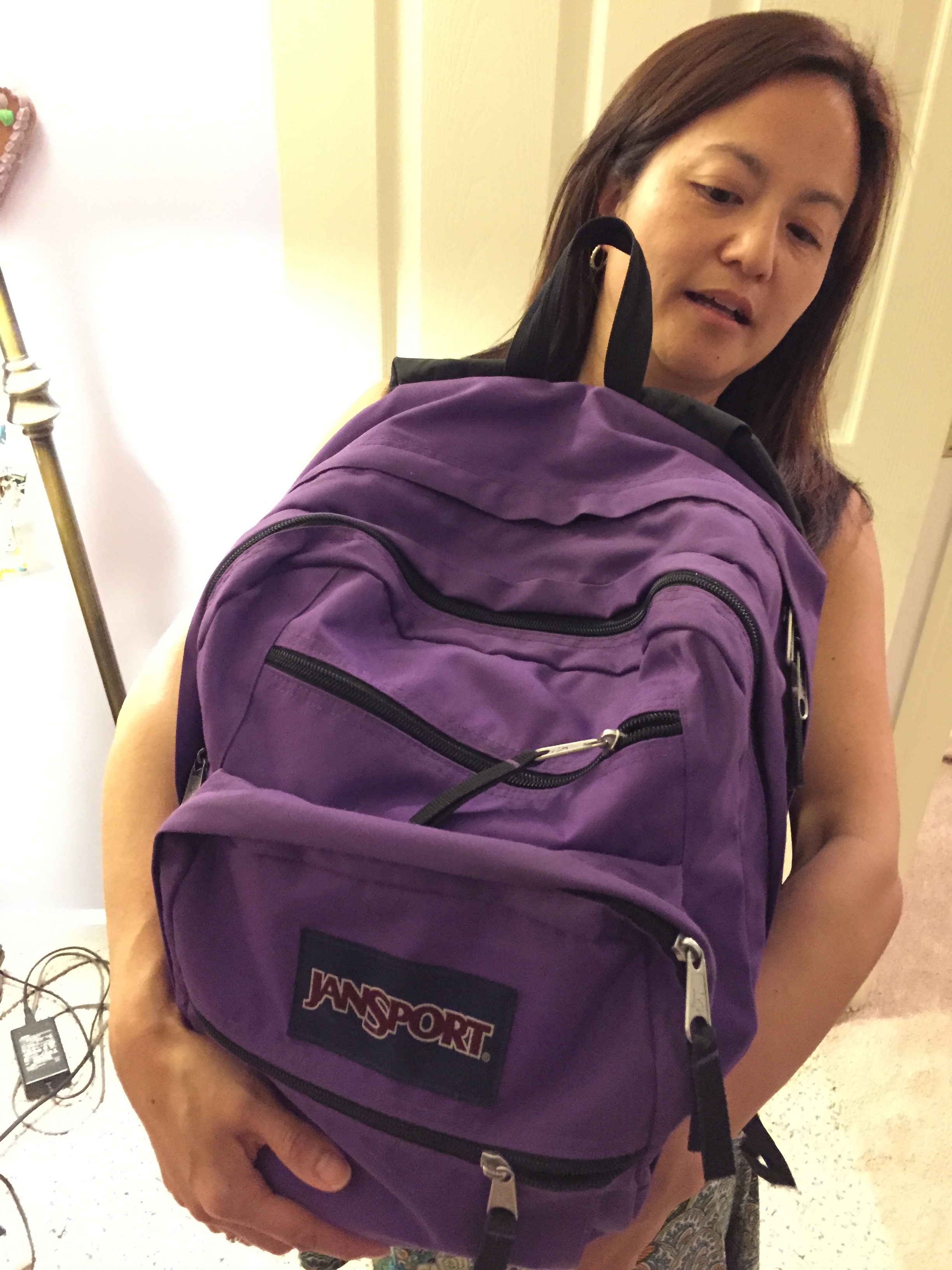
Staggering: How to tell if your child’s back pack is too heavy

Dr. Lai's kid's back pack is too heavy.
Dr. Lai staggers under the load of a back pack

Although we see in the news that  ebooks are replacing textbooks, our kids’ backpacks look heavier than ever. Returning is physical therapist Dr. Deborah Stack with backpack pointers. -Drs. Lai and Kardos

With the return to school, we wanted to remind you of some healthy backpack tips. I recall the first day of school one year when the “first day of school” photo showed my not-quite-100-pound child bending in half under the weight of a backpack, trombone, lunchbox and art portfolio. I quietly decreed that it would not happen again. To make sure it does not happen at your house either, consider a few suggestions to keep your children healthy:

  1. A traditional backpack with two shoulder straps distributes the weight more evenly than a pack or messenger bag with a single strap.
  2. Look for wide, padded straps. Narrow straps can dig in and limit circulation.
  3. Buckle the chest or waist strap to distribute weight more evenly.
  4. Look for a padded back to protect your child from pointy pencils etc.
  5. Look for a lightweight pack that does not add much overall weight.
  6. Multiple compartments can help distribute weight.
  7. Place heavier items close to the spine instead of in front pockets.
  8. Compression straps on the sides or bottom of the backpack can compress the contents of the backpack and stabilize the articles.
  9. Reflective material allows your child to be visible on those rainy mornings.
  10. A well fitting backpack should match the size of the child. Shoulder straps should fit comfortably on the shoulder and under the arms, so that the arms can move freely. The bottom of the pack should rest in the contour of the lower back. The pack should “sit” evenly in the middle of the back, not “sag down” toward the buttocks.

How much should that tike be toting? The American Academy of Pediatrics recommends no more than 10-20 percent of body weight and the American Physical Therapy Association recommends no more than 15 percent of a child’s weight. Here’s a chart to give you an idea of the absolute maximum a child should carry in a properly worn backpack:

Child’s Weight

(pounds)

Maximum Backpack Weight (based on 15% of body weight)

(pounds)

50 7.5
60 9
70 10.5
80 12
90 13.5
100 15
110 16.5
120 18
130 19.5

Here are some ideas to help lighten the load, especially for those middle school kids who have a plethora of textbooks:

  1. Find out of your child’s textbook can be accessed on the internet. Many schools are purchasing access so the students can log on rather than lug home.
  2. Consider buying an extra set of books for home. Used textbooks are available inexpensively online.
  3. Limit the “extras” in the backpack such as one free reading book instead of five. I am not exaggerating; one day I found five free reading books in my child’s backpack!
  4. Encourage your child to use free periods to actually study, and leave the extra books in his locker.
  5. Remind your child to stop by her locker between classes to switch books rather than carrying them all at once.
  6. Consider individual folders or pockets for each class rather than a bulky 3-ring notebook that holds every subject.

You may need to limit the load even further if your child is still:

  • Struggling to get the backpack on by herself
  • Complaining of back, neck or shoulder pain
  • Leaning forward to carry the backpack

If your child complains of back pain or numbness or weakness in the arms or legs, talk to your doctor or physical therapist.

When used correctly, backpacks are supported by some of the strongest muscles in the body: the back and abdominal muscles. These muscle groups work together to stabilize the trunk and hold the body in proper postural alignment. However, backpacks that are worn incorrectly or are too heavy can lead to neck, shoulder and back pain as well as postural problems. So choose wisely and lighten the load. Happy shopping!

Deborah Stack, PT, DPT, PCS
With over 20 years of experience as a physical therapist, Dr. Stack heads The Pediatric Therapy Center of Bucks County in Pennsylvania. She holds both masters and doctoral degrees in physical therapy from Thomas Jefferson University.

2010, 2015, 2016 Two Peds in a Pod®

Share

Pack healthy school lunches: beware of junk food disguised as healthy foods

pack healthy school lunches
Junk food in disguise

Need ideas on how to pack healthy school lunches? Beware of junk food masquerading as healthy food. Dr. Roxanne Sukol, an internist who writes the popular nutrition blog Your Health is on Your Plate , mom of three children, and friend of Dr. Kardos’s from medical school, shares her insights.

What should we pack in our children’s lunch bags?

The key to retraining our children to eat real food is to restore historical patterns of food consumption.  My great-grandparents didn’t eat potato chips, corn chips, sun chips, or moon chips.  They ate a slice of whole-grain rye bread with a generous smear of butter or cream cheese.  They didn’t eat fruit roll-ups.  They ate apricots, peaches, plums, and grapes.  Fresh or dried. Continue reading “Pack healthy school lunches: beware of junk food disguised as healthy foods”

Share

No more night owl! How to adjust your child’s sleep schedule for school

Great-horned owl, NPS Photo, Big Bend National Park

Okay, we admit it: our kids are definitely in summertime stay up late/sleep late sleep mode. With school starting soon, many of us now have to shift our children from summer to school year sleep schedules. Because school start times are constant (and early), the kids will have an easier time if you help them shift their bedtimes gradually over the period of a week or two toward the desired earlier bedtime. Remember, the average school-aged child needs 10-11 hours of sleep at night and even teenagers function optimally with  9-10 hours of slumber per night.

Here are some straight forward ways to help ensure good quality sleep for your child:

1)   Keep sleep onset and wake up times as consistent as possible 7 days a week. If you allow your child to “sleep in” during the weekends, she will have difficulty falling asleep earlier on Sunday night, have difficulty waking up Monday morning, and start off her week over-tired, more cranky, and less able to process new information—not good for learning. That said, you can allow your teens, who generally have a much earlier school start time than their biological clocks desire, to sleep in an hour or so on weekends to catch up on sleep.

2)     Limit or eliminate caffeine intake. Often teens who feel too sleepy from lack of sleep drink tea, coffee, “energy drinks” or other caffeine laden beverage in attempt to self-medicate in order to concentrate better. What many people don’t realize is that caffeine stays in your body for 24 hours so it is entirely possible that the caffeine ingested in the morning can be the reason your child can’t fall asleep later that night. Know also that kids who drink “pre-work out” drinks may not realize that caffeine is one of the ingredients. Better to pre-hydrate with water. Caffeine can have side effects of jitteriness, heart palpitations, increased blood pressure, and gastro-esophageal reflux (heartburn). If your child already has a daily ice-tea, coffee, or other caffeine containing drink, let her wean down gradually- abrupt caffeine withdrawal can cause headaches.

3)      Keep a good bedtime routine. Just as a soothing, predictable bedtime ritual can help babies and toddlers settle down for the night, so too can a bedtime routine help prepare older kids for sleep. Prevent your child from doing homework on his bed- better to associate work with a desk or the kitchen table and his bed with sleep.

4)     Avoid TV/computer/ screen time/smart phones just before bed. Although your child may claim the contrary, watching TV is known to delay sleep onset. We highly recommend no TV in a child’s bedroom, and suggest that parents confiscate all cell phones and electronic toys, which kids may otherwise hide and use without parent knowledge, by one hour prior to bedtime. Quiet activities such as taking a bath, reading for pleasure, and listening to music are all known to promote falling asleep. Just be sure your kids put down the book, turn off the music, and turn off the light to allow time to relax in their beds and fall asleep. Many use this time for prayer or meditation.

5)      Encourage regular exercise. Kids who exercise daily have an easier time falling asleep at night than kids who don’t exercise. Gym class counts. So does playing outside, dancing, walking, and taking a bike ride. Participating in a team sport with daily practices not only helps insure better sleep but also has the added benefit of promoting social interactions.

Getting enough sleep is important for your child’s academic success as well as for their mental health. We pediatricians have had parents ask about evaluating their children for attention-deficit hyperactivity disorder because of an inability to pay attention, only to find  that their youngster’s focusing issues stem from tiredness. Teens are often so over-involved in activities that they average 6 hours of sleep or less per night. Increasing the amount of sleep in these kids will alleviate their attention problems and resolve any hyperactivity.

Additionally, sleep deprivation can cause symptoms of depression. Just recall the first few weeks of having a newborn:  maybe you didn’t think you were depressed but didn’t you cry from sheer exhaustion at least once? A cranky kid or sullen teen may become much more upbeat and pleasant if they get an extra hour of sleep each night.

Unfortunately for children, the older they get, their natural circadian rhythm shifts them toward the “night owl” mode of staying up later and sleeping later, and yet the higher-up years in school start earlier so that teens in high school start school earliest at a time their bodies crave sleeping late. A few school districts in the country have experimented with starting high school later and grade school earlier and have met with good success. Unless you live in one of these districts, however, your teens need to conform until they either go to college and when they can  choose classes that start later in the day or choose a job that allows them to stay up later and sleep later in the day.

For kids of all ages, a night time ritual of “tell me about your day” can help kids decompress, help them fall asleep, and keep you connected with your child.

Julie Kardos, MD and Naline Lai, MD

©2016 Two Peds in a Pod®, updated from 2009

Share

Poison Ivy: Soothe the itch

Teach your child to recognize poison ivy: "leaves of three, let'em be!"
Teach your child to recognize poison ivy: “leaves of three, let’em be!”

Recently we’ve had a parade of itchy children troop through our office.  The culprit: poison ivy.

Myth buster: Fortunately, poison ivy is NOT contagious. You can catch poison ivy ONLY from the plant, not from another person.

Also, contrary to popular belief, you can not spread poison ivy on yourself through scratching.  However, where  the poison (oil) has touched  your skin, your skin can show a delayed reaction- sometimes up to two weeks later.  Different  areas of skin can react at different times, thus giving the illusion of a spreading rash.

Some home remedies for the itch :

  • Hopping into the shower and rinsing off within fifteen minutes of exposure can curtail the reaction.  Warning, a bath immediately after exposure may cause the oils to simply swirl around the bathtub and touch new places on your child.
  • Hydrocortisone 1%.  This is a mild topical steroid which decreases inflammation.  We suggest the ointment- more staying power and unlike the cream will not sting on open areas, use up to four times a day
  • Calamine lotion – a.k.a. the pink stuff. This is an active ingredient in many of the combination creams.  Apply as many times as you like.
  • Diphenhydramine (brand name Benadryl)- take orally up to every six hours. If this makes your child too sleepy, once a day Cetirizine (brand name Zyrtec) also has very good anti itch properties.
  • Oatmeal baths – Crush oatmeal, place in old hosiery, tie it off and float in the bathtub- this will prevent oat meal from clogging up your bath tub. Alternatively buy the commercial ones (e.g. Aveeno)
  • Do not use alcohol or bleach– these items will irritate the rash more than help

The biggest worry with poison ivy rashes is not the itch, but the chance of infection.  With each scratch, your child is possibly introducing  infection into an open wound.  Unfortunately, it is sometimes difficult to tell the difference between an allergic reaction to poison ivy and an infection.  Both are red, both can be warm, both can be swollen.  However, infections cause pain – if there is pain associated with a poison ivy rash, think infection.  Allergic reactions cause itchiness– if there is itchiness associated with a rash, think allergic reaction.  Because it usually takes time for an infection to “settle in,” an infection will not occur immediately after an exposure.  Infection usually occurs on the 2nd or 3rd day of scratching.  If you have any concerns take your child to her doctor.

Generally, any poison ivy rash which is in the area of the eye or genitals (difficult to apply topical remedies), appears infected, or is just plain making your child miserable needs medical attention.

When all else fails, comfort yourself with this statistic: up to 85% of people are allergic to poison ivy.  If misery loves company, your child certainly has company.

Naline Lai, MD and Julie Kardos, MD

©2016, 2015 Two Peds in a Pod®, updated from 2012

Share

Time out from summer for an important flu update

Time out from summer for a flu update

We interrupt your summer to bring you a Flu vaccine reminder and update.

Although flu (influenza) may be far from your minds, as we enter hot July, pediatricians are already ordering flu vaccines in preparation for Back to School. When the time comes, parents should add “schedule flu vaccine” to their back-to-school list as flu vaccines will arrive in offices as early as late August. Even immunizations given in August will last the entire winter season.

For fans of the nasal spray version of the flu vaccine—bad news. Turns out, data from the past 3 years shows the nasal spray is not nearly as effective as the injectable version. The American Academy of Pediatrics  and the American Center for Immunization Practices both recommend giving only the injectable version of flu prevention for protection against influenza.

Nonetheless, for the inconvenience of a pinch, the vaccine is still worthwhile. A total of 77 children died from flu in the US during the 2015-2016 flu season and many more children were hospitalized with flu related complications such as pneumonia and dehydration. Flu is highly contagious and spreads rapidly within households and schools, including daycare centers. People are contagious from flu one day prior to showing any symptoms of flu.

While most people who become sick with the flu survive, they will tell you it is a tough week. In addition to having a high fever that can last 5-7 days, a hacking cough, and runny nose, those stricken will tell you that every part of their bodies hurt. Even the movement of their eyes can hurt. In addition to the physical effects, our high school and college level patients are particularly distraught about the amount of schoolwork they miss while recovering from the flu.

An ounce of prevention is worth a pound of cure, which is why the flu vaccine is so terrific. There is no “cure” for the flu- you have to let your body fight it out. Unfortunately antiviral medications such as oseltamivir at best shorten the duration of flu symptoms by about one day. Flu vaccines work by jump starting your body’s natural immune system to produce disease fighting cells called antibodies. Vaccines are given yearly because flu virus strains  often morph between flu seasons.

For more Two Peds In a Pod posts about flu and about vaccines in general: How to tell the difference between the common cold and the flu, Fact or Fiction: a flu vaccine quiz, Getting back to basics: how vaccines work.

OK, now back to your summer fun!

Julie Kardos, MD and Naline Lai, MD

©2016 Two Peds in a Pod®

Share

Bring on the heat: Hot Tub Folliculitis

Note that the hot tub folliculitis rash is worse under the area of the swimming suit at the top of the thigh.


From the start, a family I know was suspicious of the hot tub sanitation at the resort where they recently stayed. As time went by, even though the water looked clear, the hot tub seemed less chlorinated, and the water more tepid. They dubbed the tub “the scuz tub.” After their return, one of the kids broke out in the rash of hot tub folliculitis pictured above. You could say, they figured out just what the “scuz wuz”. 

 Hot tub folliculitis is a skin rash caused by a bacteria called pseudomonas aeruginosa. The rash appears a day or two after soaking in a hot tub. A light pink bump appears around hair follicles (hence the name). As you can see in this photo, the rash is typically worse on areas of skin where bacteria was trapped under a swimming suit. The rash can cover all body surfaces, including the face, if your child dunked his head under water.
 
The rash can be slightly itchy but is not usually painful. No other symptoms develop such as fever or sore throat. The rash is not contagious, but often other people who swam in the same hot tub also break out.
 
Treatment is to wait it out. Typically by one to two weeks, provided your child does not go back into the hot tub, the rash resolves on its own. If your child feels very itchy, you can treat her with oral diphenhydramine (brand name Benedryl). Rarely, just like mosquito bites, the rash can become infected with other bacteria if your child scratches too much.
 
Pseudomonas thrives in warm wet places. In fact, it’s the same bacteria that causes “swimmer’s ear.” Tight control of chlorine and acid content of the hot tub water limit the growth of the bacteria. Unfortunately, you cannot tell the pseudomonas content of water just by eyeing it.
 
May you bring back a better souvenir than this family did on your next vacation.
Julie Kardos, MD and Naline Lai, MD

©2012, 2016 Two Peds in a Pod®

Share
image_pdfimage_print