 A favorite pediatrician party game is to guess the age of a child by observing his skills and body habitus. Most people are stumped when it comes to differentiating between preschoolers. Here’s a hint: while three-year-olds look a bit pot-bellied because of weak abdominal muscles, four-year-olds look lankier because their muscles are stronger.
Here are other ways to recognize and understand four-year-olds.
They start recognizing letters and numbers. Do NOT run out and buy flash cards! Teach them simple words that are useful in everyday life. For example, point out STOP or EXIT signs. Point out key words while you read to them. Teach them simple math: “I am giving you and your sister four stickers to share—how many would each of you get to make it fair?”
Their speech is more fluent and expressive than three-year-olds’, and if you listen to them play, you will hear elaborate make-believe stories and scenarios. Make sure you limit TV/screen time so your kids have a chance to “act out” their favorite story lines.
Watch out! Four-year-olds often try potty talk for the first time, especially at the dinner table. Try not to laugh or to shush them angrily, as it only encourages them. Better to ignore and change the subject. If you respond emotionally, you give their words much more power, and they will persist to see if you continue to give an “entertaining” reaction to their words.
They are better rule followers. At preschool they absorb the rules of the classroom. At home you can encourage them to follow house rules such as hand washing before meals, no shoes on the couch, food stays in the kitchen, etc. In the context of house rules, you can introduce “no potty talk at the dinner table.” Four-year-olds will tattle on siblings who fail to follow the rules. This same rule-following skill will now allow your child to play board games that are a bit more complex.
They are hero worshippers. Four-year-olds admire their parents, older siblings, teachers, and fictional heroes who are stronger, more powerful, and larger than themselves. Feed their egos by allowing them to beat you at games or races some of the time.
In their eyes, the world still revolves around them. If you need to occupy a four-year-old, tell her a story where she is the main character. If you feel that you are not up to the creative challenge, just tell her a known fairy tale but give your four-year-old the starring role. Tell the story of “Goldilocks” but rename it “Elizabeth and the Three Bears.”
They tell riddles and understand simple jokes. Amusingly, they tell the same joke over and over again, with peals of laughter. For those of you who remember, “Riddle cups” were very popular with four-year-olds.
Kids this age like rituals. Four-year-olds more actively participate in family prayers. They often latch onto a favorite shirt or dress and insist on wearing it every day of the week. Choose your battles over this, or just buy duplicate favorites so you have time to launder the favorite outfit.
Physically they are more coordinated. They can now hop on one foot, run, climb, skip, throw and catch balls much more accurately. Kids appreciate outdoor play and playgrounds for longer time periods at this age.
Most have given up naps by now: make sure bedtime is early enough so they are not too exhausted to enjoy your bedtime ritual and that they get enough sleep. Most four-year-olds are still “early birds” and wake up with the sunrise.
Enjoy your four-year-old; elementary school is just around the corner!
Julie Kardos, MD and Naline Lai, MD
©2013 Two Peds in a Pod®

 We had such a great response to our Two Peds in a Pod® visual diagnosis post that we are posting another summertime picture puzzle:


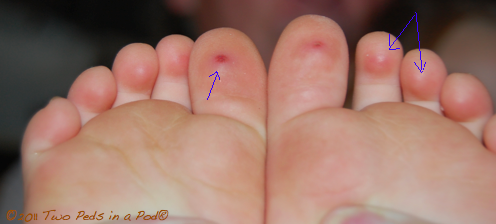
 We interrupt your summertime to present another Two Peds in a Pod® visual diagnosis learning session. Do you recognize this rash? Hint: it is mildly itchy and painful and can result from scratching bug bites or a skinned knee. Read on for the answer.
 We are so proud: Two Peds in a Pod® turns four years old today and our colleague, pediatrician Dr. Robert Sasson, wrote a sweet poem for us to share with our readers. Thank you, Dr. Bob!
 The green crosses in the photo signify that the building is a medical marijuana dispensing site. As the TMZ tour bus director pointed out the crosses when my family was recently on vacation in Hollywood, I saw all the kids on the bus crane their heads to look at the building. As I watched the kids, I was reminded that it is summer time and summer brings late night parties for teens. For parents, it brings late nights of worry. “I’d know if my kid was high or drunk,” you say to yourself. Or would you? Here are some signs you can use to tell:
 We are proud to
  Hot!
Hot! We are parents to three boys so needless to say, our house is always full of cuts, bruises or injuries of some sort. Band-Aids and “feel better” kisses are a regular part of our daily activity. And while my husband is a great “Doctor Dad” to all three boys, it is his every day involvement in my youngest son’s medical care that makes him a truly amazing father.
  Yesterday morning we were aghast to read medical misinformation in the print edition of our local newspaper. Aghast, because we were the pediatricians interviewed for the content of a summer time tips article.
  Two Peds in a Pod has reached over ONE MILLION visits!