Wondering how to burp a baby? We decided that words just didn’t convey what to do. So we introduce baby Emma in her first, and our first, how-to-video.
“I think we just hit the four month sleep regression. My baby used to sleep better, and now at four months, she is waking up every hour! What happened?”
Dr. Kardos’s fourth child wears her coat without fuss in cold weather.
Now that the weather has turned “freezy,” parents ask us how to dress their baby (and big kids) for cold weather. Even Dr. Kardos’s teenaged kids allow her to thrust winter coats on them as they head out to the bus stop. Wondering how to know if your baby, toddler, or older child are dressed correctly for the weather? Read our post on this topic.
Why get the flu shot? Vaccinate against influenza (the flu) not only to avoid missed school days, but also to avoid hospitalizations and death. Last year in the USA, 172 children died from flu. You may not have heard about these fatalities because more sensational news tends to overshadow news about illness. We wish the news would inform that the vast majority of kids who died from flu had not received the flu vaccine. In addition, about half of the children who died from the flu were previously healthy and without underlying medical problems. Excluding the 2009 flu pandemic (H1N1), last year’s flu deaths represents “the highest reported since influenza-associated pediatric mortality became a nationally notifiable condition in 2004.” Kids younger than 5 years old have the highest flu complication rate of all children, so even if they do not yet attend daycare or school, bring your little ones in for a flu vaccine. Vaccinate your school-aged kids as well, for they spread the flu to more folks than any other age group.
Just in time for families who plan to drive to Labor Day Weekend destinations, the American Academy of Pediatrics updated their car seat safety recommendations.
Families are now encouraged to keep their children rear facing for as long as possible, until they exceed the height or weight limit allowed by their car seat’s manufacturer. This means that some kids who are older than two years will continue to ride backwards. Dr. Lai’s own pip squeaks easily would have ridden backwards until they were three or four years old. Continue reading “Updated car seat safety guidelines!”
Now that you just read how to drop your kid off at school on the first day, you may be backpack shopping, pondering what to send your child for lunch, and knowing that your child will have difficulty waking up early for school. Never fear! Your Two Peds can help you and your kids get ready for school.
First, make sure your child’s backpack fits correctly and is not too heavy. Our guest blogger, a pediatric physical therapist, provides tips to help lighten the load.
Help your child get back on a school-friendly sleep schedule. If your child is still in summer vacation sleep mode, we provide ways to help get your child’s sleep back on track.
Need suggestions on how to motivate your child to want to learn? Two former school principals share their wisdom in this post.
Finally, you should know when to keep your child home for illness. This post also contains some surprising truths about when you can send your child back to school during as well as after certain maladies.
April is National Autism Awareness month in the United States. Early recognition improves outcome. This April we will post a series on the recognition of autism in a baby and in a toddler, as well as a personal story. — Drs. Kardos and Lai
Home videos of children diagnosed with autism reveal that even before their first birthdays, many autistic children demonstrate abnormal social development that went unrecognized.
When the Tin Man was a child in Oz, I’m sure his pediatrician never told his parents, “Has anyone ever said your child has a heart murmur? I hear one today.”
I know that when I tell parents about a heart murmur in their child, their hearts skip and jump. But not all heart murmurs are bad.
What is a heart murmur?
A heart murmur is an extra sound that we pediatricians hear when we listen to a child’s heart with a stethoscope. A normal heart beat sounds like this: “lub, dub. lub, dub. lub, dub.” A heart murmur adds a whooshing sound. So what we hear instead is “lub, whoosh, dub” or “lub, dub, whoosh.”
The “whoosh” is usually caused by blood flowing through a relatively narrow opening somewhere in or around the heart. Think of your blood vessels and heart like a garden hose. If you run the water (blood) very hard, or put a kink or cut a hole in the hose, the whoosh of the water grows louder in those locations.
Heart murmurs signal different issues at different ages.
In a newborn, some types of heart murmurs are expected. Normal newborn hearts contain extra holes that close up after the first hours or days of birth. One type of murmur occurs as the infant draws in his first breath and holes in the heart, present inside the womb, begin to seal. As the holes get narrower, we sometimes hear the “whoosh” of blood as it flows through the narrowing opening. Then these holes close completely and the murmur goes away.
However, some murmurs in infancy signal “extra holes” in the heart. As pediatricians, we experience our own heart palpitations when moms want to leave the hospital early with their infants who are less than 48 hours old. We worry because many infants who have abnormal hearts may not develop their abnormal heart murmurs and other signs of heart failure until the day or two after birth.
Preschool and early school-age children often develop “innocent” heart murmurs. “Innocent” implies that extra blood flows through their hearts, but the hearts are structurally normal. These murmurs are fairly common and can run in families. However, there are some significant heart problems which do not surface until this age. For this reason, remember to schedule those yearly well child checkups.
For teens, during the pre-participation sports physical, pediatricians listen carefully for a murmur that may indicate that an over grown heart muscle has developed.
What else can cause a heart murmur?
Holes are not the only culprit behind a murmur. The whoosh sound can also arise when a person is anemic and blood flows faster than normal. In anemic kids, the blood flows faster because it lacks enough oxygen-carrying red blood cells and the heart needs to move blood faster in order to supply oxygen to the body. The most common cause for anemia is a lack of eating enough iron-containing foods. Subsequently, we hear these flow murmurs in children whose diets lack iron, in teenagers who grow rapidly and quickly use up their iron stores, and in girls who bleed too much at each period. Replenishing the iron level makes a heart murmur from anemia go away.
Even a simple fever can cause a heart murmur on physical exam. The murmur goes away when the fever goes away.
Pediatric health care providers can often distinguish between “innocent” heart murmurs and not-so- innocent heart murmurs by the sound of the murmur itself (not all “whooshes” sound alike). If any question exists, your child will be referred for more testing, which could include a chest x-ray, an EKG (electrocardiogram), an ECHO (echocardiogram, or ultrasound of the heart), or evaluation by a pediatric cardiologist.
If your child’s pediatrician tells you that your child has a heart murmur, “take heart.”
Many times a murmur comes and goes or just becomes part of your child’s baseline physical exam. Even if your child has a serious heart problem, most cases respond well to medication, surgery, or both. While not all heart problems cause heart murmurs, and while not all murmurs signal heart problems, the presence of a heart murmur in a child can signal that your child needs further testing.
Unless, of course, your child is the Tin Man. In this case, extra sounds indicate that your child needs more oil!


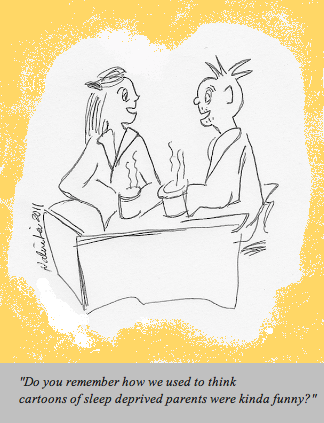 “I think we just hit the four month sleep regression. My baby used to sleep better, and now at four months, she is waking up every hour! What happened?”

 Now that you just read how to