
No more night owl! How to adjust your child’s sleep schedule for school

Great-horned owl, NPS Photo, Big Bend National Park

Okay, we admit it: our kids are definitely in summertime stay up late/sleep late sleep mode. With school starting soon, many of us now have to shift our children from summer to school year sleep schedules. Because school start times are constant (and early), the kids will have an easier time if you help them shift their bedtimes gradually over the period of a week or two toward the desired earlier bedtime. Remember, the average school-aged child needs 10-11 hours of sleep at night and even teenagers function optimally with  9-10 hours of slumber per night.

Here are some straight forward ways to help ensure good quality sleep for your child:

1)   Keep sleep onset and wake up times as consistent as possible 7 days a week. If you allow your child to “sleep in” during the weekends, she will have difficulty falling asleep earlier on Sunday night, have difficulty waking up Monday morning, and start off her week over-tired, more cranky, and less able to process new information—not good for learning. That said, you can allow your teens, who generally have a much earlier school start time than their biological clocks desire, to sleep in an hour or so on weekends to catch up on sleep.

2)     Limit or eliminate caffeine intake. Often teens who feel too sleepy from lack of sleep drink tea, coffee, “energy drinks” or other caffeine laden beverage in attempt to self-medicate in order to concentrate better. What many people don’t realize is that caffeine stays in your body for 24 hours so it is entirely possible that the caffeine ingested in the morning can be the reason your child can’t fall asleep later that night. Know also that kids who drink “pre-work out” drinks may not realize that caffeine is one of the ingredients. Better to pre-hydrate with water. Caffeine can have side effects of jitteriness, heart palpitations, increased blood pressure, and gastro-esophageal reflux (heartburn). If your child already has a daily ice-tea, coffee, or other caffeine containing drink, let her wean down gradually- abrupt caffeine withdrawal can cause headaches.

3)      Keep a good bedtime routine. Just as a soothing, predictable bedtime ritual can help babies and toddlers settle down for the night, so too can a bedtime routine help prepare older kids for sleep. Prevent your child from doing homework on his bed- better to associate work with a desk or the kitchen table and his bed with sleep.

4)     Avoid TV/computer/ screen time/smart phones just before bed. Although your child may claim the contrary, watching TV is known to delay sleep onset. We highly recommend no TV in a child’s bedroom, and suggest that parents confiscate all cell phones and electronic toys, which kids may otherwise hide and use without parent knowledge, by one hour prior to bedtime. Quiet activities such as taking a bath, reading for pleasure, and listening to music are all known to promote falling asleep. Just be sure your kids put down the book, turn off the music, and turn off the light to allow time to relax in their beds and fall asleep. Many use this time for prayer or meditation.

5)      Encourage regular exercise. Kids who exercise daily have an easier time falling asleep at night than kids who don’t exercise. Gym class counts. So does playing outside, dancing, walking, and taking a bike ride. Participating in a team sport with daily practices not only helps insure better sleep but also has the added benefit of promoting social interactions.

Getting enough sleep is important for your child’s academic success as well as for their mental health. We pediatricians have had parents ask about evaluating their children for attention-deficit hyperactivity disorder because of an inability to pay attention, only to find  that their youngster’s focusing issues stem from tiredness. Teens are often so over-involved in activities that they average 6 hours of sleep or less per night. Increasing the amount of sleep in these kids will alleviate their attention problems and resolve any hyperactivity.

Additionally, sleep deprivation can cause symptoms of depression. Just recall the first few weeks of having a newborn:  maybe you didn’t think you were depressed but didn’t you cry from sheer exhaustion at least once? A cranky kid or sullen teen may become much more upbeat and pleasant if they get an extra hour of sleep each night.

Unfortunately for children, the older they get, their natural circadian rhythm shifts them toward the “night owl” mode of staying up later and sleeping later, and yet the higher-up years in school start earlier so that teens in high school start school earliest at a time their bodies crave sleeping late. A few school districts in the country have experimented with starting high school later and grade school earlier and have met with good success. Unless you live in one of these districts, however, your teens need to conform until they either go to college and when they can  choose classes that start later in the day or choose a job that allows them to stay up later and sleep later in the day.

For kids of all ages, a night time ritual of “tell me about your day” can help kids decompress, help them fall asleep, and keep you connected with your child.

Julie Kardos, MD and Naline Lai, MD

©2016 Two Peds in a Pod®, updated from 2009

Share

Happy Birthday-Two Peds in a Pod Turns Seven! About seven-year-olds

seven year old development

We are so proud that Two Peds in a Pod® turned SEVEN this week!

It’s the golden age of seven— too old to take a nap and too young to drive. Some parental worry will now subside. Finally, you will  be able to clean your garage out on the weekend without wondering if your kid has stuck her head in a bag of mulch.

Seven Wonders of your Seven-year-old’s World

Entering first or second grade, a seven-year-old will often sport a toothless grin (and still believes in the tooth fairy) as she continues her march to independence and self care. Wondering what she is capable of? Now she is able to set an alarm, wake up for school, get dressed and brush teeth on her own. However, self care will not be as meticulous as the care you give, so be prepared to dot sunscreen on the large patch of skin that she missed.

Wondering if your child is too old for you to read to him at bedtime? We recommend you not only continue to read aloud to your child, but have your child read out loud to you. Read higher level, more interesting books to him (chapter books), which will inspire him to become a better reader. He is now transitioning from learning to read to reading to learn. In other words, he will start to gain information from reading. Bedtimes become busy, with electronics and extra curricular activities crowding up the family schedule, but persevere.

Wonder if your child can do his own homework? Improve your child’s self-esteem by allowing him do his own homework. Encourage success by setting up a quiet, clean place away from his younger siblings. At this age, homework is not supposed to take more than 10-20 minutes- if it does, alert the teacher. Let your child see natural consequences of not doing homework (teacher will have a repercussion, refrain from double punishing). Set up good expectations.

Wonder if you or your child is ready for sleepovers? Remember: kids do not sleep at sleepovers. If you will not sleep at night because a) your child is at a family’s home that you are not familiar with, b) your child is at your own home and you will be constantly interrupted by the thumping of feet running about, or c) you dread how crabby and whiny your child will be in the morning, don’t do it. Despite any accusations you may hear, you will not be the only parent in history to say “no” to a sleepover. Many times in the office when we see an ill child, the parent starts out the office visit with, “Well, she was at a sleepover and the next day she came down with a fever/sore throat/cough/etc.”

Wonder how your child conducts himself when he is away from you? A seven-year-old is fully capable of entertaining his own friend at your home and remembering “yes, please” and “no, thank you” in a friend’s home. Make sure your seven-year-old has memorized your phone number as well as his address.

When you get into a car with a seven-year-old, he not only can buckle himself up in the car (another wonder of the seven year old world and a huge improvement from having to kneel in the back seat straining your back as you buckled him up as a toddler) but also he will likely remind you to do the same. Seven-year-olds are rule followers. A strategy you can use at home to encourage desired behavior is to say “The rule in our house is that everyone cleans up his own mess,” rather than saying “Clean up your toys because I said so.” (Although he may ask, he still needs to be in a booster seat.)

Our 7th wonder of the seven year old world: when your seven-year-old recovers from a nasty stomach virus, it is possible that NO ONE ELSE in the family will catch it. A seven-year-old can use a basin, run to the toilet, wash his own hands, and change his own pajamas. You just have to supply the watered down gatorade (and comfort, as older sick kids still appreciate a parent’s cool hand and reassuring words) and remind him to keep drinking.

We are excited to have reached our 7th year writing practical pediatrics for parents on the go. That’s hundreds of posts on topics that you have suggested to us both in the office and online. Please continue to share our content- we wonder if we can reach 7 million families this year!

Thank you for your suggestions and comments over the years.

Sincerely, Julie Kardos, MD and Naline Lai, MD

©2016 Two Peds in a Pod®

Share

Poison Ivy: Soothe the itch

Teach your child to recognize poison ivy: "leaves of three, let'em be!"
Teach your child to recognize poison ivy: “leaves of three, let’em be!”

Recently we’ve had a parade of itchy children troop through our office.  The culprit: poison ivy.

Myth buster: Fortunately, poison ivy is NOT contagious. You can catch poison ivy ONLY from the plant, not from another person.

Also, contrary to popular belief, you can not spread poison ivy on yourself through scratching.  However, where  the poison (oil) has touched  your skin, your skin can show a delayed reaction- sometimes up to two weeks later.  Different  areas of skin can react at different times, thus giving the illusion of a spreading rash.

Some home remedies for the itch :

  • Hopping into the shower and rinsing off within fifteen minutes of exposure can curtail the reaction.  Warning, a bath immediately after exposure may cause the oils to simply swirl around the bathtub and touch new places on your child.
  • Hydrocortisone 1%.  This is a mild topical steroid which decreases inflammation.  We suggest the ointment- more staying power and unlike the cream will not sting on open areas, use up to four times a day
  • Calamine lotion – a.k.a. the pink stuff. This is an active ingredient in many of the combination creams.  Apply as many times as you like.
  • Diphenhydramine (brand name Benadryl)- take orally up to every six hours. If this makes your child too sleepy, once a day Cetirizine (brand name Zyrtec) also has very good anti itch properties.
  • Oatmeal baths – Crush oatmeal, place in old hosiery, tie it off and float in the bathtub- this will prevent oat meal from clogging up your bath tub. Alternatively buy the commercial ones (e.g. Aveeno)
  • Do not use alcohol or bleach– these items will irritate the rash more than help

The biggest worry with poison ivy rashes is not the itch, but the chance of infection.  With each scratch, your child is possibly introducing  infection into an open wound.  Unfortunately, it is sometimes difficult to tell the difference between an allergic reaction to poison ivy and an infection.  Both are red, both can be warm, both can be swollen.  However, infections cause pain – if there is pain associated with a poison ivy rash, think infection.  Allergic reactions cause itchiness– if there is itchiness associated with a rash, think allergic reaction.  Because it usually takes time for an infection to “settle in,” an infection will not occur immediately after an exposure.  Infection usually occurs on the 2nd or 3rd day of scratching.  If you have any concerns take your child to her doctor.

Generally, any poison ivy rash which is in the area of the eye or genitals (difficult to apply topical remedies), appears infected, or is just plain making your child miserable needs medical attention.

When all else fails, comfort yourself with this statistic: up to 85% of people are allergic to poison ivy.  If misery loves company, your child certainly has company.

Naline Lai, MD and Julie Kardos, MD

©2016, 2015 Two Peds in a Pod®, updated from 2012

Share

Time out from summer for an important flu update

Time out from summer for a flu update

We interrupt your summer to bring you a Flu vaccine reminder and update.

Although flu (influenza) may be far from your minds, as we enter hot July, pediatricians are already ordering flu vaccines in preparation for Back to School. When the time comes, parents should add “schedule flu vaccine” to their back-to-school list as flu vaccines will arrive in offices as early as late August. Even immunizations given in August will last the entire winter season.

For fans of the nasal spray version of the flu vaccine—bad news. Turns out, data from the past 3 years shows the nasal spray is not nearly as effective as the injectable version. The American Academy of Pediatrics  and the American Center for Immunization Practices both recommend giving only the injectable version of flu prevention for protection against influenza.

Nonetheless, for the inconvenience of a pinch, the vaccine is still worthwhile. A total of 77 children died from flu in the US during the 2015-2016 flu season and many more children were hospitalized with flu related complications such as pneumonia and dehydration. Flu is highly contagious and spreads rapidly within households and schools, including daycare centers. People are contagious from flu one day prior to showing any symptoms of flu.

While most people who become sick with the flu survive, they will tell you it is a tough week. In addition to having a high fever that can last 5-7 days, a hacking cough, and runny nose, those stricken will tell you that every part of their bodies hurt. Even the movement of their eyes can hurt. In addition to the physical effects, our high school and college level patients are particularly distraught about the amount of schoolwork they miss while recovering from the flu.

An ounce of prevention is worth a pound of cure, which is why the flu vaccine is so terrific. There is no “cure” for the flu- you have to let your body fight it out. Unfortunately antiviral medications such as oseltamivir at best shorten the duration of flu symptoms by about one day. Flu vaccines work by jump starting your body’s natural immune system to produce disease fighting cells called antibodies. Vaccines are given yearly because flu virus strains  often morph between flu seasons.

For more Two Peds In a Pod posts about flu and about vaccines in general: How to tell the difference between the common cold and the flu, Fact or Fiction: a flu vaccine quiz, Getting back to basics: how vaccines work.

OK, now back to your summer fun!

Julie Kardos, MD and Naline Lai, MD

©2016 Two Peds in a Pod®

Share

Bring on the heat: Hot Tub Folliculitis

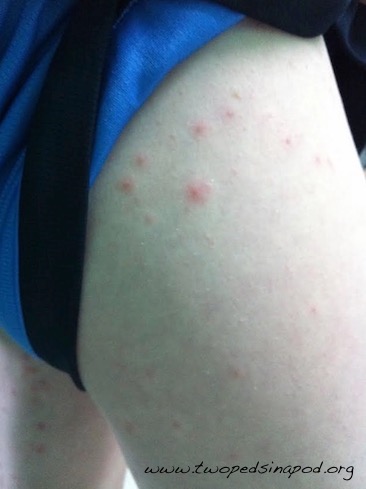
Note that the hot tub folliculitis rash is worse under the area of the swimming suit at the top of the thigh.


From the start, a family I know was suspicious of the hot tub sanitation at the resort where they recently stayed. As time went by, even though the water looked clear, the hot tub seemed less chlorinated, and the water more tepid. They dubbed the tub “the scuz tub.” After their return, one of the kids broke out in the rash of hot tub folliculitis pictured above. You could say, they figured out just what the “scuz wuz”. 

 Hot tub folliculitis is a skin rash caused by a bacteria called pseudomonas aeruginosa. The rash appears a day or two after soaking in a hot tub. A light pink bump appears around hair follicles (hence the name). As you can see in this photo, the rash is typically worse on areas of skin where bacteria was trapped under a swimming suit. The rash can cover all body surfaces, including the face, if your child dunked his head under water.
 
The rash can be slightly itchy but is not usually painful. No other symptoms develop such as fever or sore throat. The rash is not contagious, but often other people who swam in the same hot tub also break out.
 
Treatment is to wait it out. Typically by one to two weeks, provided your child does not go back into the hot tub, the rash resolves on its own. If your child feels very itchy, you can treat her with oral diphenhydramine (brand name Benedryl). Rarely, just like mosquito bites, the rash can become infected with other bacteria if your child scratches too much.
 
Pseudomonas thrives in warm wet places. In fact, it’s the same bacteria that causes “swimmer’s ear.” Tight control of chlorine and acid content of the hot tub water limit the growth of the bacteria. Unfortunately, you cannot tell the pseudomonas content of water just by eyeing it.
 
May you bring back a better souvenir than this family did on your next vacation.
Julie Kardos, MD and Naline Lai, MD

©2012, 2016 Two Peds in a Pod®

Share

Feeding picky eaters plus some recipes


Photo credit: Lexi Logan

Back by popular demand: our picky eater post, with bonus recipes at the end.

“You just don’t appreciate a picky eater until you have one.” –Overheard at Dr. Lai’s dinner table

Picky eaters come in two major varieties.

One kind is the child who eats the same foods every day and will not vary her diet. For example, breakfast is always the same cereal with milk and a banana, lunch is always peanut butter and jelly, and dinner is some form of chicken, rice, and peas. This diet is nutritionally complete (fruit, vegetable, protein, dairy, carbohydrate) but is boring to the parent.

The other kind of picky eater is the child who leaves out entire food groups, most commonly vegetables or meat, or leaves out meals, such as always eats breakfast but never eats dinner.

My twins, when younger, ranged from the One Who Tried Anything to the One Who Refused Everything! My oldest child lived on cheerios and peanut butter and jelly for about two years, but now he eats crab legs and bulgur wheat and sushi. My point: I feel your frustration, and I will give you advice that works as well as optimism and a new way of thinking about feeding your children.

Fortunately, from a medical point of view, toddler/children nutrition needs to be complete as you look over several days, not just one meal. For example, if every three days your child has eaten some fruit, vegetables, protein, dairy, and complex carbs, then nutritional needs are met and your child will thrive. Of course, if your child’s pediatrician has determined that your child is not growing appropriately, you may need to look “beyond the picky” into medical causes and treatments of poor growth.

Ways to outwit, outplay, and outlast picky eaters

  1. Never let them know you care about what they eat. If you struggle with your child at mealtimes, she will not eat and you will continue to feel bad about her not eating. Talk about the day, not about the food, at mealtime. You want your child to eat for the simple reason that she feels hungry, not to please you or anyone else, and not because she feels glad or mad or sad. Also, refrain from cooking a “special meal” for your toddler. Typically once a toddler catches on that you desperately want her to eat your cooking, she will refuse it.
  2. Do let them help you cook. Even young children can wash vegetables and fruit, arrange food on platters, mix, pour, and sprinkle ingredients. Older kids can practice reading aloud from recipes and can help measure. Kids are more apt to taste what they help create.
  3. Let them dip their food into salad dressing, apple sauce, ketchup, etc., which can make their food more appealing or interesting to eat.
  4. Hide more nutritious food in the foods they already like. For example, carefully mix vegetables into meatballs or meatloaf or into macaroni and cheese. Bright green smoothies hiding kale and other greens are very popular. See the recipes at the end of this post for Zucchini chocolate chip muffins and Magic Soup.
  5. Remember to offer foods that YOU do NOT like– your kids might like them! Here is an example: When my children were toddlers, we decorated Easter eggs at Dr. Lai’s house with her children. My kids asked if they could eat their decorated hard boiled eggs. Understand that hard boiled eggs is one food that I do NOT like. I don’t like their smell, their texture, and I really do not like the way they taste. Yet, all three of my kids, including my pickiest, loved those hard boiled eggs dipped in a little salt. Go figure. I had found an inexpensive, easy, healthy protein source to offer, even though I can’t stand the way my kitchen smells when I cook them.. but hey, if my kids actually EAT them…
  6. In the same vein, offer foods that you assume they will not like. Dr. Lai was shocked to find that her pickiest eater enjoyed hot and spicy food.
  7. Continue to offer foods even if your picky eater refuses them. Don’t force feed, just have them on the table. It could take 20 or 30 exposures before your kids might try them so do not despair. It took EIGHT YEARS of exposure to broccoli (one of my personal favorite vegetables) until two of my three kids decided they love it too. One still does not eat it. And that’s ok.
  8. Hunger is the best sauce. Refrain from offering junk food as snacks or as reward for eating “real” food. Pretzels, crackers, cookies, candy, cake, and chips have NO nutritional value yet fill up small bellies quickly. Your insightful child will HOLD OUT for the junk and refuse good nutrition if they know they can fill up on snacks later. Along the same line, avoid bribing food for food. Chances are, if you bribe eating vegetables with cookies, the focus for the rest of the meal will be on the cookies and a tantrum will follow. You and your child will have belly aches from stress rather than full bellies. While it is tempting to let your child gaze all day, this will simply fill your child up so that she does not feel hunger at a meal or snack. Beware, even water can suppress the appetite.
  9. If the goal is to have your children eat real food, then avoid “fake food.” Pouches with pureed fruit/veggie/cereal combos, fruit bars, fruit juice, protein shakes, and Puffs all may have nutrients but often have much sugar that grazes teeth and do not teach young taste buds the texture and flavors of healthier versions of actual fruits, vegetables, cereal, and protein sources such as meat.
  10. It is okay to repeat similar meals day after day as long as they are nutritious. We might like variety as grownups but many toddlers and young kids prefer sameness and predictability.
  11. Avoid becoming a “short order” chef. Picky eaters quickly take advantage of their power to make parents prepare multiple meals and likely end up not eating anyway. When your child says “I don’t want this! I want something else!” at breakfast, lunch, or dinner, you can answer calmly but firmly, “The meal is on the table.” It’s okay if they eat only one of the foods on the table. Next week she might try another. A different approach that some families use is to have one back-up meal that is the same every day for every meal and must be completely non-cook and nutritious. Examples are low sugar cereal and milk, peanut butter and jelly sandwich, yogurt with nuts or fruit mixed in, etc. that you agree to serve if your child does not want to eat what the rest of the family is eating.
  12. You can give your child a pediatric multivitamin. This tactic is not giving up or cheating. It can give the Parent as Provider of Nutrients peace of mind. You can give the multivitamin every day or just on the days that you are convinced that your child has eaten nothing.
  13. Read Green Eggs and Ham, by Dr. Seuss, to your young picky eater. It stars a picky eater who becomes convinced to “try them.” You may, however, need to learn to make green eggs!

Zucchini muffins ( or just call them “green muffins”)

3 cups flour, 1Tbs baking powder, 1 tsp salt, 1/2 tsp baking soda 1 1/2 tsp cinnamon,  1/2 tsp nutmeg

2 eggs, 1/2 cup low-fat milk, 1/2 cup canola or vegetable oil, 1 cup sugar, 2 cups shredded zucchini – approximately 2 medium zucchini- leave skins ON. OPTIONAL (but yummy): 1/2 cup mini chocolate chips

Preheat oven to 375F.

Stir together flour, baking powder, salt, baking soda, cinnamon, and nutmeg.

In separate bowl, beat eggs with electric mixer x 1 minute. Beat in milk, oil, and sugar. Stir in zucchini until well blended.

Add flour mixture to batter a bit at a time and stir to mix.

Mix in chocolate chips, if desired.

Spoon into greased muffin tins or place paper muffin liners, sprinkle tops of batter with a bit of sugar or “cinnamon sugar”

Bake 20 minutes, or until tops are golden brown and spring back when you touch them.


Magic Soup recipe

Take a large soup pot. Add raw chicken parts (breasts, thighs- bones add to the flavor) and cover with water.

Add onion, carrots, celery, cauliflower.

Flavor with salt, small amount of pepper, and any spice you like- I use tarragon but you can also use cilantro, parsley, curry powder, ginger.

Bring to boil, then cover and simmer for approximately 2 hours. toward the end, add some nappa (Chinese cabbage) or regular cabbage, cook until cabbage is wilted.

Serve to picky eaters: pull out the soft chicken pieces to pick up, pull out cooked vegetables – good finger food as well. Serve the broth in a cup. Most vitamins are water soluble, which means that even if your child only drinks the soup or if you pour the soup over something your child already likes such as noodles or rice, they are still getting all of the nutrition from your soup (hence, “magic soup”).

Julie Kardos, MD with Naline Lai, MD

©2016, 2013,2009 Two Peds in a Pod®


Share

Pleeeease- can we get a dog?

getting a petMany of our patients have dogs in their homes, and many families choose to adopt a dog during summer. Unfortunately, dog bite rates are also highest in summer, and occur most often in five to nine year olds, according to the Centers for Disease Control. Today we re-post tips on how to introduce a dog into a home with children and how to best avoid dog bites. We thank our expert consultant, veterinarian Sharin Skolnik, DVM.

–Julie Kardos, MD and Naline Lai, MD

Two Peds: Are some breeds of dogs better for children?

Dr. Skolnik: Breed recommendations are tough, because there are such different personalities within every breed. Breeds bred to protect will tend to guard their family, but may not be friendly with other kids. I have had to euthanize golden retrievers and labs for severe aggression, and know some truly stellar pit bulls. I would like every family bringing a dog into their home to think about how much time and energy they can devote to the following: exercise/walks/play dates/ mental stimulation, grooming, feeding, veterinary care, and arranging travel concerns/contingency plans.  If I had to pick a good family breed, I would suggest a Cavalier King Charles spaniel, but only if you forced me to pick one! Choosing the right dog for your family is the first big step, but do many people think about what comes with getting a new member of the family? 

Two Peds: Any suggestions for screening a dog before bringing it into the family?

Dr. Skolnik: Many rescue groups use experienced foster homes to get an idea of where a dog is at before placement, which is wonderful. Look for a puppy or dog that is not too hyper or timid, unless you have the time and energy to devote to modifying these behaviors. Inquisitive but not pushy is ideal. Having said that, dogs are incredibly trainable in the right hands. Use care when bathing, feeding, or taking things away from a newly adopted dog. Trust is a two-way deal, and positive and gentle first interactions will set the stage for the relationship.

Two Peds: Why are young kids prone to dog bites by the family dog?

Dr. Skolnik: Many factors: kids are usually very bad at reading dog body language. For that matter, many adults I meet think that a wagging tail indicates a friendly dog, when in fact it means the dog is willing to interact, positively or negatively. Kids are usually loud and move unpredictably and quickly. Never leave kids and dogs unsupervised, because the kids may not understand how to be gentle and respectful of the dog. It is important to set clear and consistent expectations for both kids and dogs on what counts as acceptable behavior.

Two Peds: What should parents teach their children about approaching a dog?

Dr. Skolnik: Teach them to always ask an owner’s permission with unknown dogs. Look for “soft” features like relaxed ears, floppy wagging tail, wiggling body. Tense body, rigid tail (wagging or not), backing up, dilated pupils– leave that dog alone. Supervision by responsible adults is key.

Two Peds: How can a dog be taught to “respect” a child?

Dr. Skolnik: The same way dogs learn to leave people’s houses and other pets alone. “Claim” items as yours, and not the dog’s, while meeting their needs. When I adopt a new dog: Guinea pigs/cats/shoes/etc. are mine. Every time the dog shows an interest in one of these things, he is told firmly “No.” The dog is given plenty of walks through the woods, praise for desired behaviors, some one-on-one time, and a few weeks later and we usually are on the same page. Consistency in training is key. The dog can’t be allowed to chase the cat when you are not home, so keep them separated! Set the dog up for praise, gently but firmly correct missteps, don’t overcorrect or correct after the fact. The latter only increase anxiety and the likelihood of future behavior problems

A common mistake in dog discipline is relying too much on punishment/ negative corrections and ignoring “good” behavior. For example; yelling at the dog for grabbing at the kids’ clothes, hands, whatever and ignoring the dog when it is chewing one of its own toys. Dogs are pack creatures; they rarely will play by themselves. Single-dog homes especially need to budget enough time each day to meet the dog’s mental and physical needs.

Two Peds: Should a dog that bites a kid be given a second chance? Can dogs be rehabilitated?

Dr. Skolnik: Depends on the scenario. A very forward dog with a history of unprovoked aggression towards kids is going to require a huge commitment to prevent injury and likely needs to go where there are no children, or humanely put to sleep. Most vets are pretty intolerant of dog aggression towards children. Now if an adult dog unfamiliar with kids snaps when a kid grabs an ear, or tries to take something away, or if the dog gave some warning that the kid should back off– I would blame the adults that put those two in the situation. Dogs (and people) can be rehabilitated, but there will always be the possibility of relapse. There are no guarantees with behavior modification.

Sharin Skolnik, DVM, holds a Bachelor’s degree from Cornell University School of Agriculture and Life Science and a veterinary degree from University of Pennsylvania School of Veterinary Medicine. She has been practicing veterinary medicine for over 20 years and is a member of the AVMA and the NJVMA. She currently works at Chesterfield Veterinary Clinic in Bordentown, New Jersey.

Her “children” include horses, dogs, cats, guinea pigs, hamsters, sheep, chickens, and rabbits. She is also a long time friend of Dr. Kardos’s. Their children play well together under close supervision.

© 2011, 2016 Two Peds in a Pod®

Share

Pretty earrings- but what you see in the back will surprise you

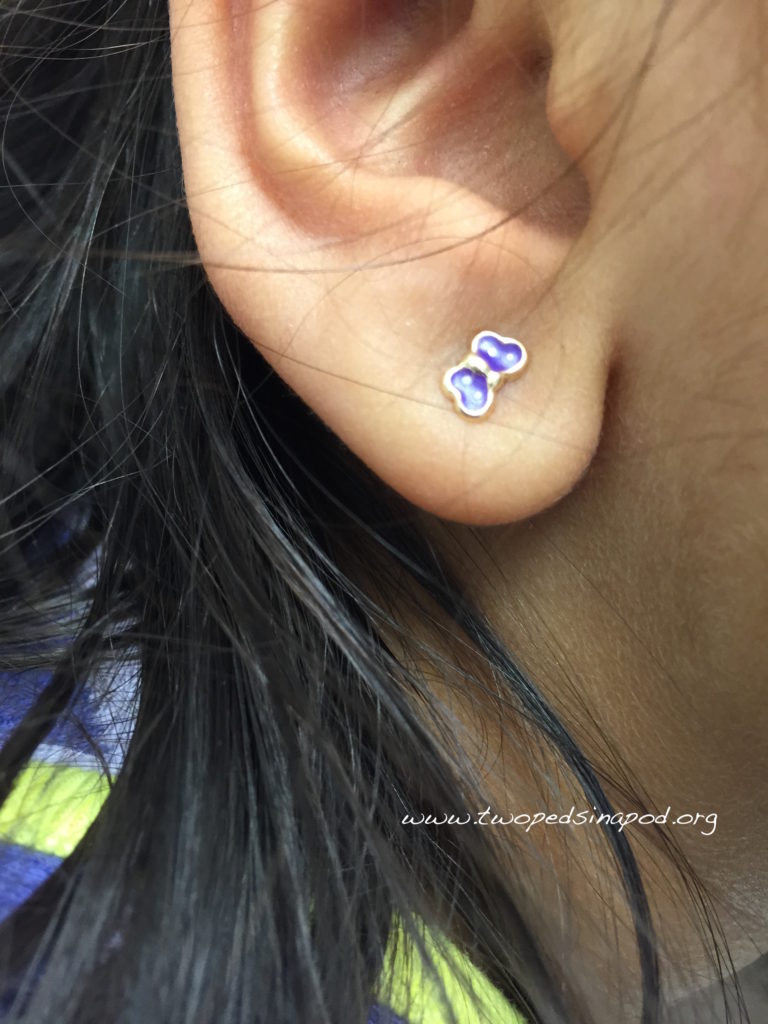
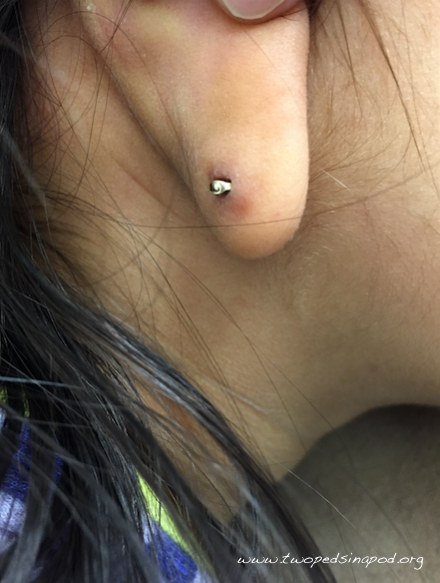
We see this a couple times a year… an earring which looks fine when viewed from the front…

earring


…is actually embedded when viewed from the back. When you flip up this child’s ear lobe, you will notice how the skin has nearly completely engulfed the earring back. Young children heal well and the skin in the back of an ear can grow over the back of an earring fairly easily. So, change earrings often and “watch their backs.” It’s not enough just to spin the earrings around from the front.

embedded earring back


Naline Lai, MD and Julie Kardos, MD

© 2016 Two Peds in a Pod®

Share

Mom “nose” best: Happy Mother’s Day 2016

elephant nose

This Mother’s Day, we honor Dr. Kardos’s mom, who passed earlier this year.

Dr. Kardos and I had been planning a post on nasal congestion in kids, but because we couldn’t have said it any better, we share a poem that Dr. Kardos’s mom wrote on this topic.

–Drs. Lai and Kardos


Runny Noses


My grandsons seem always to have runny noses;

They drip from their noses and land on their toeses;

One kid especially, his name is Aaron,

Will hug you so tight that what’s runnin’ you’re sharin’.


Alex will wipe with the back of his hand;

His runs in the house, on the beach, on the sand.

Jacob is older and he’ll use a tissue,

So his runny nose is not much of an issue.


In case they have colds, I hand each one a sweater,

But wearing a sweater does not make things better.

Allergic to dust? That’s the answer I’m seeking;

But while I keep dusting, their noses keep leaking.


They eat well and sleep well and play hard all day

In spite of their dripping that won’t go away.

So I’ve come to conclude, and I’m happy to say

That the noses of kids prob’ly just come that way.


by Felice Kardos (1943-2016)


Share

The best sunscreen: questions answered

sunburn
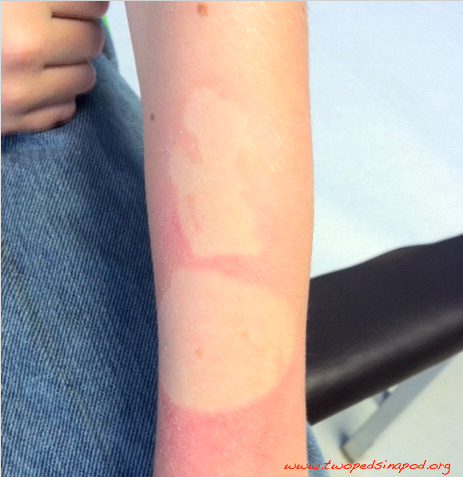
An inadvertent sunburn tattoo

I was greatly relieved recently when my teen arrived back from a music department trip to Disney without a sunburn. I had pictured a bright red cherry tomato coming off the plane. For those of us stuck in the middle of an East Coast perpetual rain cloud, it’s hard to believe that anyone outside of the South needs to worry about sunscreen. But soon enough, you will be scratching your head in a pharmacy aisle asking yourselves these questions:

What is SPF?

  • SPF stands for Sun Protection Factor. SPF gives you an idea of how long it may take you to burn. SPF of 15 means you will take 15 times longer to burn without sunscreen. If you would burn after one minute in the sun, that’s only 15 minutes of protection!
  • The American Academy of Pediatrics recommends applying a minimum of SPF 15 to children, while the American Academy of Dermatology recommends a minimum of SPF 30. We both apply sunscreen with SPF 30 to our own kids (mom hint: the high SPF sunscreens tend to be watery).
  • Apply all sunscreen liberally and often– at least every two hours. More important than the SPF is how often you reapply the sunscreen. All sunscreen will slide off of a sweaty, wet kid. Even if the label says “waterproof,” reapply after swimming.
  • Watch out for sunlight reflecting off water as well as sunburning on cool days. One pediatrician mom I know was aghast at seeing signs posted at her kid’s school reminding parents to apply sun screen “because it will be in the 80’s.” Kids burn on 60 degree days too. Lower temperatures do not necessarily mean less UV light.

Why does the bottle of sunscreen say to “ask the doctor” about applying sunscreen to babies under 6 months of age?

  • Sunscreens were not safety-tested in babies younger than 6 months of age, so the old advice was not to use sunscreen under this age. The latest American Academy of Pediatrics recommendation is that it is more prudent to avoid sunburn in this young age group than to worry about possible problems from sunscreen. While shade and clothing are the best defenses against sun damage, you can also use sunscreen on exposed body areas.
  • Clothing helps to block out sunlight. In general, tighter weaves protect better than loose weaves. Expensive “sun-protective clothing” is not always better— a study from 2014 suggests regular clothing may be as protective.
  • Hats help prevent burns as well.
  • Remember that babies burn more easily than older kids.

Which brand of sunscreen is best for babies and kids?

  • Although clothing and shade block harmful rays the best, no one brand of sunscreen is better for children than another. We both tell our patients to apply a “test patch” the size of a quarter to an arm or leg of your baby and wait a few hours. If no rash appears, then use the sunscreen on whatever body parts you can’t keep covered by clothing. Look for UVA and UVB protection. More expensive does not always mean “better” and SPF above 50, according to the American Academy of Dermatology, has not been proven to be more effective than 50.

What do we know about the ingredients in sunscreen such as oxybenzone? In the United States sunscreen ingredients are considered medications and are regulated by the FDA. Oxybenzone is one of the oldest broad-spectrum (UVA and UVB) sunscreens, and was approved by the FDA in 1978. Oxybenzone’s main side effect is that it can cause allergic reactions of the skin. Recently, some people question whether oxybenzone can be a hormone disrupter and have questioned the use of oxybenzone. At this point, no hormonal disturbances have been clearly found in humans and the American Academy of Dermatology continues to support the use of oxybenzone.

Sunscreens made with zinc oxide and titanium dioxide (the white stuff on a lifeguard’s nose) have not garnered any questions nor sparked any debate about safety. Interestingly, zinc oxide is not only an effective sunscreen but also you will recognize it as the main ingredient in many newborn diaper rash creams.

Any info about the popular sprays? For spray formulations of any type of sunscreen, many doctors are concerned that any aerosolized oily substance will irritate the lungs and are looking into long term effects now. Avoid spraying sun screen near a child’s head to avoid inhalation. Also with the spray, some dermatologists worry that people might not be as thorough when they apply a spray as when they apply a cream.

Can I use last year’s sunscreen? Most sunscreens have expiration dates, as long as your bottle hasn’t expired, then it should be effective. In general, sunscreens are designed to last about three years before they expire.

Remember when we used to call sunscreen lotion “suntan lotion,” and when tolerating red, blistering shoulders was considered a small price to pay for a tan? Live and learn.

Naline Lai, MD and Julie Kardos
Two Peds in a Pod® rev ©2016 , 2015

Share
image_pdfimage_print