Thankful for Foster Parents


thanksgiving 2016

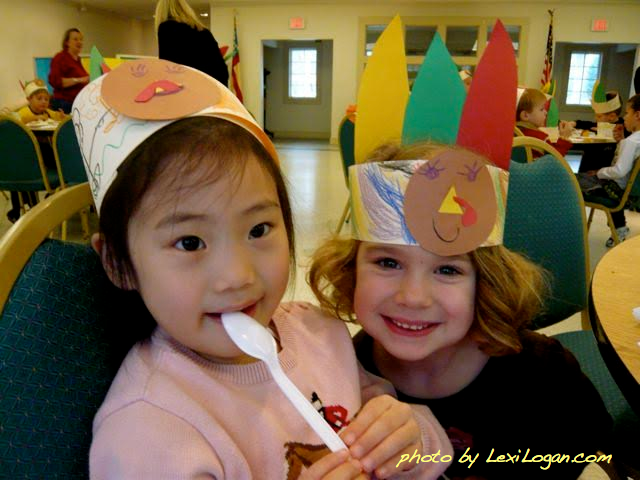
A foster mom brought a new child into the office the other day and I smiled picturing her with her last foster child. This thanksgiving, Two Peds in a Pod is grateful for the foster parents who open their homes for dinner today and everyday. Dr. Heather Forkey, Clinical Director of Foster Children Evaluation Service at UMass Children’s Medical Center, provides a post on becoming a foster parent. –Dr. Lai with Dr. Kardos

There are approximately 400,000 children in the US foster care system, with 225,000 entering each year. Most of these children spend time with foster families who open their homes and lives to kids that need a safe nurturing environment while their own parents take the time to address issues which put the child at risk. All types of people make great foster parents, but it is not for everyone. Foster parents must be able to meet the physical, emotional and developmental needs of a child or teen in partnership with community agencies, social workers, schools, and counselors.

If you are considering foster parenting, consider whether you can:

  • Provide 24-hour care and supervision on a daily basis
  • Be able to care for yourself financially without the child’s stipend
  • Be flexible, patient and understanding
  • Have a sense of humor
  • Recognize the impact of trauma
  • Have a home free of fire and safety hazards
  • Complete a criminal/protective services background check
  • Have the ability to work as a member of a team

If interested, you need to become licensed or approved by your state or county, and that process is different in each locality. One should start by doing an internet search for “becoming a foster parent in (your state or county)”. The child welfare agency for your state (Department of Children and Family Services or Department of Social Services) will also have information about how to start the process.

Children come to foster care often after adverse experiences which we know have health, emotional and developmental consequences. Foster parents who can look at the child’s health and behavior from a perspective of “what happened to the child” rather than “what is wrong with the child”, and observe a child’s behavior through the trauma lens (and help foster and child welfare personnel to do the same) allow the child in their care to view their health and emotions as normal adaptations to unhealthy situations, rather than evidence of illness. This allows the child to go forward with a better understanding of their experience, their own responses and, ultimately, foster health.

Heather C. Forkey, M.D.

Dr. Heather Forkey serves as the Clinical Director, Foster Children Evaluation Service (FaCES) and the Chief of the Child Protection Program at Mass Children’s Medical Center

2015 Two Peds in a Pod®


Share

Paris: explaining scary news to your children

talkingtochildrenIn light of recent tragic events in Paris, you may be left wondering if, and how, to explain this or other tragedies to your children.

Understand that kids sense your emotions even if you don’t tell them. Not telling them about an event may make them concerned that they are the cause for your worried hushed conversations. Break away from your discussion with adults to say, “ Do you know what we are talking about? We are not talking about you.”

Even though an event may be far away, media makes it seem as if it happened next door, and sooner or later your children will see or hear about it. Tell the facts in a straight forward, age appropriate manner. Answer questions and don’t be afraid to answer with an “I don’t know.” Preschoolers are concrete in their thinking—dragons are real and live under their bed, so don’t put any there that do not exist. For a preschooler a simple “Mom is sad because a lot of people got hurt,” will suffice. Young school age kids will want to know more details. And be prepared to grapple with more high level questions from teens.

Look for the helpers.  Mr. Rogers who hosted Mister Roger’s Neighborhood for 30 years, tells this story about seeing scary things on the news: “My mother would say to me, ‘Look for the helpers. You will always find people who are helping.’ To this day, especially in times of ‘disaster,’ I remember my mother’s words, and I am always comforted by realizing that there are still so many helpers-so many caring people in this world.”

If the kids ask,” Will that happen here?” or “Why did that happen?” Again, reassure in a simple straight forward manner. For instance you can say, “Many people are working hard to prevent something like that here.” Consider answering the question with a question. Asking “What do you think?” will give you an idea of exactly what your child fears. You can also reach out to other family supports for help with answers. Say to your child, ”I wonder what our minister or school counselor has to say about this, let’s ask.”

Routine is reassuring to children, so turn off the background 24 hour television and internet coverage and make dinner, take them to sports activities, and get the homework done.

Give your kids something tangible to do to be helpful. Help them set up a coin donation jar at school or put aside part of their allowance for a donation.

If your child seems overly anxious and fearful, and her worries are interfering with her ability to conduct her daily activities, such as performing at school, sleeping, eating, and maintaining strong relationships with family and friends, then seek professional help.

Parent your children so they feel secure in themselves and secure in the world around them. You may not hold the answers to why a tragedy strikes, but you do hold the ability to comfort and reassure your children.

For more advice on this topic, please see this American Academy of Pediatrics recommendation for parents.

Naline Lai, MD with Julie Kardos, MD
© 2015 Two Peds in a Pod®, adapted from our 2011 post

Share

Holiday gift ideas for children of all ages and stages

gift ideas by developmentFor those of you who plan ahead: It’s gift-giving season! We love pop culture, but if you are tired of GameStop gift cards or feeling a bit overwhelmed by  Frozen, Star Wars and Minecraft marketing, here’s another list of ideas arranged by ages and developmental stages.

0-3 months: Babies this age have perfect hearing and enjoy looking at faces and objects with contrasting colors. Music, mobiles, and bright posters are some age appropriate gift ideas. Infants self-soothe themselves through sucking- if you can figure out what your nephew’s favorite type of binkie is, wrap up a bunch-they are expensive and often mysteriously disappear.

3-6 months: Babies start to reach and grab at objects. They enjoy things big enough to hold onto and safe enough to put in their mouths- try bright colored teething rings and large plastic “keys.” New cloth and vinyl books will likewise be appreciated; gnawed books don’t make great hand-me-downs.

6-12 months: Around six months, babies begin to sit alone or sit propped. Intellectually, they begin to understand “cause and effect.” Good choices of gifts include toys with large buttons that make things happen with light pressure. Toys which make sounds, play music, or cause Elmo to pop up will be a hit. For a nine-month-old old just starting to pull herself up to a standing position, a water or sand table will provide hours of entertainment in the upcoming year. Right now you can bring winter inside if you fill the water table with a mound of snow. Buy some inexpensive measuring cups and later in the summer your toddler will enjoy standing outside splashing in the water.

12-18 months: This is the age kids learn to stand and walk. They enjoy things they can push while walking such as shopping carts or plastic lawn mowers. Include gifts which promote joint attention. Joint attention is the kind of attention a child shares with you during moments of mutual discovery. Joint attention starts at two months of age when you smile at your baby and your baby smiles back. Later, around 18 months, if you point at a dog in a book, she will look at the dog then look back at you and smile. Your child not only shows interest in the same object, but she acknowledges that you are both interested. Joint attention is thought to be important for social and emotional growth.

At 12 months your baby no longer needs to suck from a bottle or the breast for hydration. Although we don’t believe mastery of a  sippy cups is a necessary developmental milestone, Dr. Lai does admire the WOW cup because  your child can drink from it like she does from a regular cup. Alternatively, you can give fun, colored actual traditional plastic cups, which difficult to break and encourage drinking from a real cup.

18-24 months: Although kids this age cannot pedal yet, they enjoy riding on toys such as “big wheels” “Fred Flintstone” style. Dexterous enough to drink out of a cup and use a spoon and fork, toddlers can always use another place setting. Toddlers are also able to manipulate shape sorters and toys where they put a plastic ball into the top and the ball goes down a short maze/slide. They also love containers to collect things, dump out, then collect again.

Yes, older toddlers are also dexterous enough to swipe an ipad, but be aware, electronics can be a double edged sword— the same device which plays karaoke music for your daddy-toddler sing-along can be transformed into a substitute parent. The other day, a toddler was frighted of my stethoscope in the office. Instead of smiling and demonstrating to her toddler how a stethoscope does not hurt, the mother repeatedly tried to give her toddler her phone and told the child to watch a video. Fast forward a few years, and the mother will wonder why her kid fixates on her phone and does not look up at the family at the dinner table. Don’t train an addiction.

2-3 years: To encourage motor skills, offer tricycles, balls, bubbles, and boxes to crawl into and out of. Choose crayons over markers because crayons require a child to exert pressure and therefore develop hand strength. Dolls, cars, and sand boxes all foster imagination. Don’t forget those indestructible board books so kids can “read” to themselves. By now, the plastic squirting fish bath toys you bought your nephew when he was one are probably squirting out black specks of mold instead of water- get him a new set. Looking ahead, in the spring a three- year-old may start participating in team sports (although they often go the wrong way down the field) or in other classes such as dance or swimming lessons. Give your relatives the gift of a shin guards and soccer ball with a shirt. Offer to pay for swim lessons and package a gift certificate with a pair of goggles.  

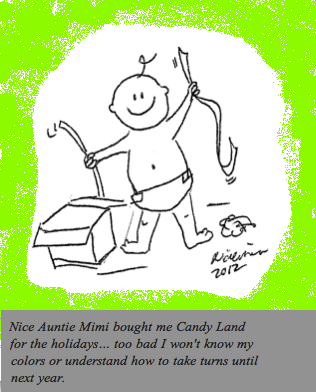
3-4 years: Now kids engage in elaborate imaginary play. They enjoy “dress up” clothes to create characters- super heroes, dancers, wizards, princesses, kings, queens, animals. Kids also enjoy props for their pretend play, such as plastic kitchen gadgets, magic wands, and building blocks. They become adept at pedaling tricycles or even riding small training-wheeled bikes. Other gift ideas include crayons, paint, markers, Play-doh®, or side-walk chalk. Children this age understand rules and turn-taking and can be taught simple card games such as “go fish,” “war,” and “matching.” Three-year-olds recognize colors but can’t read- so they can finally play the classic board game Candyland, and they can rote count in order to play the sequential numbers game Chutes and Ladders.  Preschool kids now understand and execute the process of washing their hands independently… one problem… they can’t reach the faucets on the sink. A personalized, sturdy step stool will be appreciated for years. 

5-year-olds: Since 5-year-olds can hop on one foot, games like Twister® will be fun. Kids this age start to understand time. In our world of digital clocks, get your nephew an analog clock with numbers and a minute hand… they are hard to come by. Five-year-olds also begin to understand charts— a calendar will also cause delight. They can also work jigsaw puzzles with somewhat large pieces.

8-year-olds: Kids at this point should be able to perform self help skills such as teeth brushing. Help them out with stocking stuffers such as toothbrushes with timers. They also start to understand the value of money (here is one way to teach kids about money). The kids will appreciate gifts such as a real wallet or piggy bank. Eight-year-olds engage in rough and tumble play and can play outdoor games with rules. Think balls, balls, balls- soccer balls, kickballs, baseballs, tennis balls, footballs. Basic sports equipment of any sort will be a hit. Label makers will also appeal to this age group since they start to have a greater sense of ownership.

10-year-olds: Fine motor skills are quite developed and intricate arts and crafts such as weaving kits can be manipulated. Give a “cake making set” (no, not the plastic oven with a light bulb) with tubes of frosting and cake mix to bake over the winter break. Kids at this age love doodling on the long rolls of paper on our exam table. Get your kid a few rolls of banner paper to duplicate the fun. Buy two plastic recorders, one for you and one for your child, to play duets. The instrument is simple enough for ten-year-olds or forty-year-olds to learn on their own. Ten-year-olds value organization in their world and want to be more independent. Therefore, a watch makes a good gift at this age. And don’t forget about books: reading skills are more advanced at this age. They can read chapter books or books about subjects of interest to them. In particular, kids at this age love a good joke or riddle book.

Tweens: Your child now has a longer attention span (30-40 minutes) so building projects such as K’nex models will be of interest to her. She can now also understand directions for performing magic tricks or making animal balloons. This is a time when group identity becomes more important. Sleepovers and scouting trips are common at this age so sleeping bags and camping tents make great gifts. Tweens value their privacy – consider a present of a journal with a lock or a doorbell for her room.

Teens: If you look at factors which build a teen into a resilient adult, you will see that adult involvement in a child’s life is important. http://www.search-institute.org/research/developmental-assets

We know parents who jokingly say they renamed their teens “Door 1” and “Door 2,” since they spend more time talking to their kids’ bedroom doors than their kids. Create opportunities for one-on-one interaction by giving gifts such as a day of shopping with her aunt, tickets to a show with her uncle, or two hours at the rock climbing gym with dad.

Encourage physical activity. Sports equipment is always pricey for a teen to purchase- give the fancy sports bag he’s been eying or give a gym membership. Cool techy trackers like Fitbit will always appreciated or treat your teen to moisture wicking work-out clothes.

Sleep! Who doesn’t need it, and teens often short change themselves on sleep and fall into poor sleep habits.  Help a teen enjoy a comfortable night of rest and buy  luxurious high thread count pillow cases, foam memory pillows, or even a new mattress. After all,  it been nearly 20 years since you bought your teen a  mattress and he probably wasn’t old enough at the time to tell you if he was comfortable. Since a teen often goes to bed later than you do, a remote light control will be appreciated by all.

Adolescence is the age of abstract thinking and self awareness— Google “wall decals” and find a plethora of inexpensive ways to jazz up his or her room with inspiring quotes.

Enjoy your holiday shopping.

Naline Lai, MD and Julie Kardos, MD
©2012, 2014, 2015 Two Peds in a Pod®

Share

Sinus infection or a cold?

sinus infection
Holes in your head – sinus infections

You have a hole in your head.

Actually, you have several.

You, your children, and everyone else.


These dratted air pockets in your skull can fill with pus and cause sinus infections. Scientists hypothesize they once helped us equilibrate in water while swimming. Now, sinuses seem only to cause headaches.


Sinuses are wedged in your cheek bones (maxillary sinuses), behind your nose (ethmoid sinuses) and in the bones over your forehead (frontal sinuses).  When your child has a cold or allergies, fluid can build up in the sinuses. Normally, the sinuses drain into the back of your nose.  If your child’s sinuses don’t drain because of unlucky anatomy, the sludge from her cold may become superinfected with bacteria and becomes too thick to move. Subsequently, pressure builds up in her sinuses and causes pain.  A sinus infection of the frontal sinuses manifests itself as pressure over the forehead.  The pain is exacerbated when she bends her head forward because the fluid sloshes around in the sinuses.  Since frontal sinuses do not fully develop until around ten years old, young children escape frontal sinus infections.
 
Another sign of infection is the increased urge to brush the top row of teeth because the roots of the teeth protrude near the  maxillary sinuses. Kids with sinusitis sometimes complain that their teeth hurt. Bad breath caused by bacterial infested post nasal drip can also be a sign. Occasionally kids with sinus infections develop swelling above or below the eyes, giving a puffy look to their faces.


The nasal discharge associated with bacterial sinus infections can be green/yellow and gooey.  However, nasal drainage from a cold virus is often green/yellow and gooey as well.  If your child has green boogies on the third or fourth day of a cold, does not have a fever, and is comfortable, have patience. The color should revert to clear. However, if the cold continues past ten days, studies have shown that a large percentage of the nasal secretions have developed into a bacterial sinus infection. To further confuse things for parents: a child can have a really yucky thick green/yellow runny nose and have “just a cold” or they can have clear secretions and have a sinus infection. In this case, the duration of symptoms is a clue to whether your child’s runny nose is from a cold or from a sinus infection.
 
Because toddlers in group childcare often have back-to-back colds, it may seem as if he constantly has a bacterial sinus infection. However, if there is a break in symptoms, even for one day, it is a sign that a cold has ended, and the new runny nose represents a new cold virus. Pediatric trivia: the average young child gets 8-10 colds per year, and colds last up to 10-14 days, sometimes even as long as three weeks. However, a cold seems better after 10 days even if some cough or mild nasal congestion lingers. Sinusitis is the cold that seems WORSE after ten days.


Hydrate your child well when she has a sinus infection. Your child’s body will use the liquid to dilute some of the goo and the thinner goo will be easier for her body to drain.  Since sinus infections are caused by bacteria, your pediatrician may recommend an antibiotic.  The usual duration of the medicine is ten days, but for chronic sinus infections, two to four weeks  may be necessary. Misnamed, “sinus washes” do not penetrate deep into the sinuses; however, they can give relief by mobilizing nasal secretions. When using a wash, ask the pharmacist for one with a low flow. Although the over the counter cold and sinus medicines claim to offer relief, they may have more side effects than good effects. Avoid using them in young children and infants. One safe and reliable way to soothe the nasal stuffiness of a sinus infection is to use simple saline nasal spray as often as needed.


Who knows. Someday we’ll discover a purpose to having gooey pockets in our skulls. In the meantime, you can tease your children about the holes in their heads.


Naline Lai, MD and Julie Kardos, MD
© 2010, updated 2015, Two Peds in a Pod®

Share

How to treat your vomiting child


oh no, my child is vomiting

“Mommy, I throwed up.”

Few words are more dreadful for parents to hear, especially at 2:00am (my children’s usual time to start with a stomach bug).
In my house, I am the parent who, after the vomiting, comforts, changes pajamas and sheets, washes hands and face, and sprays the disinfectant. My husband scrubs (and scrubs, and scrubs) the rug. Little kids never throw up neatly into a toilet or into the garbage can. Sometimes even big kids can’t seem to manage to throw up conveniently.

What should you do when you have a vomiting child?

After you finish cleaning your child and her immediate environment, I suggest that you CHANGE YOUR OWN CLOTHES AND WASH YOUR HANDS! The most common cause of vomiting in kids is a stomach virus, and there are so many strains, we do not develop immunity to all of them. And trust me, stomach viruses are extremely contagious and often spread through entire households in a matter of hours. Rotavirus, a particularly nasty strain of stomach virus, is preventable by vaccine, but only young babies can get the vaccine. The rest of us are left to fend for ourselves.

Stomach viruses usually cause several episodes of vomiting and conclude within 6-8 hours. Concurrently or very soon thereafter, the virus makes an exit out the other end in the form of diarrhea, which can last a week or so.

A hint to get through a long night: If your kid is too young to vomit into the nearest trash can, make a nice nest for her with many towels on the bathroom floor. For the older kids, put layers of towels on the pillow. 

The biggest problem children face when vomiting is dehydration.

Kids need to replace fluids lost from vomiting.  Pedialyte® or other oral rehydration solutions (ORS) such as Kaolectrolyte® or CeraLyte® are useful and well tolerated beverages for rehydrating kids. They contain salt, sugar, electrolytes and water, all substances that kids need when they throw up and have diarrhea. 

For babies however, try to “feed through” with breast milk or formula unless otherwise directed by your child’s doctor.

Most oral rehydration guidelines are based on diarrheal illnesses such as cholera, so you will find slight variations on how to rehydrate. Basically, they all say to offer small frequent amounts of liquid. I council parents to wait until no throwing up occurs for 45 minutes to an hour and then start offering very small amounts of an ORS (we’re talking spoonfuls rather than ounces) until it seems that the vomiting has subsided.

In her house, Dr. Lai uses the two vomit rule: her kids go back to bed after the first vomit  and she hopes it doesn’t occur again. If vomiting  occurs a second time, she starts to rehydrate. 

Continue to offer more fluids until your child urinates- this is a sign that her body is not dangerously dehydrated. Refusing to drink? Children of all ages do better with straws, and you’d be surprised how much you can get in with a medicine syringe (available at  pharmacies).  

Can’t immediately get out to the store?

The World Health Organization has recommended home based oral rehydration solutions for years in third world countries.  Also, while the oral rehydration solutions are ideal, any fluid is better than none for the first hours of a stomach bug. You can give older kids watered down clear juices, broth or flat ginger-ale with lots of ice.  Now, some kids hate the taste of Pedialyte®. Plain, unflavored Pedialyte® splashed with juice often goes down better than the flavored varieties. For some reason, plain water tends to increase nausea in sick kids and copious amounts of plain water can lower the salt in a child’s bloodstream. So, offer a fluid other than plain water while  your child is vomiting.

Even if your child drinks the Pedialyte®, once the stomach symptoms have subsided, don’t forget that  Pedialyte®, while excellent at “filling the tank,” has no nutrition. The gut needs nutrition to overcome illness. Start to offer small amounts of food at this point. Easy-to-digest foods include complex carbohydrates such as rice, noodles, toast with jelly, dry cereal, crackers, and pretzels.  Additionally, give protein such as bits of turkey or baked chicken or tofu.

Thicker fluids such as milk and orange juice do not sit as well in upset bellies, nor do large quantities of anything, food or drink. So offer small bits of nutrition fairly frequently and let kids eat as their appetite dictates. Warning- just when everything blows over, toddlers in particular may go a day without vomiting, then vomit one more time as a last hurrah.

Vomiting from stomach viruses typically does not cause severe pain.

A child curled up whimpering (or yelling) on the floor with belly pain might have something more serious such as appendicitis, kidney stones, or a urinary tract infection. Call your child’s doctor about your child’s vomiting if you see any of the following:

  • Blood in vomit or in stools
  • Severe pain accompanying vomiting (belly pain,  headache pain, back pain, etc.)
  • No urine in more than 6 hours from the time the vomiting started (dehydration)
  • Change in mental state of your child- not responding to you appropriately or  inconsolable
  • Vomit is yellow/green
  • More fluid is going out than going in
  • Illness not showing signs of letting up
  • Lips and mouth are dry or eyes sunken in
  • Your own gut tells you that something more is wrong with your child

Of course, when in doubt, call your child’s doctor .

Hope this post wasn’t too much to stomach!

Julie Kardos, MD and Naline Lai, MD
©2013, 2015 Two Peds in a Pod®

Share

Treat your child’s sore throat

sore throatMany times parents bring their children with sore throats to our office to “check if it’s strep.” Some are disappointed to find out that their child does NOT have strep. Moms and Dads lament, “But what can I do for him if he can’t have an antibiotic? At least strep is treatable.”

Take heart. Strep or no strep, there are many ways to soothe your child’s sore throat:

  • Give  pain medication such as acetaminophen (brand name Tylenol) or ibuprofen (brand names Advil or Motrin).  Do not withhold  pain medicine before you bring her in to see her pediatrician. Too many times we hear “We wanted you to see how much pain she is in.” No need for this! Pediatricians are all in favor of treating pain as quickly and effectively as possible. Pain medicine will not interfere with physical exam findings nor will it interfere with strep test results.
  • Give lots to drink. Some kids prefer very cold beverages, others like warm tea or milk. Avoid citrus juices since they sometimes sting sore throats.  Frozen Slurpies, on the other hand, feel great on sore throats. Tell your child that the first three sips of a drink may hurt, but then the liquid will start to soothe the throat. Watch for signs of dehydration including dry lips and mouth, no tears on crying, urination less than every 6 hours and  lethargy.
  • Provide soft foods if your child is hungry. For example, noodles feel better than a hamburger on a sore throat. And ice-cream or sherbet therapy is effective as well.
  • Try honey (if your child is older than one year) – one to two teaspoons three times a day. Not only can it soothe a sore throat but also it might quiet the cough that often accompanies a sore throat virus. Give it alone or mix it into milk or tea.
  • Kids older than three years who don‘t choke easily can suck on lozenges containing pectin or menthol for relief. Warning: kids sucking on lozenges may dupe themselves into thinking they are hydrating themselves. They still need to drink and stay hydrated.
  • Salt water gargles are an age-old remedy.  Mix 1 teaspoon of salt in 6 ounces of warm water and have your kid gargle three times a day.
  • Magic mouthwash: For those older than 2 years of age, mix 1/2 teaspoon of liquid diphenhydramine (brand name Benadryl 12.5mg/5ml) with 1/2 teaspoon of Maalox Advanced Regular Strength Liquid (ingredients: aluminum hydroxide, magnesium hydroxide 200 mg, and simethicone) and give a couple time a day to coat the back fo the throat prior to meals. Do not use the Maalox formulation which contains bismuth subsalicylate. Bismuth subsalicylate is an aspirin derivative and aspirin is linked to Reye’s syndrome.
  • For kids three years and older, try throat sprays containing phenol (brand name Baker’s P&S and Chloraseptic® Spray for Kids). Use as directed.


Strep throat does not cause cough, runny nose, ulcers in the throat, or laryngitis. If your child has these other symptoms in addition to her sore throat, you can be fairly sure that she does NOT have strep. For a better understanding of strep throat see our posts: “Strep throat Part 1: what is it, who gets it and why do we care about it” and “Strep throat Part 2: diagnosis, treatment, and when to worry.”

Any sore throat that prevents swallowing or prevents your child from opening his mouth fully, pain that is not alleviated with the above measures, fever of 101F or higher for more than 3-4 days, or a new rash all merit a prompt visit to your child’s doctor for further evaluation. Please see our prior post on how to tell if you need to call your child’s doctor for illness.


Julie Kardos, MD and Naline Lai, MD

©2012 Two Peds in a Pod®, reposted 2015

Share

Is my teen listening? Tips on talking to your teen

Take time to talk to your teen

My twins just got their driving learner’s permits (yikes!), and Dr. Lai’s son is a few months away from getting his. We know that we will have many talks with our sons about driving. But is my teen listening? Books and community lectures on the topic of “how to talk to teens” abound, and in the office we hear exasperated parents searching for ways to talk effectively to their teens and bemoan “She never listens to me, maybe she will listen to you.” In this post, we give you tips on talking to your teen.

Here’s the secret: while teens wear their “bored face” or may act as if they do not hear their parents, in fact they are listening. Below are suggestions on talking to your teen in ways your teen will find palatable.

1-Express your opinion as your opinion, such as “I believe…” or “Your dad and I feel…,” which implies to your teen that you understand that he or she may have a different opinion.

2-Remember that while teens do have opinions, they lack life experience. Use anecdotes: “I remember when I was in high school, a friend of mine found himself in this situation…” Anecdotes are less confrontational than directly warning your child about a situation that you are concerned he may be in.

3Join your teen when she watches TV. Comment on the characters or plot theme, and ask what your teen would do, or if she thinks that the show reflects reality. Criticize the character if you disagree with the way the character is reacting to a situation and allow your teen to hear your thought process. She will file your thoughts away for future consideration even if she disagrees with you at the time. Encourage dialogue from your teen.

4Say good-night to your teen in his room. Stay and visit a bit. Just like when they were young, teens often choose bedtime to bring up an event or dilemma from earlier in the day. (Hopefully they are getting to bed before you do.)

5-If your teen actually does choose to ask your advice, avoid jumping in immediately with a solution. Remember to pause and ask first how he thinks he could solve the problem or what he has already tried. Then you can encourage your teen’s ideas if you think they have merit and praise his insights, or you can offer your suggestions as further options.

6Attend your teen’s sporting events or concerts. Your child is the same one who at age four looked for you in the stands during the T-ball game. The event will give you both something to talk about later. Just refrain from yelling out anything embarrassing. Or anything at all!

7-Preface your rules with “So you are safe.” Teens stomach house rules better when they hear you are concerned about their safety rather than about being the boss. For example, “So I know you are safe, please call or text me if you are running late,” rather than “You will be punished if you break curfew.”

8Put down your phone when talking to your teen, and insist that he does the same. When you are using your phone, your teen feels ignored (think back to trying to talk on the phone when your teen was a toddler) and thus you encourage him to ignore you back.

9- Car trips are excellent times for talking to your teen, so volunteer to drive him rather than always relying on the other teen’s parent. Maybe it’s the lack of eye contact, but when you drive your teen somewhere, you are not otherwise distracted- your teen might be encouraged to talk to you in the car. Do not, however, invite possible heated conversation while YOUR TEEN is behind the wheel- especially when he is still learning to drive!

In addition to strengthening bonds with our kids, routine talking with our teens encourages them to talk to us when they need help, to consider our advice, and to learn from our own life experiences. In turn we impart communication skills and independence as teens learn to problem-solve and avoid life-altering mistakes. Talking with our teens encourages positive attention. Again, remember your teen as the toddler who might have thrown a toy or hit his brother to get your attention.

Dr. Lai’s friends joke that they renamed their children “Door 1” and “Door 2” when they became teenagers because the parents spent a lot of time talking to closed doors. But her friends kept talking, because they knew, even behind closed doors, teens do listen.

Julie Kardos, MD and Naline Lai, MD

©2019, updated from 2015, Two Peds in a Pod®

thanks to therapist Dina Ricciardi for her input

Share

Getting back to basics: How do vaccines work?

vaccine

Recent comments by politicians have brought vaccines back into the public eye. In this post, we get down to basics.

Did you ever wonder how a vaccine works?

To understand how vaccines work, I will give you a brief lesson on the immune system. Trust me, it is interesting. Let me give you an example of me. When I was eight, I had chicken pox. It was a miserable week. I started out with fever and headache, then suffered days of intense body itching from blister-like spots, and ultimately, because I scratched off some scabs, ended up with scars. During this time, my immune system cells worked to battle off the chicken pox virus. Immune cells called memory cells also formed. These cells have the unique job of remembering (hence the name “memory cells”) what the chicken pox virus looks like. Then, if ever in my life I was to contact chicken pox again, my memory cells could multiply and fight off the virus WITHOUT MY HAVING TO GET SICK AGAIN WITH CHICKEN POX. So after I recovered, I was able to play with my neighbor even while he suffered with chicken pox.  I returned to school where other children in my class had chicken pox, but I did not catch chicken pox again. Even now, as a pediatrician, I don’t fear for my own safety when I diagnose a child with chicken pox, because I know I am immune to the disease.

This is an amazing feat, when you think about it.

So enter vaccines. A vaccine contains some material that really closely resembles the actual disease you will protect yourself against. Today’s chicken pox vaccine contains an altered form of chicken pox that is close to but not actually the real thing. However, it is so similar to the real thing that your body’s immune system believes it is, in fact, real chicken pox. Just as in the real disease, your body mounts an immune response, and makes  memory cells that will remember what the disease looks like.  So, if you are exposed to another person with chicken pox, your body will kill off the virus but YOU DON’T GET SICK WITH THE CHICKEN POX. What a beautiful system! Rather than thinking about a vaccine as a foreign substance, think of it as a substance that is able to strengthen your body’s natural immune system.

Before chicken pox vaccine, about 100 children per year in the US died from complications of chicken pox disease. Many thousands were hospitalized with pneumonia, skin infections, and even brain damage (encephalitis) from chicken pox disease. Now a small injection into the arm can prevent a disease by creating the same kind of immunity that you would have generated from having the disease, only now you have one second of pain from the injection instead of a week of misery and possible permanent disability or death. I call that a Great Deal!

I used the example of chicken pox because the vaccine was invented during my own lifetime. However, I could have used the example of polio, which, prior to its vaccine development in 1955, paralyzed 10,000 children per year in the United States, or measles, which infected 4 million children per year and killed 3000 per year in the United States before doctors began to give children a vaccine against measles in 1963.

All vaccines operate by this principle: create a safe environment for your immune system to make memory cells against a potentially deadly disease. Then when you are exposed to someone who actually has the disease, you will not “catch” it. Your body will fight the germs, but you do not become sick. If everyone in the world were vaccinated, then the disease itself would eventually be completely eradicated. Even if MOST people were vaccinated, this disease eradication can occur, because the majority of immunized people protect the few who are too young or too ill to receive vaccines themselves. This happened with small pox, a disease that killed 50 percent of infected people. There is no longer small pox because nearly everyone on earth received the small pox vaccine. Now we do not need to give small pox vaccine because the disease no longer exists. This is a huge vaccine success story.

Friedrich Nietzsche said “What doesn’t kill us makes us stronger.” We pediatricians feel this is unacceptable risk for children. We would rather see your child vaccinated against a disease in order to become immune rather than risking the actual disease in order to become immune. The vaccines that we give children protect against diseases that can cause serious, lifelong disability or death.

Hopefully this blog post answers your questions about how vaccines work. For more details or more in-depth explanations, I refer you to the AAP (American Academy of Pediatrics) website www.aap.org, the Immunization Action Coalition, Children’s Hospital of Philadelphia’s Vaccine Education Center,  and the book Vaccines: What You Should Know, by pediatricians Dr. Paul Offit and Dr. Louis Bell.

Julie Kardos, MD and Naline Lai, MD

© 2009, 2015 Two Peds In a Pod®, updated 9/2015

For more information about vaccines, please see our prior posts: Should I vaccinate my child?, Closure: there is no link between the MMR vaccine and autism, Fact or Fiction: a flu vaccine quiz for all teachers, babysitters, parents, and anyone else who breathes on children, Do vaccines cause autism?, Measles outbreak: would you recognize measles in your child?, A vaccine parable , and Are my teen’s vaccines up to date?

Share

In need of school snack ideas?

healthysnacks

It’s only a few weeks into the school year and we are running out of snack ideas for our kids. We looked back and found a couple of our favorite posts for snacks by guest bloggers Dr. Roxanne Sukol and  Health Coach  Mary McDonald .  Click here if you are in the same boat:

Packing your child’s school lunch: Beware of junk food disguised as healthy food

Overhauling the Sports Snack Stand


Julie Kardos, MD and Naline Lai, MD

2015 Two Peds in a Pod®

Share

Mommy, my friend dumped me

friend dumping

Dr. Kardos says she still remembers when her friend dumped her back in 7th grade. Guest blogging for Two Peds in a Pod, is child and adolescent counselor Dina Ricciardi with advice to help walk your kids through the experience.

It can happen very quickly, and often without explanation: your son or daughter gets “dumped” by his or her best friend or group of friends. One minute they are inseparable; the next, your child is left out and being ignored, and is completely bewildered as to why or what happened. Welcome to cliques, a typical part of the tween and adolescent landscape. While enduring these shifts in peer relationships can be extremely painful for both of you, there are some things you can do to help your child emerge safely on the other side of the experience.

Do empathize. Make sure your child knows that you understand why they are upset, and that you would be too.

Do take your child’s grief seriously. We adults know that friendships change and shift over time, and that we all survive. However, your child may see this as the worst thing that has ever happened to her, and she may be right.

Don’t downplay your child’s pain. It’s normal for him to feel hurt and rejected, and to question his own actions and the authenticity of the friendship.

Do keep an eye out for bullying or name-calling. If the situation seems to require it, enlist the support of school personnel to monitor things under their watch.

Don’t disparage or belittle the offending friend(s). It might feel good in the moment, but it can set the wrong example and make it difficult for your child to reconcile if the opportunity presents itself.

As a parent, it is hard to watch your child suffer. Our instinct is often to try to fix the situation, which we need to resist. Part of adolescence is allowing our children to develop their own identity and to learn relationship skills. Through their peer relationships, they learn sophisticated concepts such as trust, loyalty, empathy, compassion, and tolerance. They also start to encounter difficult emotions such as jealousy. The most important thing we can do as parents is be available to help our children sort out their feelings and to give them a different perspective. We can also help them discover that while peers are important, they can be strong and fine on their own, and do not need other people to give them their identity. This helps them value themselves as individuals. In the process, maybe we parents learn something new also. Buckle in; it can be a bumpy ride!

Dina Ricciardi, LSW, ACSW

Dina Ricciardi is a psychotherapist in private practice treating children, adolescents, and adults in Doylestown, PA. She specializes in eating disorders and pediatric and adult anxiety, and is also trained in Sandtray Therapy. Ricciardi is a Licensed Social Worker and a member of the Academy of Certified Social Workers. She can be reached at dina@nourishcounseling.com.

Dr. Lai adds: Help your kids cultivate their interests. As they do their interests, they will look around and find that  those kids will become their friends. The hardest part about adolescence is figuring out your own interests, and not those of your peers.

2015 Two Peds in a Pod®

Share
image_pdfimage_print